When an old man dies, a library burns.
“When an old man dies, a library burns.” Amadou Hampâté Bâ’s famous line is usually read as a lament. It works better as an instruction we can now follow.
In 1960, at the eleventh session of UNESCO’s General Conference in Paris, a Malian scholar named Amadou Hampâté Bâ made a request that sounded, to many in the room, slightly strange. UNESCO was in the middle of an international campaign to save the temples of Abu Simbel from the rising waters of the Aswan High Dam. Hampâté Bâ asked the organisation to show the same urgency for something that had no stone, no address and no physical form at all: the oral traditions of Africa.
To make the point, he used a sentence that has since been quoted in hundreds of languages: “En Afrique, quand un vieillard meurt, c’est une bibliothèque qui brûle.” In Africa, when an old man dies, a library burns.
The line is usually treated as a lament, something to read at a funeral or print on a genealogy society’s newsletter. I think it is more useful read as a precise claim about how knowledge is stored, why it disappears, and what it takes to keep it. The claim is mostly right. Where it is wrong, the error points to the solution.
Who was Amadou Hampâté Bâ?
Hampâté Bâ was born in Bandiagara, in what is now Mali, around 1900 or 1901, into a Fula (Peul) family. As a child he studied at the Qur’anic school of the Sufi teacher Tierno Bokar, then at French colonial schools. He spent two decades as a clerk and interpreter in the colonial administration before joining the Institut français d’Afrique noire in Dakar in 1942, with the support of the naturalist Théodore Monod.
From then on, much of his life was spent doing what his famous sentence demanded: sitting with elders, griots and religious teachers, and writing down what they knew before it was gone. He published histories of the Fula empire of Macina, collections of initiatory tales, and a novel, L’Étrange Destin de Wangrin (1973), based on the life of a real colonial interpreter. His memoirs, beginning with Amkoullel, l’enfant peul, were published after his death in Abidjan in 1991.
So the sentence was not a poetic flourish from someone observing from a distance. It was a working archivist’s description of the problem he faced every week.
What does “when an old man dies, a library burns” actually mean?
The literal meaning is simple: in a society that transmits knowledge by speech, each elder holds information that exists nowhere else. When they die without passing it on, it is lost as completely as if a building full of books had burned.
But the metaphor carries three more specific ideas, and each is worth separating out.
The first is uniqueness. A library that burns is a tragedy in proportion to how many of its books existed only there. Most modern libraries could burn without losing a single unique text, because every book in them has thousands of copies. An elder’s memory is the opposite: a collection in which almost every item is the only copy.
The second is scale. We tend to think of a person’s memory as a handful of anecdotes. Hampâté Bâ’s point was that a single life contains a vast, structured body of knowledge: genealogies going back generations, the histories of villages and lineages, the meanings of rituals, the uses of plants, the reasons behind customs, and the stories that explain who owes what to whom.
The third is suddenness. A library does not slowly fade. It is there one day and gone the next. Oral knowledge works the same way. It feels permanent right up until the moment it is not, which is precisely why it is so easy to postpone recording it.
How did griots preserve history without writing?
The clearest example of what Hampâté Bâ meant is the West African institution of the griot, or jeli in the Mande languages. Griots were hereditary specialists: the role passed from parent to child, and with it the duty to memorise and perform the genealogies, praise songs and histories of the families and rulers they served.
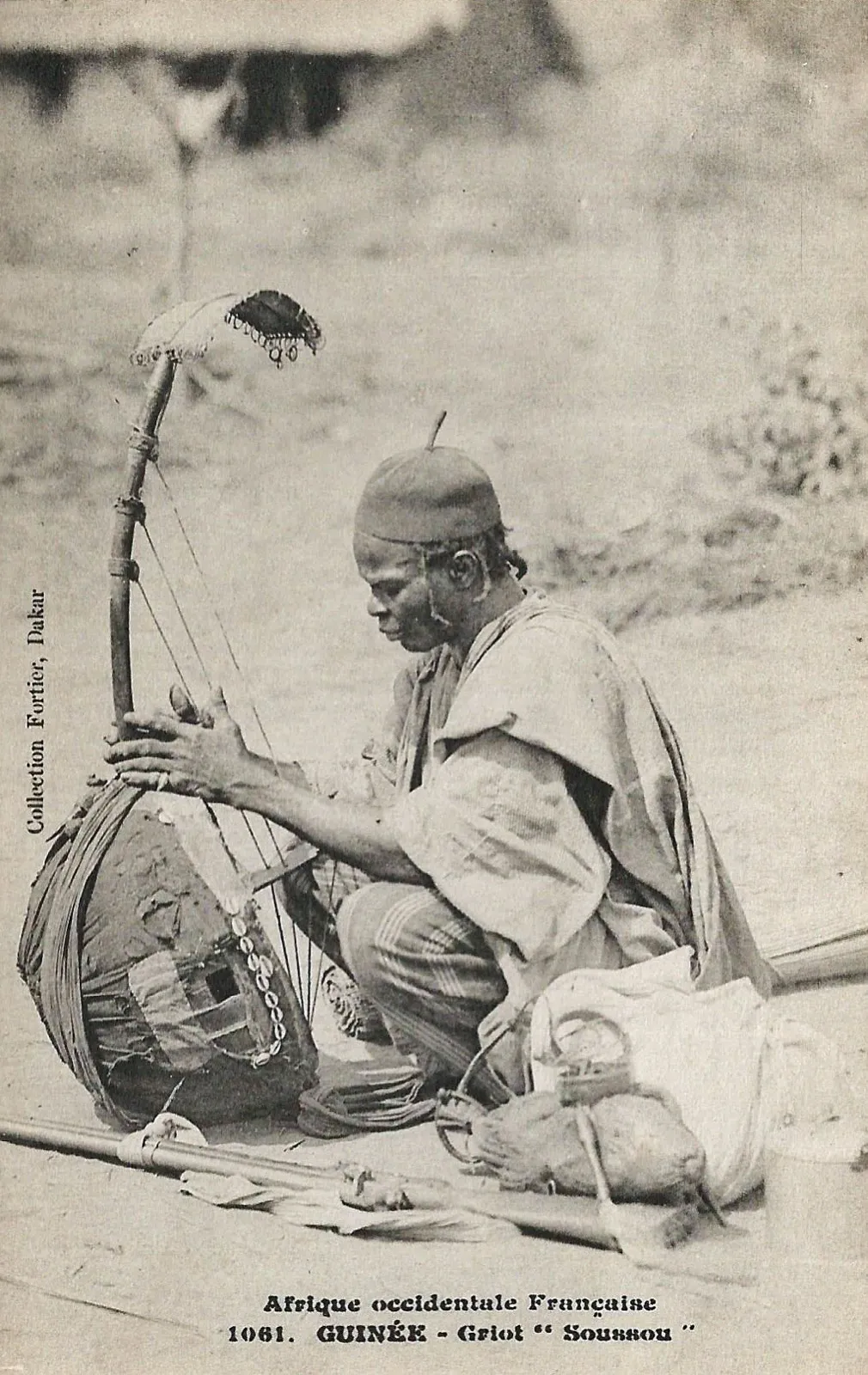 “Griot Soussou”, Guinea, photograph by François-Edmond Fortier, around 1905. Public domain.
The best-known result is the Epic of Sundiata, which tells how Sundiata Keita overcame a childhood disability and exile to found the Mali Empire in the thirteenth century. The epic survived for roughly seven hundred years largely through performance. The version most readers know today was recorded from the griot Djeli Mamoudou Kouyaté and published in French by the historian Djibril Tamsir Niane in 1960, the same year Hampâté Bâ spoke at UNESCO.
That coincidence is telling. A story that had been carried in human memory for centuries became a book at roughly the moment people began to fear that the memory itself would not last. (For how other ancient stories crossed the gap from voice to page, see the oldest stories in the world, and how they survived.)
Where is the metaphor wrong?
Not everyone admired the sentence. The Congolese novelist Alain Mabanckou mocks it in his novel Broken Glass (2005), and critics have pointed out that it can reinforce a false idea: that Africa was a continent of speech with no written tradition of its own.
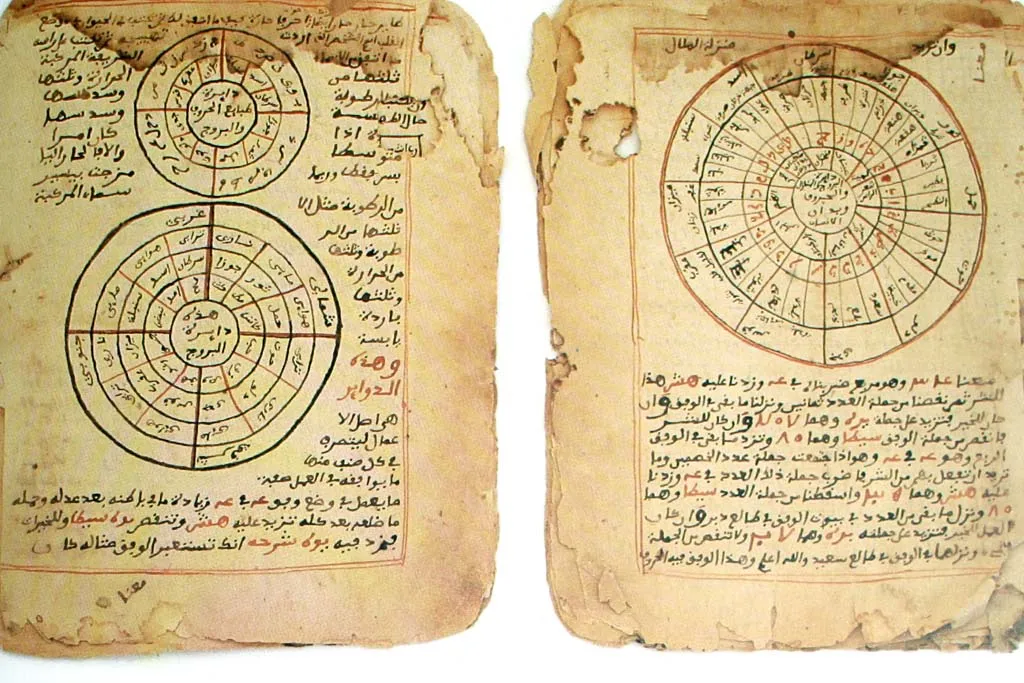
The manuscripts of Timbuktu are the obvious rebuttal. The city was a centre of Islamic scholarship for centuries, and its families and institutions accumulated hundreds of thousands of handwritten works on law, theology, astronomy, medicine and mathematics, like the pages at the top of this article.
In January 2013, as French and Malian forces approached the city, militants who had occupied Timbuktu set fire to manuscripts at the Ahmed Baba Institute. Reports suggest several thousand were destroyed. What makes the story remarkable is what did not burn. In the months before, the librarian Abdel Kader Haidara and a network of couriers had quietly packed roughly 350,000 manuscripts into metal trunks and smuggled them south to Bamako, hidden in cars, carts and river boats.
So in 2013 an actual African library did burn, and most of it survived anyway, for one reason: someone moved the books before the fire.
This is the real weakness in the metaphor, and also its most useful lesson. A library is not doomed because it is flammable. It is doomed when it holds the only copy and nobody acts in time. The same was true of the Library of Alexandria and the other great losses of the ancient world: what vanished was mostly what had not been copied.
What exactly is lost when an elder dies?
There is a second, subtler problem with the metaphor. A library holds texts. An elder holds something a text cannot fully contain.
When Niane wrote down Mamoudou Kouyaté’s Sundiata, he preserved the plot, the names and many of the speeches. He could not preserve the performance: the music of the kora or ngoni behind the words, the timing, the shifts in voice, the way a griot adjusts the story to the audience in front of him. Hampâté Bâ himself argued, in his chapter on “the living tradition” for UNESCO’s General History of Africa, that in oral cultures the spoken word is bound up with the person who speaks it. The knowledge and the knower are not easily separated. (The Balkan epic singers recorded by Milman Parry and Albert Lord in the 1930s showed the same thing, and it explains a familiar habit of grandparents, which I wrote about in why old people repeat the same stories.)
This is not only true of griots. Everyone who has lost a grandparent knows the feeling of having the facts but missing the person. You may know where they were born and what they did for work. What you cannot recover is how they told the story of their first job, which parts made them laugh, and where they paused.
My grandmother has since passed away. I have four hours of her telling her life story on video, and what I return to is rarely the information. It is her face when she talks about her mother, and the hesitation before certain answers. A transcript would preserve the library’s catalogue. The video preserves something closer to the library itself. (I have written more about this difference in why recording a life story on video beats writing it down.)
Is the fire still burning?
In the most measurable sense, yes. According to Ethnologue, more than 40 per cent of the world’s roughly 7,000 languages are endangered, and when a language has its last fluent speakers, every story told only in that language depends on a few elderly people. (What happens when the last speaker of a language dies, and why some languages come back, depends almost entirely on what was recorded first.)
But the more common version of the fire is quieter and closer to home. It does not require an endangered language or a vanished empire. It happens in every family, every generation, when someone dies with the stories nobody asked them to tell. Over the past six years I have filmed more than a hundred life stories through The Archive, including Holocaust survivors, and the pattern I see most often is not reluctance from the storyteller. It is delay from the family. People assume there will be another visit, another Christmas, a better time. (On why we wait, see the questions I wish I had asked my parents.)
What would Hampâté Bâ ask of us now?
Hampâté Bâ’s request to UNESCO was, in practical terms, a request for copying. Record the elders, transcribe what they say, put it somewhere it can outlast them. In 1960 that was slow, expensive work requiring trained researchers, recording equipment and institutional funding. It was the kind of thing an international organisation had to do on behalf of whole peoples.
The economics have since inverted. The equipment Hampâté Bâ could only have wished for is in almost every pocket. A phone can record not only the words but the face, the voice and the pauses that a transcript loses. The cost of making a second copy of a person’s library is now an hour of conversation.
What has not changed is the part that cannot be automated: someone has to ask. That is the problem Everyone, a free app that guides you through filming a relative’s life story one question at a time, was built around. But any tool matters far less than the decision to use it before the fire rather than after.
Every family has at least one library holding the only copy of its contents. The sentence Hampâté Bâ spoke in 1960 is usually heard as a description of loss. It reads better as a deadline.