Mass Observation and the anthropology of ourselves.
In 1937 three young Britons asked ordinary people to write down their days. Mass Observation now holds the history everyone else forgot to keep.
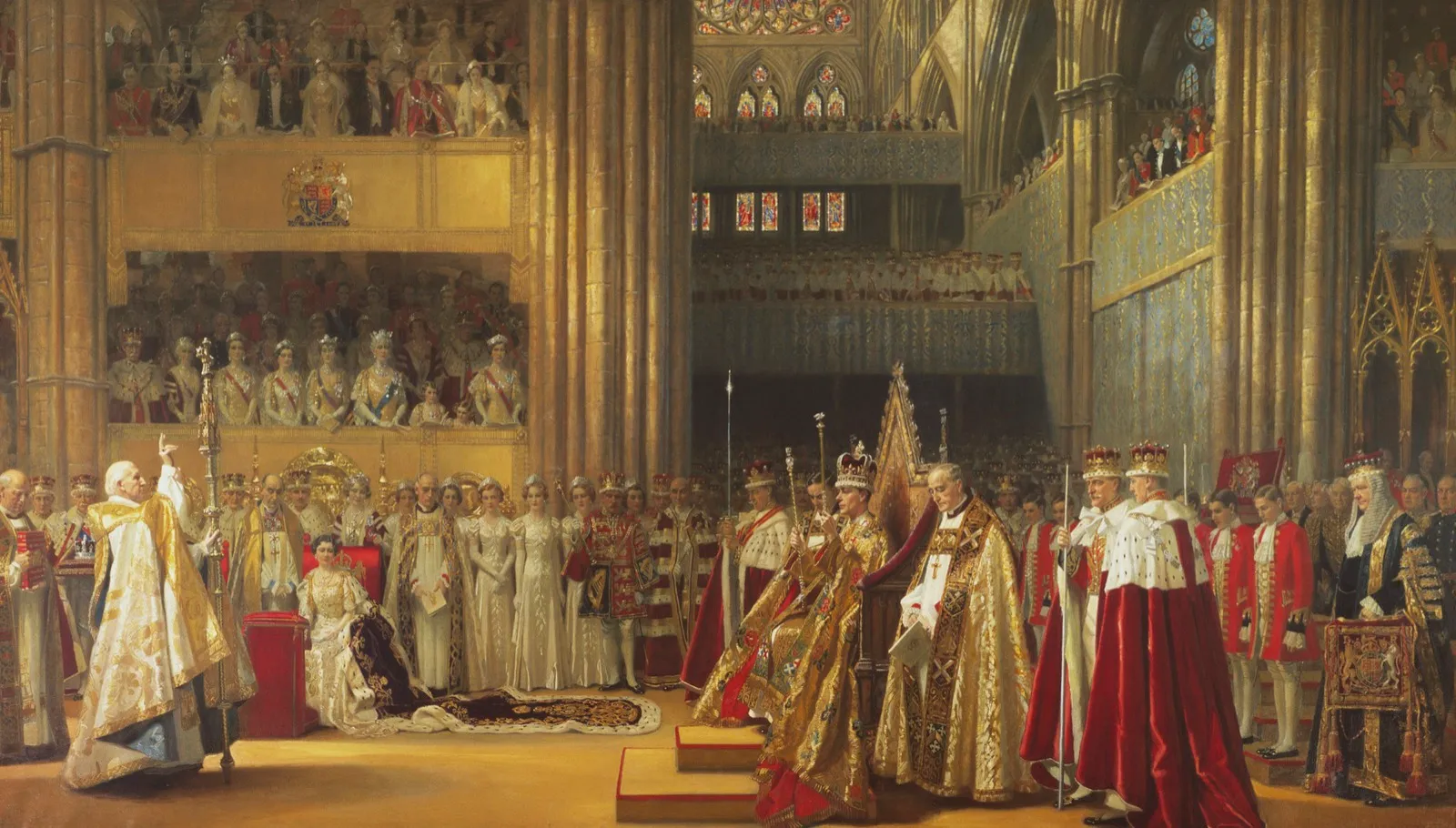
On 12 May 1937, King George VI was crowned in Westminster Abbey. The official record of the day is magnificent and almost useless. The painting at the top of this page shows it as the state wished it to be seen: gold, ermine, bishops, peers, galleries of the titled. It tells you nothing about what anyone else in Britain did that day.
A small group of young men had decided to find out. They asked volunteers across the country to write down, in as much detail as they could, everything that happened to them on coronation day: what they ate, who they talked to, whether they listened on the wireless or went to the pub, what they thought of the whole business. The accounts were edited into a book, May the Twelfth, published later that year. It was the first major publication of an organisation called Mass Observation.
Mass Observation is one of the strangest and most useful archives in the world. Its founding idea was that ordinary life is worth recording while it is happening, by the people living it, because no one else will. Nearly ninety years later, that idea is more relevant than ever, and much easier to act on.
What was Mass Observation?
Mass Observation was founded in 1937 by three men in their twenties: Tom Harrisson, Charles Madge and Humphrey Jennings. They made an unlikely team. Harrisson was a self-taught anthropologist who had lived among the people of Malekula in the New Hebrides (now Vanuatu). Madge was a poet and journalist. Jennings was a surrealist painter and documentary filmmaker who would later make Listen to Britain (1942), one of the most admired films of the war.
What united them was a complaint. Anthropologists travelled to the far side of the world to study the beliefs and habits of other peoples, yet nobody was studying the British in the same way. Their phrase for what they wanted was an “anthropology of ourselves”. How did people in a cotton town spend their Saturday nights? What did they believe about luck, or death, or the king? What did they talk about in the pub? These questions seemed too trivial for serious scholars, and so no one had recorded the answers.
The founders set up two parallel efforts. Harrisson took a team of observers to Bolton in Lancashire, which they called “Worktown”, and studied it in exhaustive detail: pubs, dance halls, churches, elections, holidays in Blackpool. One result was the book The Pub and the People (1943). Meanwhile, Madge recruited a national panel of volunteers who kept diaries and answered regular questionnaires, which the organisation called “directives”.
Why did anyone think ordinary life was worth recording?
The deeper argument behind Mass Observation was about what history leaves out.
For most of the past, written records were produced by and about a narrow slice of people: rulers, clergy, the wealthy, the litigious and the criminal. Ordinary people appear mainly as numbers in a tax roll or names in a parish register. This is the problem I wrote about in ordinary people in history: the farther back you go, the more the past consists of the few people who were written about, standing in for the many who were not.
Mass Observation recognised that the same thing was happening in their own time, only more quietly. Newspapers recorded events. Governments recorded statistics. But the texture of daily life, what it actually felt like to be a typist in Croydon or a miner’s wife in Durham in 1937, was being recorded by almost no one. It was too ordinary to seem worth writing down, and it would vanish the moment it changed.
There is a simple reason for this blind spot. The people living an ordinary life are the least likely to think it interesting. To them it is not history. It is Tuesday.
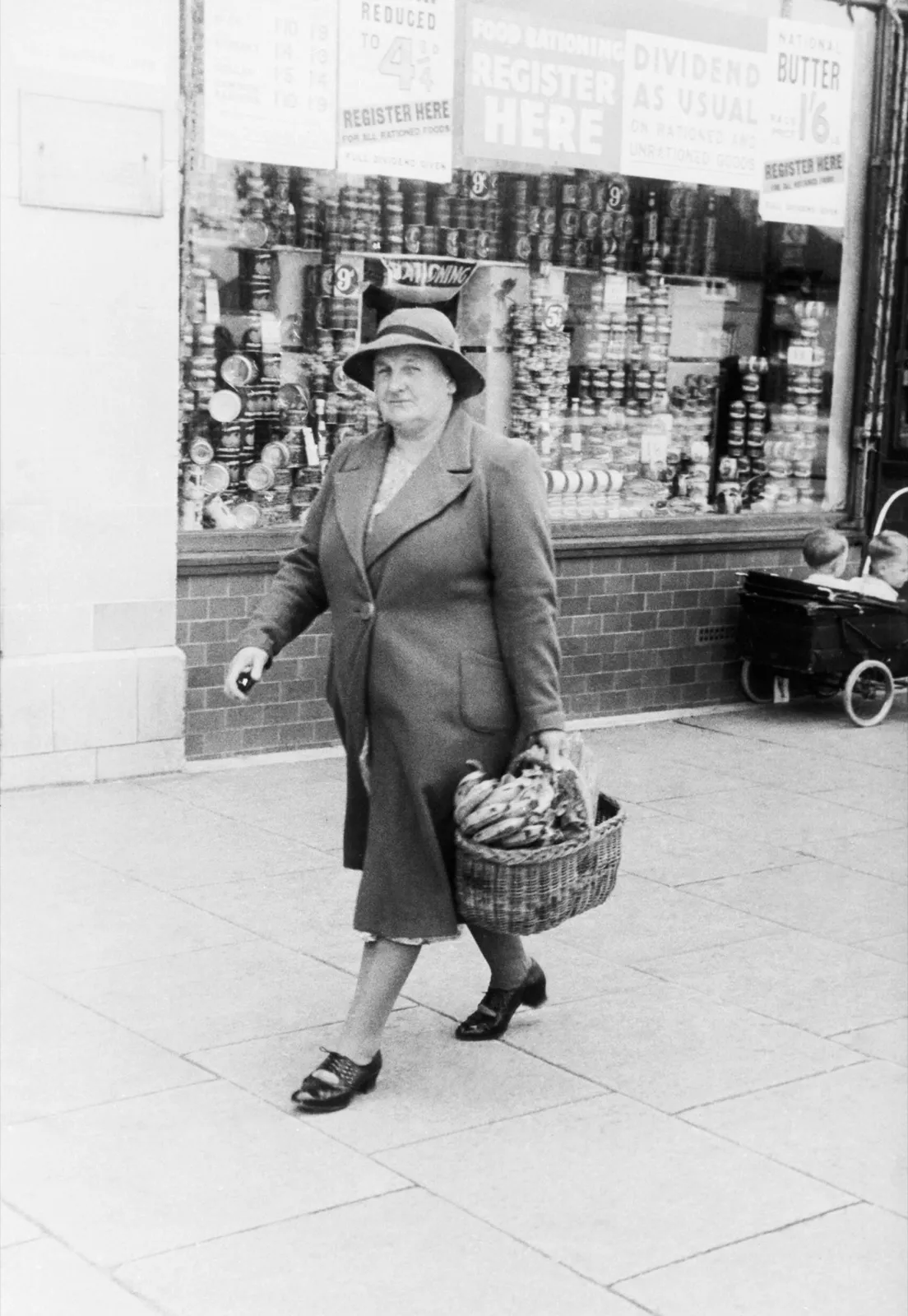 A housewife leaves the Co-op on Westhorne Avenue, Eltham, London, 1940. Ministry of Information Photo Division. Public domain.
What did the diarists record?
When war broke out in 1939, Mass Observation asked its volunteers to keep diaries, and hundreds did. These diaries became an unparalleled record of the home front: not the war as it appeared in speeches and communiqués, but the war as it was lived in kitchens, queues and air-raid shelters. The government itself made use of Mass Observation’s reports to gauge public morale.
The best-known diarist is Nella Last, a housewife in Barrow-in-Furness who began writing in 1939 and kept going until 1966, long after most volunteers had stopped. She wrote about rationing, her sons, her marriage, the bombing of Barrow, the women’s voluntary work that gave her a sense of purpose for the first time. Her diaries were later published as Nella Last’s War, and adapted for television as Housewife, 49 (2006), with Victoria Wood playing Nella.
Nobody would have commissioned a biography of Nella Last. She did nothing that would have made the newspapers. Yet her diary is now read by historians, students and the general public precisely because it records what the newspapers did not. Her ordinariness is the whole point.
The historian’s word for these sources is irreplaceable. Once the people who lived through rationing have died, no amount of research can recover what it felt like to queue for an hour for an onion. You can reconstruct the ration allowances from official documents. You cannot reconstruct the onion.
Did Mass Observation end?
The original organisation faded after the war and became a market research company in the late 1940s. For a time it looked as though the experiment was over. In 1970, the papers were brought to the University of Sussex, largely through the efforts of the historian Asa Briggs, then the university’s vice-chancellor, and in 1981 the project was relaunched. A new national panel of volunteers began answering directives again, and it still does: writing about the economy, the royal family, their homes, their health, their families, whatever the archive asks about that season. The collection is now held at The Keep, an archive centre near Brighton.
The archive has also revived the idea behind May the Twelfth. In recent years it has invited people across Britain to write a diary of their day on 12 May each year, building a long series of ordinary days to set beside the first one in 1937.
What does Mass Observation teach us about recording our own lives?
Three lessons seem to me to follow from the story, and each applies to a single family as much as to a nation.
First, the present is always underrecorded. Every generation assumes that its ordinary life is not worth writing down, and every later generation wishes it had been. If you have ever tried to find out what your great-grandmother’s daily life was like, you will know how little survives. The researchers of 1937 understood that the time to record ordinary life is while it is ordinary, not after it has become history.
Second, the people best placed to record a life are the people living it. Mass Observation did not rely only on trained researchers. Its most valuable material came from volunteers describing their own days in their own words. No observer, however skilled, could have produced Nella Last’s diary. Only Nella could. The same is true in a family: a parent’s account of their own childhood is worth more than anything their children could later piece together about it.
Third, small details outlast big events. Mass Observation is not prized for its account of the coronation, which is well documented elsewhere. It is prized for what people ate that day, the jokes they made, the arguments they had with their neighbours. In my own experience of filming more than a hundred life stories since 2020, the same is true. The moments families treasure most are rarely the headline events of a life. They are the description of a kitchen, a nickname, a habit, the way someone tells a story they have clearly told many times before.
Why do so few people do this?
Writing a diary is hard. It takes discipline, a little literary confidence and time at the end of a tiring day. Mass Observation’s volunteers were self-selected: people who already liked writing, and who had the time to do it. Most people, then and now, never will. That is one reason the archive, rich as it is, still represents a small and somewhat unusual fraction of the population.
This is the part of the story that has changed. In 1937, the only practical way for an ordinary person to leave a detailed record of their life was to write it. Today almost everyone carries a camera that also records sound, and speaking is far easier than writing for most people. Someone who would never keep a diary will happily talk for twenty minutes about their first job if asked a good question. And a video preserves things a diary cannot: the voice, the face, the pause before the difficult part. (I have made the longer case for this in why recording a life story on video beats writing.)
The “anthropology of ourselves” no longer requires a national organisation, a panel of volunteers and a filing system in Brighton. It requires someone in each family to decide that ordinary life, as it is lived now, is worth keeping, and then to ask. That might mean filming your grandmother describing an ordinary day from her childhood, or it might mean recording your own life while you are living it, a few minutes at a time. Everyone, the app I make, was built for exactly that: one question, one short video, kept for the people who come after you.
The volunteers of 1937 did not think they were making history. They thought they were writing down an ordinary Wednesday. That is why their diaries matter now, and why ours will.