Why do old people repeat the same stories? Because those are the ones that matter.
When an older relative tells the same story again, it looks like a memory lapse. The research suggests something else: it is the story they most want kept.
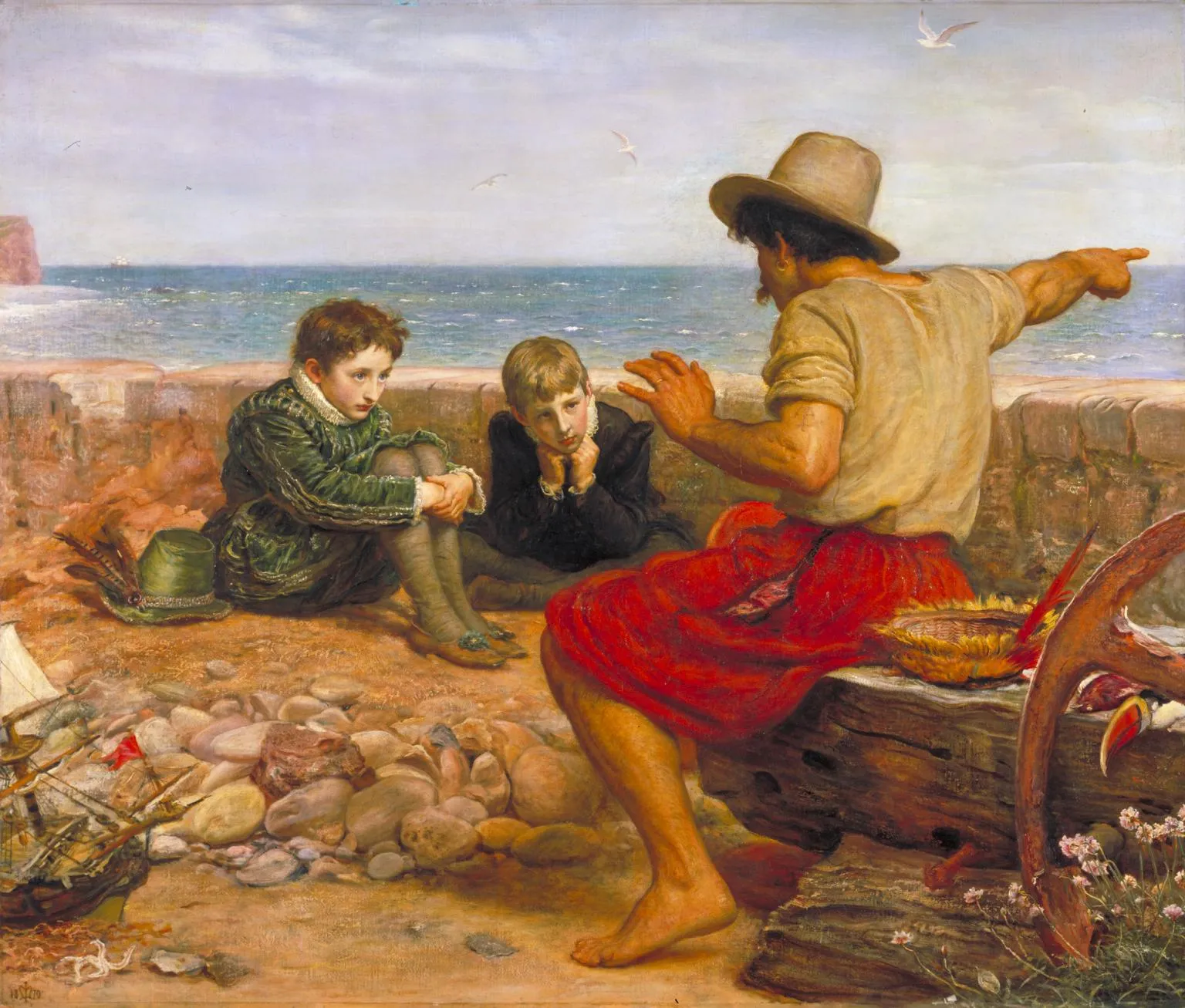
In 2009 two psychologists at the University of Waterloo in Canada, Nigel Gopie and Colin MacLeod, published a paper in Psychological Science with an unusually candid title: “Destination Memory: Stop Me if I’ve Told You This Before.” They had asked volunteers to tell a series of facts to pictures of famous faces, and later tested whether they could remember which fact they had told to whom. People were noticeably worse at this than at the reverse task, remembering who had told them something.
Most families know the result without the paper. At some point an older relative begins a story, and someone at the table says, as gently as they can manage, “You’ve told us this one.” Why do old people repeat the same stories? The usual answer is that memory is slipping. That answer is partly correct, and mostly beside the point. The memory that fails is narrow and specific. The stories themselves are doing something else, and once you see what it is, the repeated story stops looking like a symptom and starts looking like a request.
What is destination memory?
Psychologists distinguish between source memory, knowing where you learnt something, and destination memory, knowing to whom you passed it on. Gopie and MacLeod’s explanation for why the second is weaker is attention. When you are telling a story, most of your attention is on the telling: finding the words, watching the effect, enjoying the punchline. Very little is left over to file away the fact that this particular listener has now heard it. Outgoing information, they argued, is less tightly bound to its context than incoming information.
The following year Gopie, together with Fergus Craik and Lynn Hasher at the University of Toronto, compared younger adults with healthy adults aged roughly 60 to 83. Their results, published in Psychology and Aging in 2010, showed that the older group was disproportionately impaired on destination memory compared with their memory for the facts and faces themselves. The story was intact. What had faded was the tag saying told to Sarah, last Christmas.
This is worth being precise about, because it removes most of the sting from the experience. An older person who repeats a story has usually not forgotten the story, or you, or the earlier conversation in any broad sense. They have lost one small piece of bookkeeping that everyone is fairly bad at, and that gets worse with age.
Why do old people repeat the same stories, and not others?
Destination memory explains why a repeat can happen. It does not explain which stories get repeated, and that is the more interesting question. Grandparents do not cycle randomly through everything they remember. They return, again and again, to a small set: the boat, the move, the first job, the night the house flooded, the meeting at the dance. If forgetting were the whole explanation, the repeats would be spread evenly. They are not.
In 1963 the psychiatrist Robert Butler published a paper called “The Life Review”, arguing that reminiscence in old age is not a retreat from the present but a natural process of taking stock, prompted by the sense that life is ending. (I described his argument in more detail in how to interview older family members.) Later researchers tried to measure what reminiscence is actually for. The Canadian psychologist Jeffrey Webster developed a questionnaire in the 1990s, the Reminiscence Functions Scale, which in its best-known form sorts the reasons people think and talk about the past into eight groups. They include reducing boredom, preparing for death, maintaining a sense of identity, solving current problems, keeping alive a bond with someone who has gone, and teaching or informing others. Research on nostalgia points the same way: looking back tends to make people feel more connected, not less.
Look at that list from the listener’s side. Several of these functions only work if someone hears the story. Teach and inform needs a student. Identity needs a witness. The story about the boat is not only a memory being replayed. It is a person saying: this is who I am, and this is what I want you to know.
Do stories get better with retelling?
They change, and in a particular direction. In his book Remembering (1932), the Cambridge psychologist Frederic Bartlett asked people to recall an unfamiliar Native American folk tale, “The War of the Ghosts”, repeatedly, at intervals that in a few cases stretched to years. The details that did not fit his participants’ expectations were dropped or rationalised. What remained was a shorter, smoother, more conventional story whose general shape tended to settle early and then persist.
Family stories go through the same process, except that the teller is refining their own experience. Each retelling is a small edit. The pointless detours drop away, the timing improves, the line that gets a laugh is kept. By the fortieth telling, a story has been workshopped by its author over decades. This is why the story you have heard ten times is often better told than anything else the person says, and why it is a mistake to treat it as the least valuable thing they offer.
Repetition also tells you something about the editor. Of all the thousands of episodes in a long life, these are the ones that survived the cut. The psychologist Dan McAdams has argued that people make sense of their lives by shaping them into a story with turning points, low points and themes. The stories a person repeats are usually the turning points of that internal narrative. (More on his research in the life story interview.)
How did oral cultures use repetition?
For most of human history, repetition was not a failing of memory. It was the storage system.
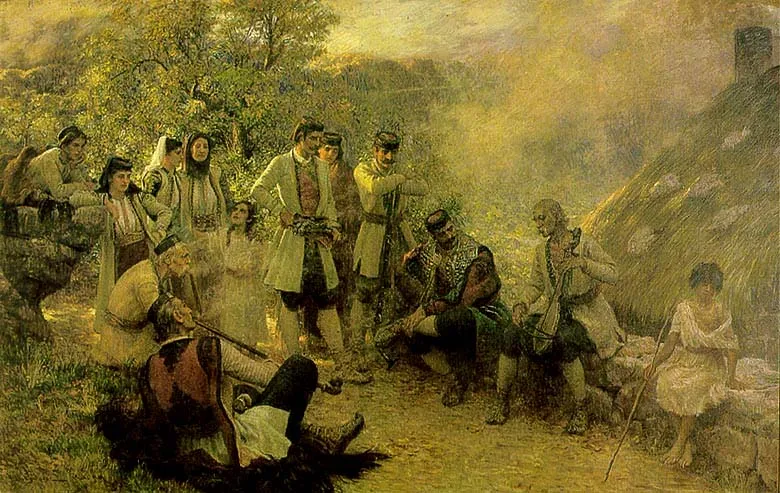 “Guslar” by Vlaho Bukovac, undated. Public domain.
Between 1933 and 1935, the American classicist Milman Parry travelled through Yugoslavia with his assistant Albert Lord, recording singers of heroic epic, known as guslari after the one-stringed gusle they played. Parry wanted to understand how Homer could have composed poems as long as the Iliad without writing. The answer they found was that the singers did not memorise fixed texts. They had heard the same songs performed again and again since childhood, absorbed their stock phrases and patterns, and rebuilt each song afresh in performance.
The most gifted of them, Avdo Međedović from Bijelo Polje in Montenegro, once listened while another singer performed a song of 2,294 lines that he had never heard before. He then sang it himself, and his version ran to 6,313 lines. Lord described the tradition in The Singer of Tales (1960). Lord reported that singers would often insist a song was “the same” as one they had sung before, even when the recordings showed real differences. To them, the same meant the same story told faithfully, not the same words.
That is close to how family stories work. The grandfather telling the boat story again is not malfunctioning. He is doing what storytellers did for most of human history: keeping a story alive by telling it, and telling it to the next generation because that is the only place it can be kept. The difference is that a guslar had an audience who wanted to learn the song. Many grandparents have an audience that has started checking its phones.
What is lost when we stop listening?
Here is the irony. The stories a person repeats are the ones they have most clearly marked as important. They are also the ones families are most likely to tune out, because they have heard them before. Familiarity creates the impression that the story is safely known. Usually it is not. What survives in the listeners is the outline: something about a boat, and a storm, and an uncle. The names, the year, the reason they were on the boat at all, and the particular way he told it tend to go.
Bartlett’s experiments suggest why. A story heard many times is remembered as a gist, and the gist is exactly what repetition reinforces. Hearing the boat story a tenth time does not add detail; it confirms the outline you already hold. The family knows the headline, and mistakes it for the story.
There is also a simpler loss. A repeated story is one of the most characteristic things about a person: the phrasing, the gesture at the same moment, the laugh before the punchline. Since 2020 I have filmed more than a hundred life stories through The Archive, and I have four hours of my grandmother telling hers on video. She has since passed. What I return to is rarely the information. It is her, telling it.
What should you do when they tell it again?
If the repeated story is a request to be remembered, the useful response is not to stop it but to go further into it.
- Do not interrupt with “you’ve told me”. It corrects a minor lapse at the cost of a moment the person clearly values. If you must say something, say “I love this one.”
- Ask the next question. The story they repeat is a door they have already opened. Ask what came just before, who else was there, what they were afraid of, what happened to the people in it afterwards. Open questions work best, as I wrote in how to interview someone.
- Ask for the story behind the story. “Why do you think that night stayed with you?” turns an anecdote into an explanation of a life.
- Record it once, properly. In a quiet room, with the light on their face, ask them to tell it from the beginning as though you had never heard it. After that, let them repeat it as often as they like.
The story is the point
A repeated story is a small paradox. It is evidence of a memory that has weakened, and of a memory that has held. The bookkeeping of who heard what has slipped, while the story itself has been polished for decades into the form its owner wants it to take. It is, in a sense, the person’s own selection of what should outlast them.
We are the first generation for whom keeping that selection is trivial. A phone can record the story with the voice and the face that made it worth hearing, and an app such as Everyone can prompt the follow-up questions one at a time. The tool matters less than the shift in attitude. The next time an older relative starts the story you have heard before, it is worth recognising what is happening. They are not forgetting. They are handing it to you.