What is nostalgia? It used to be a disease.
In 1688 a Swiss medical student named a new and sometimes fatal disease. Psychologists now think nostalgia does the opposite. Here is what changed.
In 1688 a medical student at the University of Basel, Johannes Hofer, wrote a dissertation about a disease that did not yet have a name in Latin. It struck Swiss people living far from home: students, servants, and above all the young men who hired themselves out as soldiers to the armies of France and Italy. Accounts of his thesis describe the patients as melancholy and sleepless, losing their appetite, falling into fevers, and thinking of nothing but home. Some, he believed, died of it. The cure he recommended was simple: send them back.
Hofer built the name from two Greek words, nostos, a return home, and algos, pain. He called it nostalgia.
Three centuries later the word means something almost cosy: an old song on the radio, a smell from a grandparent’s kitchen, a photograph of a summer holiday. So what is nostalgia, really? The history of the word, and the psychology that has caught up with it, suggest an answer that is more interesting than either “disease” or “sentimentality”. Nostalgia appears to be a tool the mind uses to get through hard times, and like any tool, it depends on the material it has to work with.
Was nostalgia really considered a disease?
For about two hundred years, yes, and doctors took it seriously.
The Swiss case became famous because of a song. In the Alps, cowherds called their cattle with a melody known in German as the Kühreihen and in French as the Ranz des vaches. When the physician Theodor Zwinger reissued Hofer’s thesis in 1710, he printed the melody in full, and explained why. Swiss soldiers abroad, he wrote, were seized by the illness on hearing it, because it revived the memory of home. The officers, having seen some of their men die of a burning fever, were driven to ban the song by strict law.
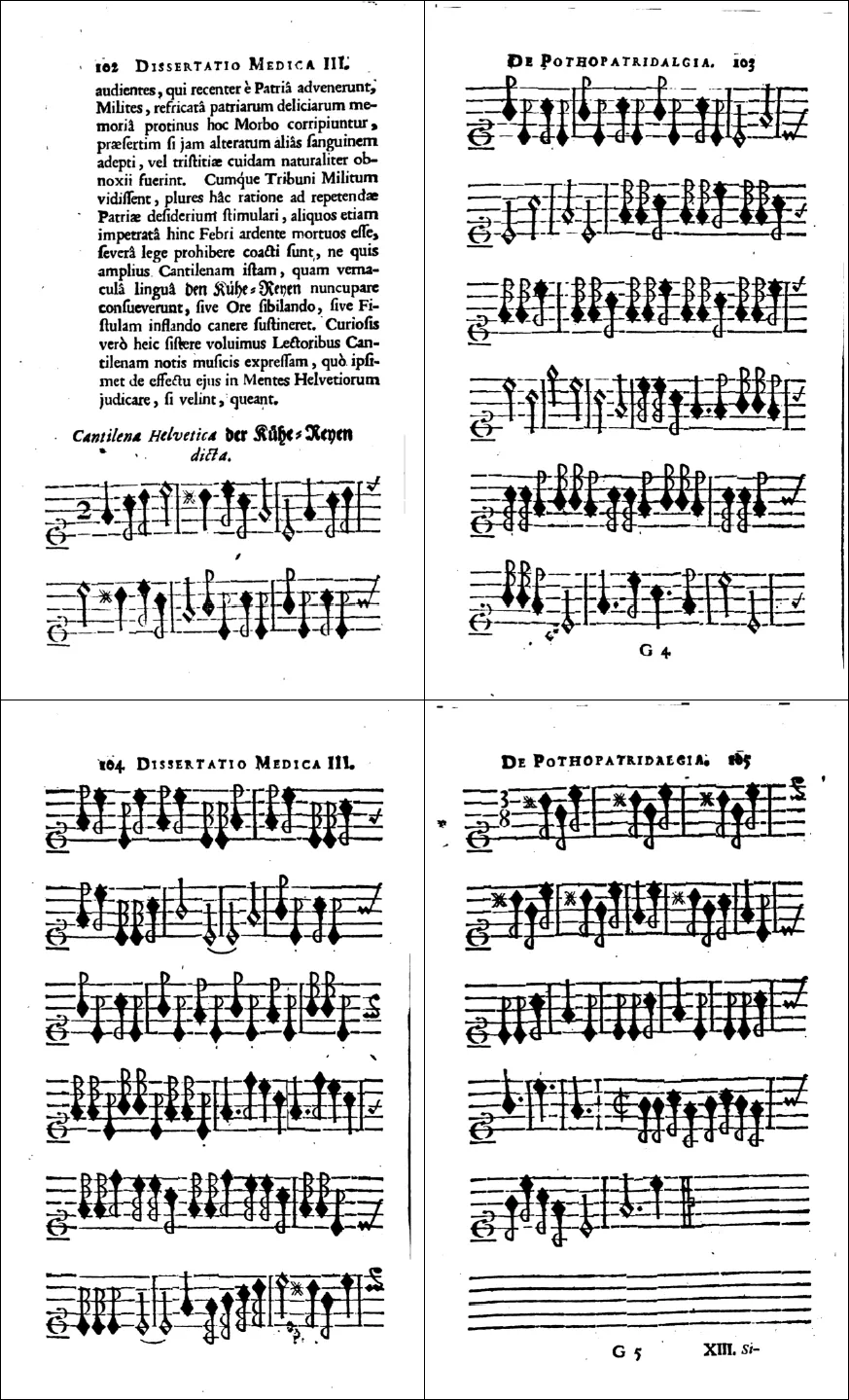 The Swiss cowherd song, printed in Theodor Zwinger’s 1710 edition of Hofer’s dissertation on nostalgia. Public domain.
Later writers, Rousseau among them, repeated the story that playing the tune to Swiss troops was punishable by death. Whether that penalty was ever carried out is doubtful. But the belief itself tells us something: people at the time were convinced that a few bars of music could carry a man home so completely that his body would follow his mind into illness.
The diagnosis spread. Napoleon’s army surgeons wrote about it. During the American Civil War, Union army doctors recorded it as a medical condition. The historian Susan Matt, drawing on the army’s official medical history, counts 5,537 Union soldiers whose homesickness was severe enough to come to a doctor’s attention between 1861 and 1866, and 74 deaths attributed to it. Other readings of the same records give slightly different totals, but the scale is clear.
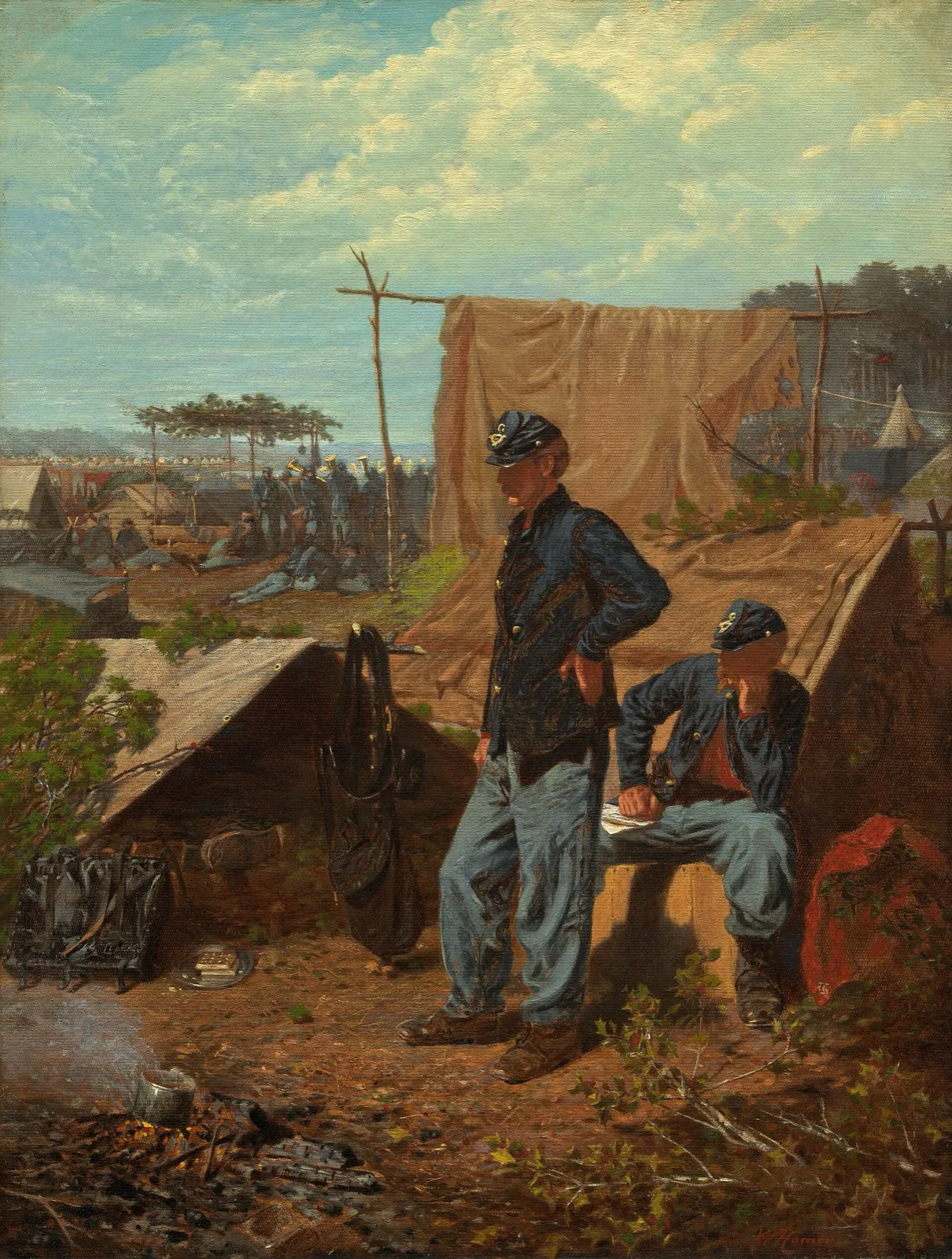
Winslow Homer painted the scene in about 1863, in the picture at the top of this page. Two soldiers stand by their tent while a regimental band plays in the distance. The title is the name of the song: Home, Sweet Home. One of the men has a letter on his knee. Neither of them is looking at anything in particular.
When did nostalgia stop being an illness?
Slowly, and by changing its object.
Over the nineteenth and twentieth centuries, medicine abandoned the idea that longing for home was a disease in itself, and the word drifted out of the clinic into ordinary speech. In the process it moved from place to time. Hofer’s patients longed for a valley they could, in principle, return to. A modern person feeling nostalgic is usually longing for a period of their own life that cannot be returned to at all.
That shift matters. Homesickness has a cure: go home. Nostalgia for the past does not. You cannot go back to being nine years old in your grandmother’s house. The only versions of the past still available to you are the ones you can remember, and the ones somebody recorded.
The literary scholar Svetlana Boym drew a useful distinction in The Future of Nostalgia (2001). Restorative nostalgia wants to rebuild the lost home exactly as it supposedly was, and tends to forget that the memory has been edited. Reflective nostalgia dwells on the longing itself, knows the past is gone, and holds its contradictions in view. The second is closer to what most people feel when they look at an old photograph.
What does nostalgia actually do for us?
The most sustained answer comes from psychologists at the University of Southampton, Constantine Sedikides and Tim Wildschut, who have spent roughly two decades studying nostalgia experimentally. Their findings have turned Hofer’s view almost upside down.
In a 2006 paper in the Journal of Personality and Social Psychology, they and their colleagues asked people to describe nostalgic experiences and then analysed what the stories contained. Several patterns stood out:
- The self is almost always at the centre, surrounded by close others. Nostalgic memories are rarely about objects or places on their own. They are about family, friends and partners, at weddings, holidays, birthdays and ordinary evenings.
- Bad moods and loneliness trigger it. People reported feeling nostalgic most often when they were low, and in experiments, inducing a negative mood or a sense of loneliness made people more nostalgic.
- It tends to make people feel better, not worse. Recalling a nostalgic memory, compared with an ordinary one, raised people’s sense of being loved and connected, their self-regard and their mood.
Later studies from the same group and others extended the list. Nostalgia appears to increase the sense that life has meaning, and what the researchers call self-continuity: the feeling that the person you are now is connected to the person you were. A 2024 study across many countries by Erica Hepper and colleagues found the same broad pattern: nostalgia was triggered by threats, sensory cues and social gatherings, and recalling nostalgic memories increased connectedness, continuity and meaning.
The strangest finding is physical. In 2012 Xinyue Zhou and colleagues, including Sedikides and Wildschut, published five studies in the journal Emotion under the title “Heartwarming memories”. People felt more nostalgic on colder days and in a chilly room. Recalling a nostalgic event made a room feel warmer to them. And in a test where participants held a hand in iced water, those who had been thinking nostalgic thoughts kept it there longer.
Put together, this suggests a model the researchers describe as regulatory. Nostalgia is not mainly a wound. It is a response to one. When we feel cold, lonely, unmoored or afraid, the mind reaches into its store of memories of being loved and draws on them, the way the body draws on fat reserves.
Why were Hofer’s soldiers dying, then?
Hofer’s patients were not imagining things. Young men far from home, in miserable camps among strangers, were under enormous strain, and disease was everywhere. Hofer saw nostalgia alongside the suffering and took it for the cause.
The Southampton findings suggest another reading. The longing was a symptom of the distress, and possibly the mind’s attempt to treat it. A soldier who heard the cowherd’s song was reaching for the one comfort he had left: the memory of people who loved him. Sometimes that sharpened the gap between where he was and where he wanted to be. Most of the time, for most people, it seems to help.
What is nostalgia, really, if it is mostly about people?
If you take the research seriously, nostalgia is less a longing for the past than a longing for the people in it, and for the version of yourself that existed among them. The song, the smell and the photograph are cues. What they retrieve is a grandmother’s voice, a father laughing, a kitchen full of relatives.
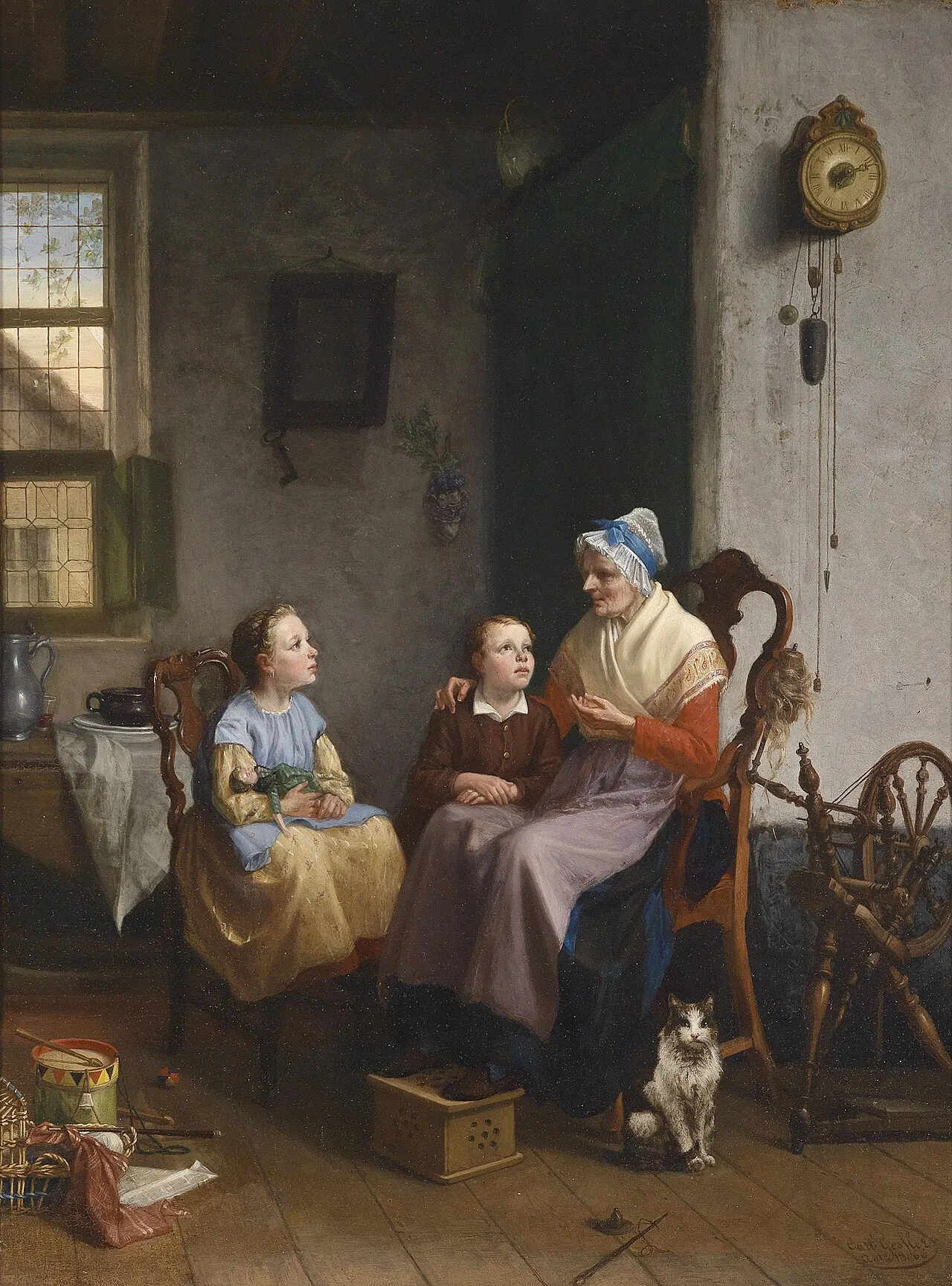 “Exciting Stories” by Carl Geißler, 1866. Public domain.
This creates a problem that Hofer never had to think about. Nostalgia runs on memory, and memory is not a recording. It fades, it simplifies, and it is quietly rewritten each time it is recalled. The details go first: the exact sound of a voice, the phrase someone always used, the stories they told. This is part of why older relatives tell the same stories again and again, and why the memories they reach for cluster in the years psychologists call the reminiscence bump.
It also means that nostalgia gets thinner with each generation. You can be nostalgic for a grandparent you knew. Your children can feel only a faint, borrowed version of it, assembled from a few photographs and second-hand anecdotes. Your grandchildren usually feel nothing at all, because there is nothing left to draw on.
Can you give future generations something to be nostalgic about?
My grandmother has since passed away. I have four hours of video of her telling me about her life. When I watch it, the experience is unmistakably nostalgic, but in Boym’s reflective sense rather than the restorative one. The video does not let me pretend she was simpler or saintlier than she was. I can see her pause before the harder parts, hear her laugh at her own jokes, and notice things I had forgotten. It keeps the memory honest while keeping it warm.
That is the difference a recording makes. A memory gives you a feeling about a person. A film gives you the person, and lets each new generation form its own feeling from the original rather than from a copy of a copy.
Since 2020 I have filmed more than a hundred life stories, and the families who watch them afterwards almost always react in the same way. They do not say they learnt new facts, although they usually do. They say it was like being in the room again.
What Hofer’s cure means now
Hofer’s prescription was to send the patient home. For nostalgia in its modern sense, that cure is unavailable. Nobody can return to the past.
But the research points to something nearly as good. What nostalgia reaches for is people, and their stories, and the sense that our lives are connected to theirs. Those things can be kept, now, more easily than at any point in history. A phone, a quiet room and an hour of good questions to ask your grandparents are enough. We built Everyone, a free app for filming family stories on video, one question at a time, for exactly that reason.
The people in your family who will one day feel nostalgic for this period of your life are, in many cases, not yet born. What they will have to draw on depends on what is recorded while the people in it are still here to speak.