The last speaker of a language, and what dies with them.
When the last speaker of a language dies, revival depends on what was recorded. Manx had voices on disc; others had only word lists. The lesson for families.
On 27 December 1974, a fisherman named Ned Maddrell died on the Isle of Man at the age of 97. He was widely regarded as the last native speaker of Manx, the Gaelic language of the island. With him went the last person who had grown up hearing Manx at home, the last person who did not have to think about how a sentence should sound.
What makes his case unusual is not that a language died. Languages die often. It is that Manx did not stay dead. Today children on the Isle of Man are taught entirely in Manx at a primary school, the Bunscoill Ghaelgagh, founded in 2001. The census records well over a thousand people claiming some knowledge of the language.
The reason it could come back is a set of recordings. In 1948 the Irish Folklore Commission came to the island and recorded the last native speakers, Maddrell among them, on acetate discs. Those voices became the textbook for a generation of learners.
The story of the last speaker of a language is usually told as a story about loss. It is more useful to read it as a story about records: what was kept, in what form, and how much of a living thing a record can carry forward. That question applies to every family, not only to linguists.
How often does a language lose its last speaker?
There are a little over 7,000 living languages. Ethnologue, the standard catalogue, classes roughly 44 per cent of them as endangered, and many have only a few hundred speakers, most of them elderly. A figure often repeated in the press is that a language dies every few weeks. That number is hard to pin down, partly because the death of a language is rarely a single event. It is a slow narrowing, in which children stop learning it, then adults stop using it with one another, until it survives only in the memories of a few old people who no longer have anyone to talk to.
Australia is one of the starkest examples. Before 1788 the continent held at least 250 distinct languages, and possibly many more. According to recent national surveys, only around a dozen are still being learnt by children as a first language. Most of the rest are no longer spoken fluently by anyone, or are spoken only by the old.
The final speaker is therefore not really the moment of death. It is the moment the last copy is lost. Everything that has not been recorded by then is gone.
What did the recordings of the last speakers actually preserve?
The interesting variable is not whether something was recorded, but what kind of record it was. Compare four cases.
Kaurna, the language of the Adelaide Plains, was documented in 1840 by two German missionaries, Christian Teichelmann and Clamor Schürmann. Their Outlines of a Grammar, Vocabulary and Phraseology contains around 2,000 words and a couple of hundred translated sentences. The last fluent speaker is usually said to have died in 1929. Revival began in the late 1980s, led by Kaurna people working with the linguist Rob Amery at the University of Adelaide, and Kaurna is now taught in schools and heard at public ceremonies across the city.
It is a remarkable achievement, and it was built almost entirely on paper. The missionaries wrote the words down in a spelling designed for German and English ears. Nobody alive has heard a native speaker. Pronunciation, rhythm and intonation have had to be reconstructed, partly by comparison with related languages. The Kaurna spoken today is real and growing, but it is also, unavoidably, a careful inference.
Wampanoag, a language of what is now Massachusetts, had its last fluent speakers in the nineteenth century. It survived in an unusual archive: thousands of documents written by Wampanoag people themselves in the seventeenth and eighteenth centuries, and a complete Bible translated by the missionary John Eliot and printed in 1663, the first Bible printed in the Americas. From the 1990s the Wampanoag linguist Jessie Little Doe Baird used those texts to rebuild the language, work that earned her a MacArthur Fellowship in 2010. Her daughter is often described as the first native speaker of Wampanoag in more than a century.
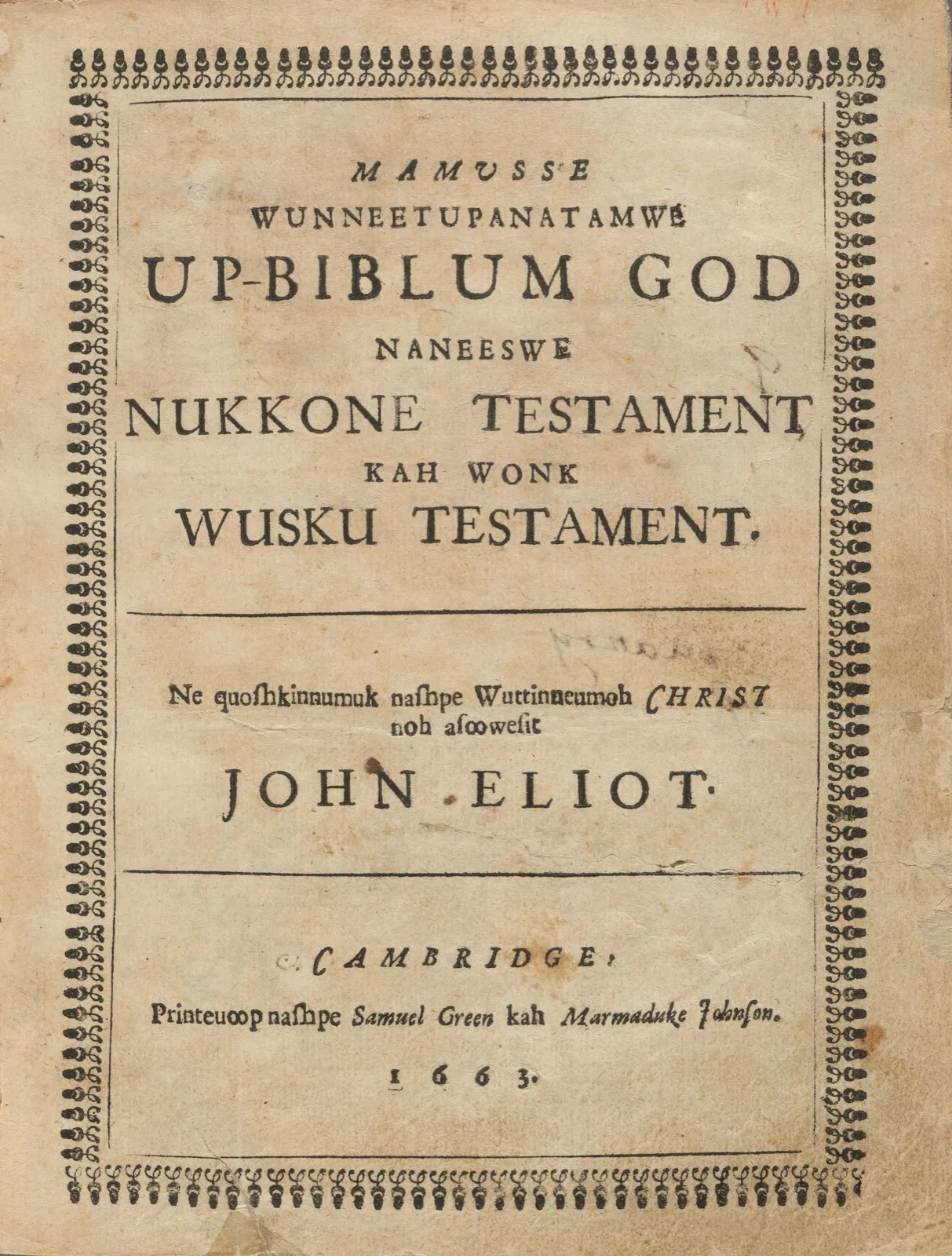 Title page of John Eliot’s Bible in the Massachusett–Wampanoag language, printed in Cambridge, Massachusetts, 1663. Houghton Library, Harvard University. Public domain.
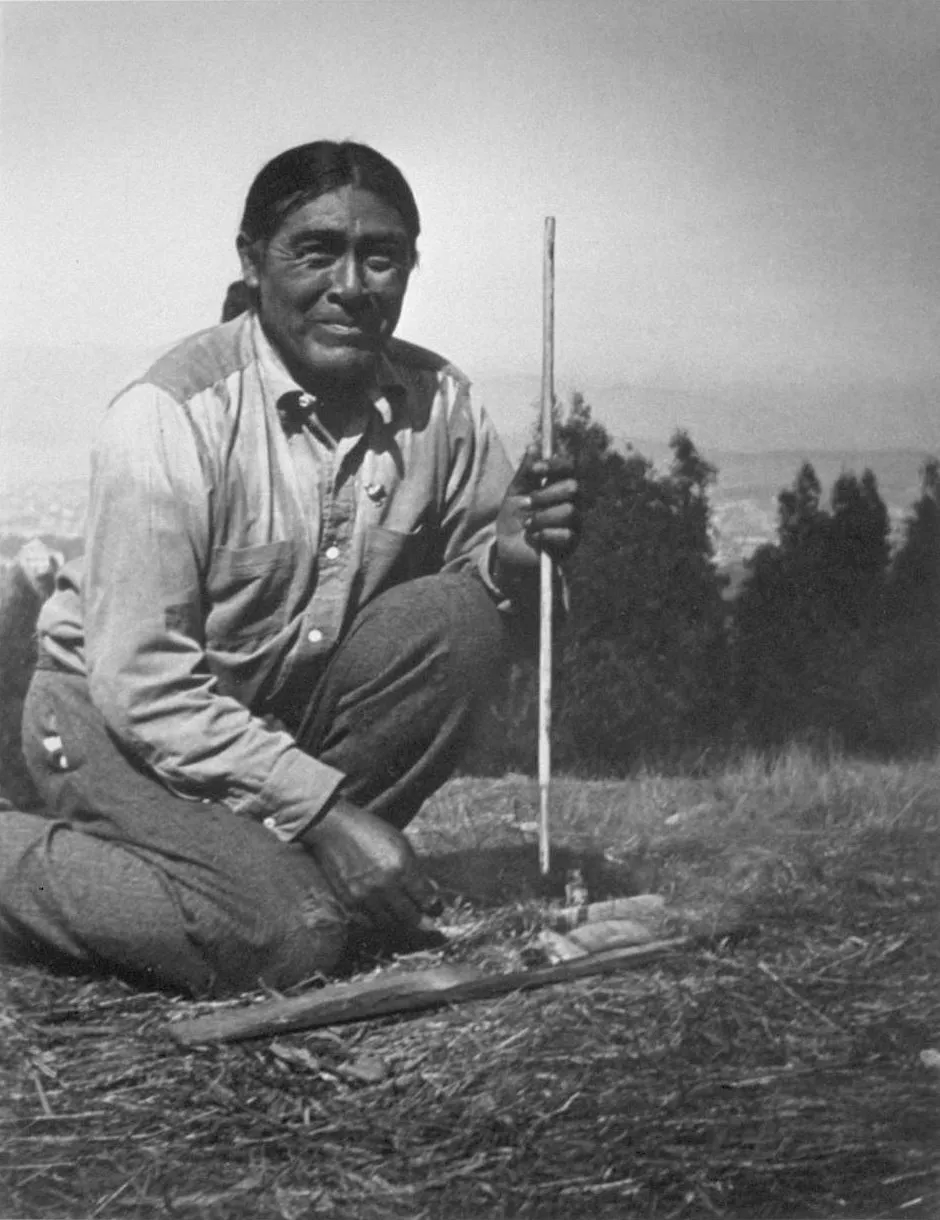
Yahi, a language of northern California, ends with a single man. In August 1911 a Yahi man walked out of the hills near Oroville, the last survivor of his people. He never told outsiders his personal name; the anthropologist Alfred Kroeber called him Ishi, which means “man” in Yahi. Between 1911 and 1914 Kroeber and his colleague Thomas Waterman recorded him on 148 wax cylinders, almost six hours of songs and stories. Ishi died in 1916.
Those cylinders are now the largest record of Yahi in existence, and they show the limits of the technology. Many have degraded badly, and some are close to inaudible. Even where the sound survives, there is no community of speakers to carry it forward. A record without anyone to receive it is an archive, not a language.
Ubykh, from the north-western Caucasus, is famous among linguists for its enormous range of consonants, around 80 by most counts, against only a handful of vowels. Its last fluent speaker, Tevfik Esenç, died in Turkey on 7 October 1992. He had spent years working with the French scholar Georges Dumézil and others, dictating stories, correcting transcriptions and making recordings, some of which are now available online. Because of him, Ubykh is one of the best-documented extinct languages in the world. Nobody speaks it.
Why do some languages come back and others do not?
Put these cases side by side and a pattern appears. Two things are needed, and they are not the same thing.
The first is a record rich enough to rebuild from. A word list preserves vocabulary. A grammar preserves structure. Only a recording preserves sound: how the vowels were shaped, where the stress fell, the music of an ordinary sentence. Written records, however careful, filter a language through the ears and alphabet of whoever wrote them down.
The second is people who want the language back. Kaurna and Wampanoag were revived from paper because their communities were determined to do it. Yahi and Ubykh, for different reasons, have no such community, and so the best records in the world remain on the shelf.
Manx had both, and that is why its revival is so often held up as a model. The Irish Folklore Commission’s discs meant that learners could hear Ned Maddrell and his contemporaries speak. One of the most important figures in the revival, Brian Stowell, spent years transcribing and learning from those 1940s recordings. When Manx speakers today want to know how a phrase should sound, there is, in principle, a native voice to check it against.
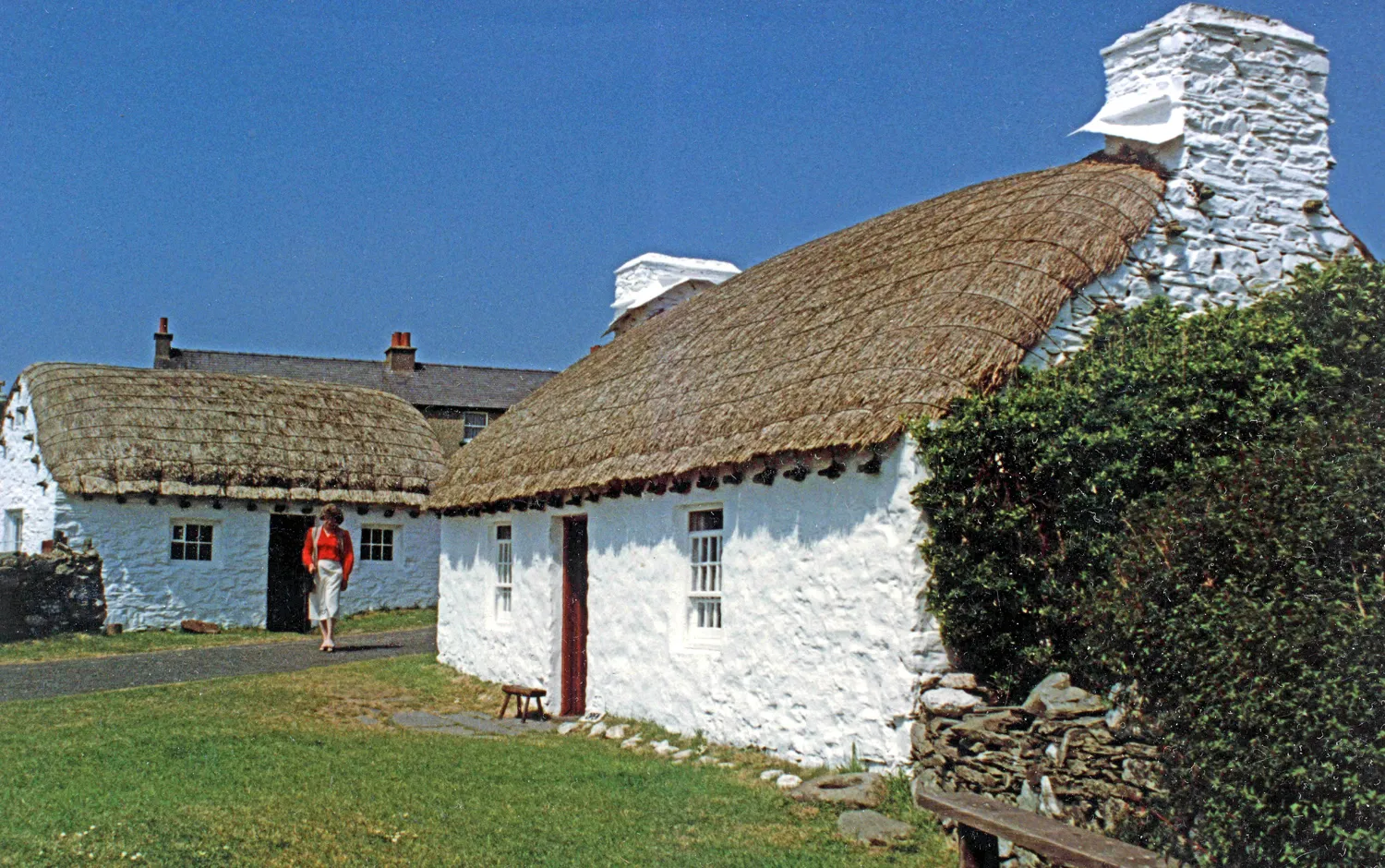 Cottages at Cregneash, in the south of the Isle of Man, where some of the last native Manx speakers were recorded. Photographed in 1988 by RuthAS, CC BY 3.0.
What can a recording not capture?
Audio was a leap beyond writing, but it is not the end of the line. Linguists working with endangered languages today almost always film rather than simply record sound, and the reason is practical. Much of how people communicate is visible: the shape of the mouth on a difficult sound, the gestures that accompany a story, where a speaker looks, how a listener responds. In some languages, pointing and gesture carry part of the meaning that words carry elsewhere. A sound file of Ishi singing preserves his voice. It does not show his face while he sang, or the people he imagined he was singing to.
There is a broader point here, which I have made before about why video beats audio as a record. Each format strips away a layer of the person. Writing strips away the voice; audio strips away the face; even video loses the room. The further down that list a record sits, the more of the speaker someone in the future has to guess.
Is every family a small language?
It would be easy to treat all of this as a specialist problem, of interest only to linguists and the communities concerned. I think it is closer to home than that.
Every family has something like its own dialect: the phrases a grandparent always used, the way a story was always told, an accent shaped by a town that has since changed beyond recognition, words from a language the grandchildren no longer speak. Migrant families feel this most sharply, because the old language often stops with the generation that crossed the border.
In this sense each older person in a family is the last speaker of something. When my grandmother died, I lost the only person who could tell certain stories in her particular way, with her timing and her pauses. I have four hours of her on video, and that is the reason I can still hear it. Most of what she knew went with her anyway. Some of it did not.
The lesson of the last speakers is that revival, recovery and simple remembering all depend on the same thing: what was captured while the speaker was still alive, and in what form. A word list is better than nothing. A recording is much better than a word list. A video of someone telling their own story, in their own voice and with their own face, is the closest thing we have to keeping the speaker in the room. As the West African saying goes, when an old man dies, a library burns.
When the Irish Folklore Commission visited the Isle of Man in 1948, it made a language revival possible decades later. For a family, the equivalent is an afternoon with a phone and a list of good questions. That is what we built Everyone for, but the tool matters less than the timing. The recordings that count are the ones made before the last speaker is gone.