Swedish death cleaning, and the stories we throw away.
Swedish death cleaning asks what to throw out before you die. The harder question is which stories belong to the things you keep, and who will know them.
In 2009, two writers, Rob Walker and Joshua Glenn, went to thrift stores, yard sales and flea markets and bought a hundred unremarkable objects: a plastic banana, a souvenir ashtray, a wooden mallet, a snow globe. The total cost was $128.74. They then asked a hundred writers each to invent a short story about one of the objects, and listed the objects on eBay with the stories as their descriptions. The listings said plainly that the stories were fiction.
Everything sold. The hundred objects that had cost $128.74 fetched $3,612.51, an average of about $36 each. Nothing about the objects had changed. The only thing added was a story.
Walker and Glenn called it the Significant Objects project, and it is the most useful thing I know of for thinking about Swedish death cleaning, the practice of sorting through your possessions before you die so that your family does not have to. Death cleaning is usually presented as a problem of stuff. I think it is really a problem of stories, and that the stories are the part most likely to be thrown away.
What is Swedish death cleaning?
The term comes from the Swedish döstädning: dö, death, and städning, cleaning. It reached most English speakers through The Gentle Art of Swedish Death Cleaning (2017) by Margareta Magnusson, an artist and mother of five who described herself as being somewhere between eighty and a hundred years old. The book became an international bestseller and was later adapted for television. Magnusson died in March 2026, in her early nineties.
The idea is simple and humane. Most of us accumulate far more than we need, and when we die, someone we love has to deal with all of it, usually while grieving and often in a hurry because a house must be sold or a lease ended. Death cleaning means doing that work yourself, gradually and calmly, while you still can. You give things away to people who want them, you throw out what no one will want, and you keep what makes your life better. Magnusson’s tone is practical and often funny rather than morbid.
It is good advice. But the reason it is needed tells us something important about what objects are.
Why doesn’t anyone want their parents’ things?
In 2017 the journalist Richard Eisenberg, writing for the American site Next Avenue after his father died at ninety-four, published an article with the blunt title “Sorry, Nobody Wants Your Parents’ Stuff”. It became the most-read piece the site had ever published. The article described what thousands of readers had discovered for themselves: that children rarely want the dining tables, china sets, crystal, figurines and collections their parents treasured, and that dealers and auction houses often do not want them either.
The usual explanations are economic: smaller houses, changed tastes, cheap furniture. All true, but they do not quite explain the feeling, familiar to anyone who has cleared a parent’s house, of standing in a room full of objects that were plainly precious to someone and having no idea why.
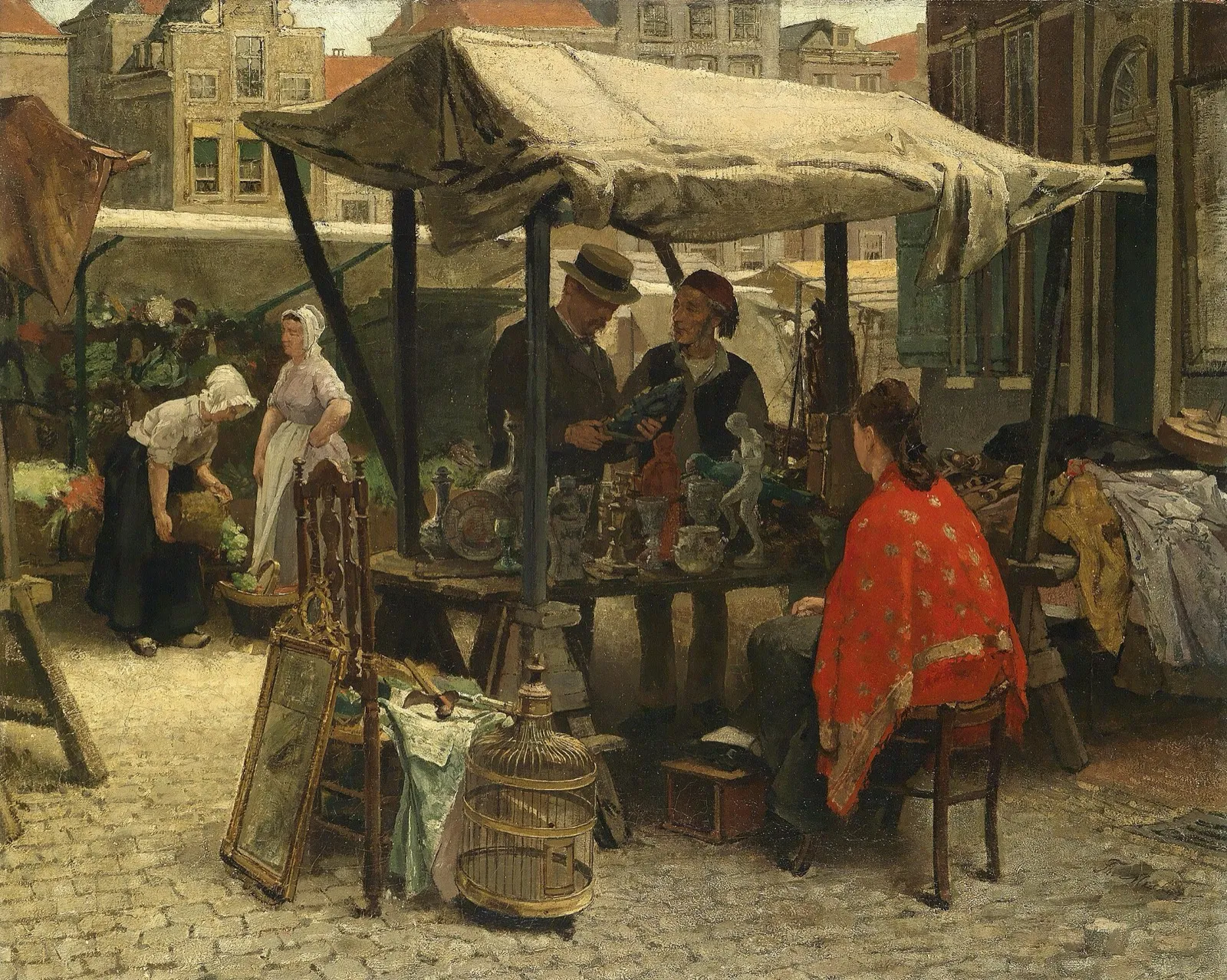 “Bric-a-brac” by Theo Mesker, before 1894. Every second-hand stall is a collection of objects that have lost their stories. Public domain.
That is the real problem. An object’s value to a family is rarely in the object. It is in what the object stands for: the clock that was a wedding present from a grandmother who walked out of a war with almost nothing; the ugly vase that was the first thing a couple bought together; the toolbox whose handles were worn smooth by a particular pair of hands. When the person who knew those stories dies, the object does not change at all, yet it loses most of its value overnight. It becomes, in the most literal sense, stuff.
Do objects have biographies?
Anthropologists have been saying something like this for decades. In an influential 1986 essay, “The Cultural Biography of Things”, published in a collection edited by Arjun Appadurai called The Social Life of Things, the anthropologist Igor Kopytoff argued that we should study objects the way we study people: by asking where they came from, who made them, how their status changed over their “life”, and what happened to them when they stopped being useful. A thing can move in and out of being a commodity. A mass-produced teacup is a commodity in the shop, a personal possession in the kitchen, a family heirloom after its owner dies, and a commodity again on the flea-market table.
What moves it between those states is mostly information. The teacup becomes an heirloom because the family knows its story. It returns to the market when nobody does.
The Significant Objects experiment demonstrated this in reverse. It took objects at the very bottom of the market, gave them invented biographies, and watched their value rise roughly twenty-eight-fold. The stories were not even true, and buyers knew it. A true story, told by the person who lived it, is worth incomparably more to the people who loved them.
There is a museum in Zagreb that runs on the same principle. The Museum of Broken Relationships, which began in 2006 as a travelling exhibition by the artists Olinka Vištica and Dražen Grubišić and opened a permanent home in 2010, displays ordinary objects donated by strangers at the end of their relationships: a pair of shoes, a toaster, a wedding dress, an axe. On its own, none of it would be worth exhibiting. Each object is shown with a short text written by the donor, and it is the text that makes visitors stand in front of a toaster for five minutes.
Why is the story the first thing we lose?
Because it is the only part of an heirloom that is not physical. A table survives a house move, a flood of paperwork, a probate sale and three generations of indifference. The story behind it lives in one or two heads and passes on, if at all, by being told aloud at the right moment to someone who happens to be listening.
Death cleaning, done in the usual way, makes this worse rather than better. Its method is triage: keep, give, throw. Every object gets a decision, but the decision is about the object. The story is rarely written down, because the person doing the sorting already knows it and it does not occur to them that it needs recording. The things that are kept arrive in the next generation’s homes stripped of their reasons. A few decades later, those things are on a stall like the one in Mesker’s painting.
I have seen the opposite happen in interviews. Over the past six years I have filmed more than a hundred life stories through The Archive, and some of the most revealing moments have come when someone picks up an object and explains it. A ring, a medal, a photograph, a battered suitcase. Objects are powerful memory cues: an old person who struggles to answer “Tell me about your childhood” will often talk for twenty minutes when handed a particular photograph and asked, “Who is this?” (I wrote about why in how to film an interview at home, which explains how props unlock memories that questions cannot reach.)
How to death clean without losing the stories
None of this is an argument against death cleaning. It is an argument for doing it with one extra step. If you are sorting your own things, or helping a parent sort theirs, the following makes the difference between leaving a family heirlooms and leaving them furniture.
- Sort with someone, not alone. Magnusson recommends talking to your family about death cleaning, and the conversation is the point. When a parent sorts their belongings with a child beside them, every object becomes a prompt. “Why have you kept this?” is one of the best interview questions ever devised.
- Record the story before deciding the object’s fate. Whether a thing is kept, given away or thrown out, the story attached to it can be preserved. A thirty-second explanation, filmed on a phone, of where an object came from and why it mattered will outlast the object itself.
- Film the object in the hands of its owner. A label taped to the bottom of a vase records a fact. A video of your mother holding it, turning it over and explaining it records her, which is what the family actually wanted from the vase in the first place.
- Let go of the object once the story is safe. Much of the guilt in death cleaning comes from a feeling that throwing away a thing betrays the person it belonged to. Once the story has been kept, that guilt usually loosens.
- Start with what matters most, not what is biggest. For stories, begin with the small objects that carry the most meaning: jewellery, letters, photographs, medals, recipe cards. (Recipes deserve their own method; see how to preserve family recipes.)
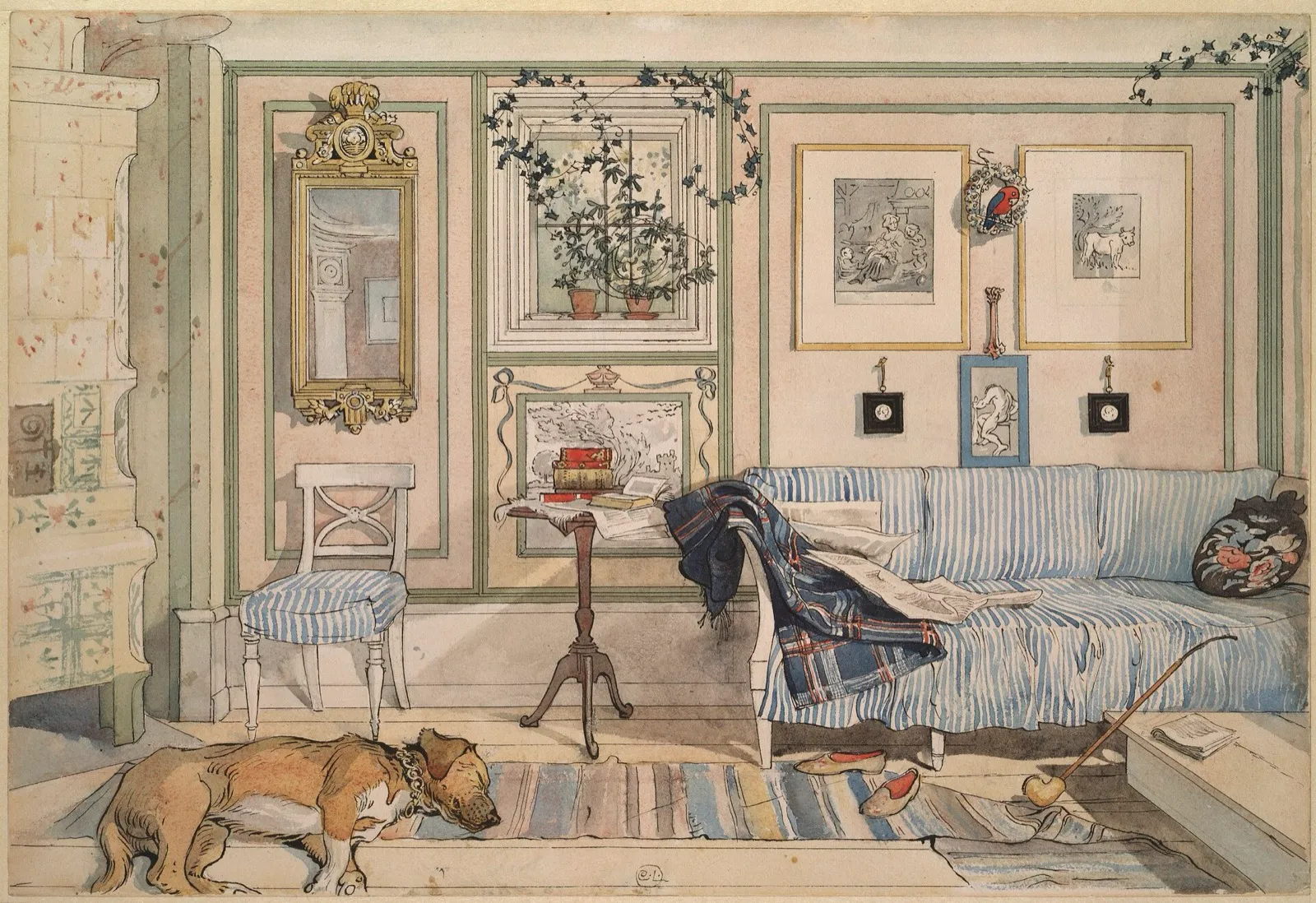
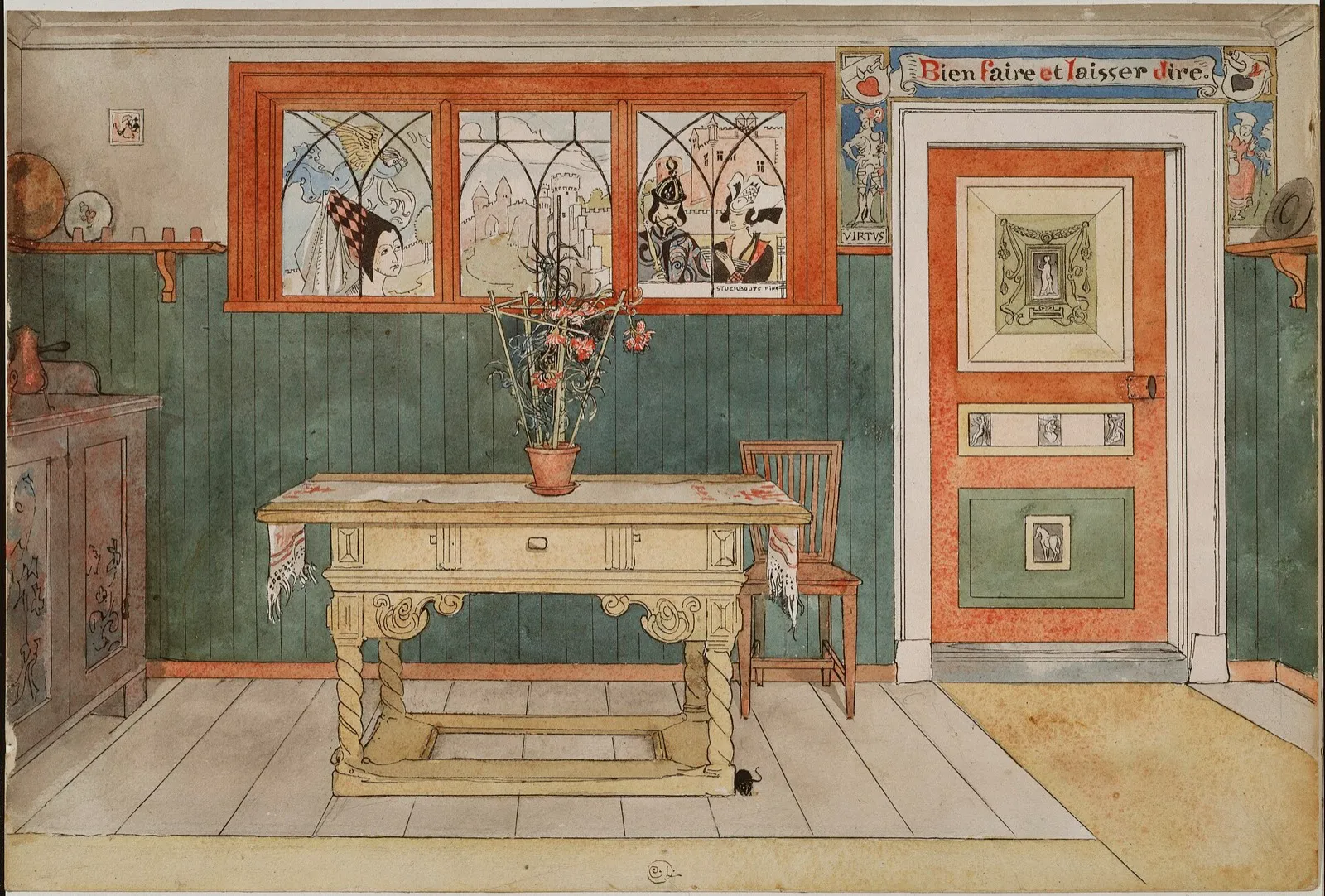 “The Dining Room” by Carl Larsson, from the series Ett hem (A Home), 1890s. Nationalmuseum, Stockholm. Public domain.
What should you actually keep?
Carl Larsson’s watercolours of his family home in Sundborn, published as Ett hem in 1899, show a house before anyone has had to clear it, when every slipper, pipe and picture still has an owner who could explain it. That condition does not last. Eventually every house is cleared, and the question Swedish death cleaning raises is not really what to throw away. It is what the people who come after us will be left holding, and whether they will know why.
For most of history the honest answer was that they would hold a few objects and very little explanation. That is no longer necessary. The most valuable thing a family can keep from a house clearance costs nothing to store and takes up no room: the voice and face of the person who lived there, explaining why the things mattered. A few minutes of video for each important object, recorded during the sorting rather than after the funeral, is a better inheritance than most of the objects themselves. The same logic applies to presents for older relatives who are trying to own less; see sentimental Christmas gifts for grandparents. (For what happens to such recordings once they exist, see what happens to your photos and videos when you die.)
If you want a structure for it, Everyone lets you film one short story at a time and keep them together, which suits a box of objects well: one object, one question, one video. But any camera will do. What matters is that the story is captured while the person who owns it is still here to tell it.