Sentimental Christmas gifts for grandparents who have everything.
Grandparents who have everything rarely want more things. Sentimental Christmas gift ideas, including for nursing homes and dementia, that mean something.
In 1993 the economist Joel Waldfogel published a short paper in the American Economic Review with a title that has annoyed people every December since: “The Deadweight Loss of Christmas”. He surveyed his students about the presents they had received and asked how much each gift had cost the giver and how much the student would have paid for it themselves. On his estimates, between a tenth and a third of the money spent on Christmas presents is simply destroyed, because givers buy things recipients value less than their price.
There is one instruction in Waldfogel’s method that matters more than the numbers. His students were told to leave out sentimental value. That was reasonable for an economist trying to measure prices, but it removes the only part of a gift that grows with age. And it points to the real problem with finding sentimental Christmas gifts for grandparents: the people we most want to thank are the people for whom an ordinary present is closest to worthless.
This piece is about why that is, and what to give instead, including for grandparents in a nursing home and grandparents living with dementia.
Why are grandparents so hard to buy for?
Because the usual logic of a present runs backwards at that stage of life.
A gift to a child or a young adult adds to a life that is still being furnished. A gift to someone in their eighties often adds to a life that is being cleared. Many older people are deliberately getting rid of things, a process that the Swedish artist Margareta Magnusson made famous as Swedish death cleaning: sorting your possessions while you can, so that your family does not have to do it after your funeral. Another scented candle, another jumper, another box of chocolates that the doctor has advised against, is one more decision for someone to make later.
“They have everything” is usually true in a literal sense. What it really means is that the things they lack cannot be bought: time with family, the sense of being useful and interesting, and some confidence that what they lived through will not disappear with them.
What makes a gift sentimental?
A gift is sentimental when its value depends on who gave it and what it refers to, rather than on what it is. A watch is a commodity. A watch engraved by a grandson with the date of his grandfather’s arrival in Australia is not, and it becomes more valuable, not less, as decades pass.
There is research on what kind of gift draws people closer. In a 2017 paper in the Journal of Consumer Research, Cindy Chan and Cassie Mogilner ran four studies comparing material gifts (objects to keep) with experiential gifts (things to do or live through). Recipients of experiential gifts reported a greater increase in how connected they felt to the giver, and the authors traced the effect to emotion: experiences tend to be more emotionally moving than objects.
For grandparents, the most emotionally charged material is already in their possession. It is their own past. The best sentimental gifts either make that past visible or give them an occasion to share it.
Sentimental Christmas gift ideas for grandparents
Most of these cost little or nothing. What they cost is attention.
- Record their life story. Sit down with them, ask about their childhood, their parents, how they met, what they would tell their younger selves, and film the answers. It is a gift in two directions: they receive the experience of being asked and listened to, and the family receives the recording. (For what to ask, see these questions to ask your grandparents.)
- A captioned photo book of their early life. Borrow their old photographs, scan them, and have them printed in a book. The captions are the important part, and they require you to ask who is in each picture, which turns the making of the gift into a conversation.
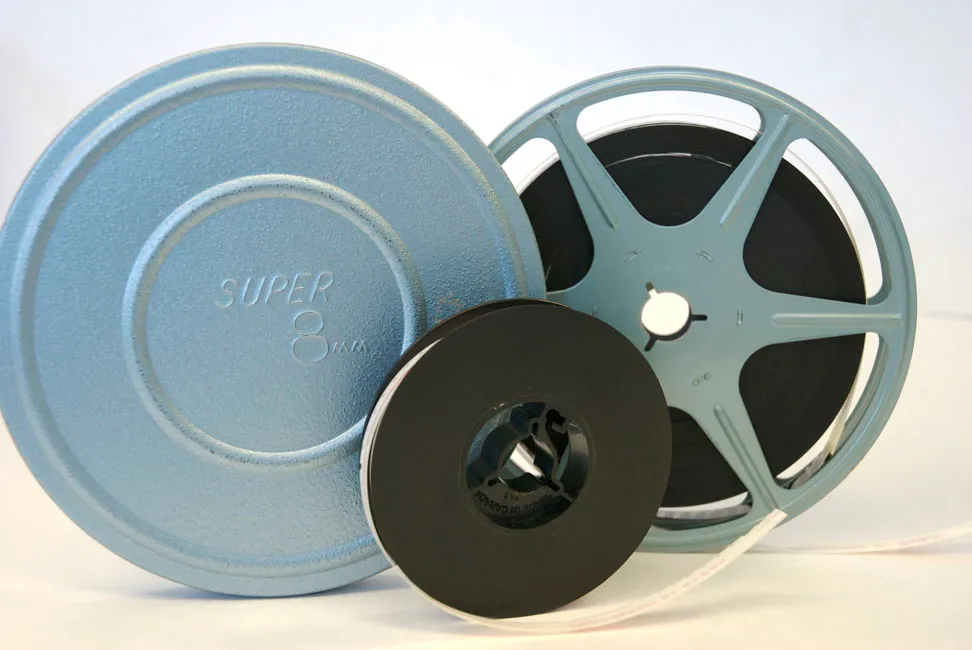
- Digitised slides, cine film or cassettes. Many families have boxes of slides, Super 8 reels or tapes that no one can play. Converting them, then watching them together on Christmas afternoon, gives a grandparent the rare pleasure of narrating their own past to an audience. (See how to digitise old home movies.)
- Their recipes, in their handwriting. Ask for the recipes they are known for, photograph the cards or notebook, and bind them for the whole family.
- A letter from each grandchild. Not a card with a line in it but a page each, describing a specific memory: the holiday, the lesson, the thing they said that stuck. Older people keep letters. Almost nobody keeps a gift card.
- A playlist of the music of their youth. Psychologists have found that older adults remember a disproportionate share of their lives from roughly their teens to their late twenties, an effect known as the reminiscence bump. Songs from those years carry particular weight.
- A promised visit, with a date. A voucher for “a day together” is easily forgotten. A written plan for a specific day, a specific place they used to love and a specific person who will take them there is not.
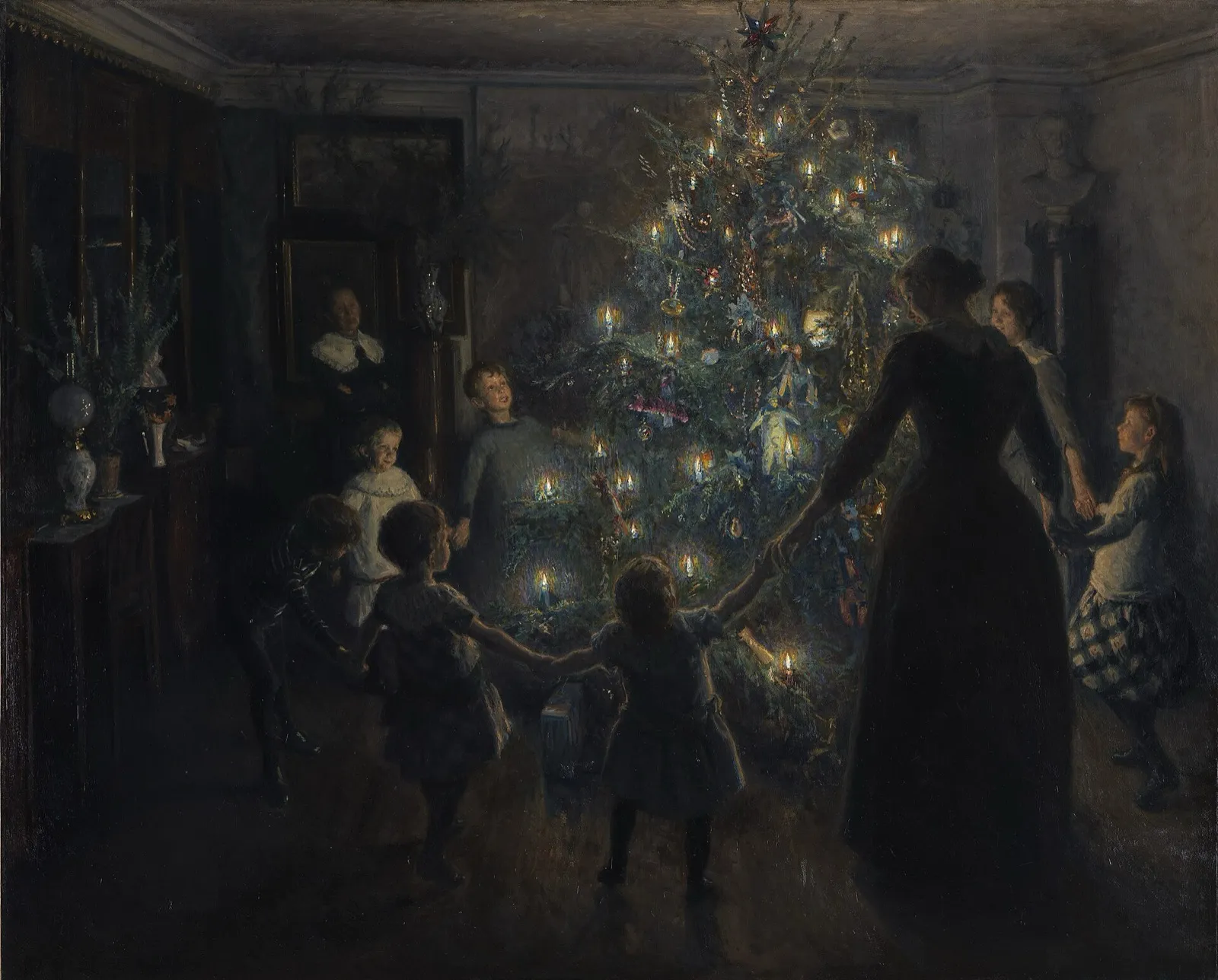
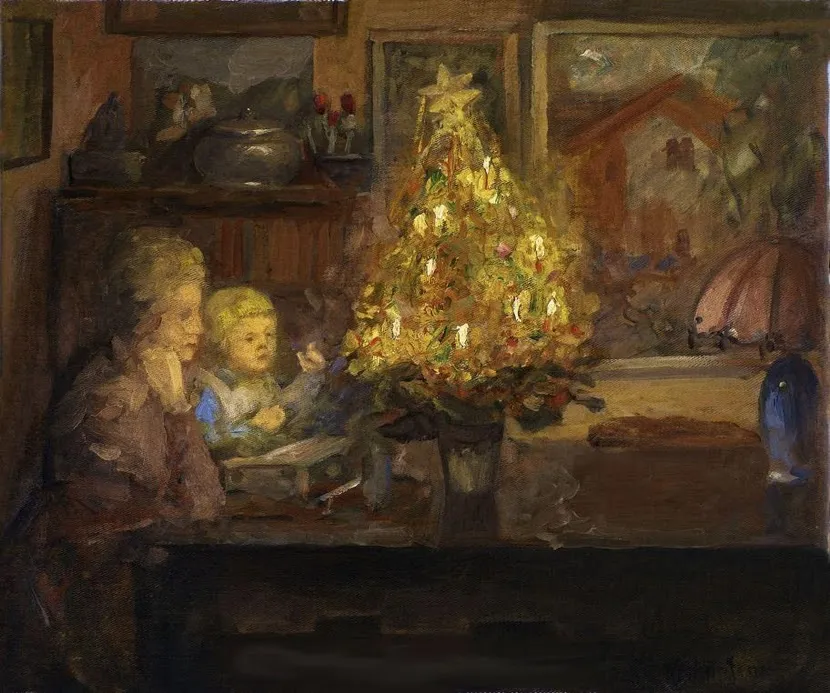 “A Christmas Story” by Viggo Johansen, before 1935. Public domain.
Christmas gifts for grandparents in a nursing home
A grandparent living in residential aged care usually has one small room, limited storage and a staff who will have to look after anything delicate. That rules out most conventional presents and strengthens the case for sentimental ones.
What tends to work:
- Things that fit on a wall or a bedside table. A small number of labelled family photographs, with names and dates written underneath, helps staff and other visitors start conversations as well.
- Things that bring people in. A calendar with visits already written in by different family members is a gift that keeps arriving through the year.
- Things that make them interesting to others. A short printed summary of their life, or a video of their story that staff and visitors can watch, changes how they are seen. To the people around them, a resident becomes a person with a history rather than a room number.
- Comfort items they actually use. A soft blanket or a familiar dressing gown is fine. Ask staff what is allowed and what is needed before buying.
The common thread is that the room is small but the life is not, and the best gifts let the second fit inside the first.
Christmas gifts for grandparents with dementia
Dementia changes the question again, because a gift needs to work for the person as they are now, and that may change between one visit and the next.
Two features of the condition matter. In many forms of dementia, particularly Alzheimer’s disease, recent memories are lost earlier than older ones, so the distant past often remains more reachable than last week. And people living with dementia are often surrounded by carers who do not know who they used to be.
This is why dementia charities encourage what is called life story work. In the UK, Alzheimer’s Society developed a form called “This is me” with the Royal College of Nursing, so that a person’s background, habits and preferences can travel with them into hospital or care. A life story book, a memory box of meaningful objects, or a short video can do the same job at home.
Some principles for gifts:
- Use prompts, not quizzes. A photograph with a name and date written on it lets them enjoy the picture without being tested. Avoid asking “Do you remember who this is?”
- Choose the senses over the facts. Familiar music, a favourite scent, a texture from their working life or a taste from their childhood can reach memories that questions cannot.
- Make it for the carers too. A one-page life story, with the names of their children, their old job, the place they grew up and the things that calm them, is a gift that improves their care every day.
- Record while you can. If they can still tell stories, film them now, gently and in short sessions. The stories they tell may repeat or drift, and that is fine: you are capturing how they remember their own life. (For a gentler method, see how to interview older family members.)
 “Young Girls Looking at an Album” by Pierre-Auguste Renoir, c. 1892. Virginia Museum of Fine Arts. Public domain.
Why is the best gift the one that asks something of them?
Most presents are designed to require nothing of the recipient. That is a kindness for most people and a quiet insult for many older ones, who are used to being looked after and rarely asked for anything that matters. Being asked to tell your story says that you are still a source of something, not only a recipient.
Since 2020 I have filmed more than a hundred life stories through The Archive, and a pattern I have seen many times is that the person being interviewed ends the session more animated than they started it. Being asked a good question and given time to answer is one of the few experiences that becomes rarer with age just as it becomes more valuable.
It also produces something that does not lose value. Waldfogel’s students were valuing sweaters and CDs, which depreciate the moment they are unwrapped. I have four hours of my grandmother telling me about her life. She has since passed away, and that recording is now worth more to my family than anything she owned.
A gift that lasts longer than Christmas
If you want one sentimental Christmas gift for a grandparent who has everything, sit down with them over the holidays and ask them to tell you about their life, and film it. You do not need a crew or a script. A phone at eye level, a quiet room and a list of good questions are enough. (The practical details are in how to film an interview at home.)
If a structure helps, Everyone, a free app, presents one question at a time and keeps each answer as a short video that the whole family can watch. But the tool matters much less than the decision. Christmas is one of the few days a year when the generations are in the same room with nothing urgent to do. It is a good day to ask.