The oldest recipes in the world left out the quantities.
The oldest written recipes skip the measurements, and so does Grandma’s card. Why family recipes die with the cook, and how to preserve them properly.
In the Yale Babylonian Collection there is a clay tablet, catalogued as YBC 4644, that holds some of the oldest recipes in the world. It was written in Mesopotamia around 1730 BCE and contains instructions for twenty-five stews and broths. Here, in translation, is one of them in full:
Stew of lamb. Meat is used. You prepare water. You add fat.
The other recipes are longer, but not by much. Ingredients are listed with almost no amounts. Salt goes in “as desired”. Things are boiled, sometimes “for a long time”. There is nothing about how to tell when a dish is ready. For years the tablets sat in the collection labelled as medical texts, and they only became widely known as cookery in the 1980s, largely through the translations of the Assyriologist Jean Bottéro.
It is tempting to treat this as a primitive stage of recipe writing. I think it shows something more interesting: what a recipe is for. A recipe has almost never been a set of instructions for a stranger. It is a reminder for someone who already knows how. And that is the central problem for anyone who wants to preserve family recipes today, because the card in the kitchen drawer, written in a grandmother’s hand, usually works exactly the way the Babylonian tablet does.
Why do old recipes leave out the important part?
Because the people who wrote them did not need it. A scribe recording a court stew was writing for cooks who had made it many times. The quantities were in their hands and the timing was in their eyes and nose. What needed writing down was the part most easily forgotten: which ingredients, in what order.
Precise measurement in home cooking is surprisingly recent. Nineteenth-century cookbooks routinely called for butter “the size of an egg” or flour “enough to make a stiff dough”. In 1896 Fannie Farmer published The Boston Cooking-School Cook Book, which became famous for insisting on standard, level measurements: a level cup, a level teaspoon. She built on earlier work, including an 1884 cookbook by Mary Lincoln for the same school, but her book sold in the hundreds of thousands and helped make exact quantities the norm. She is still sometimes called the mother of level measurements.
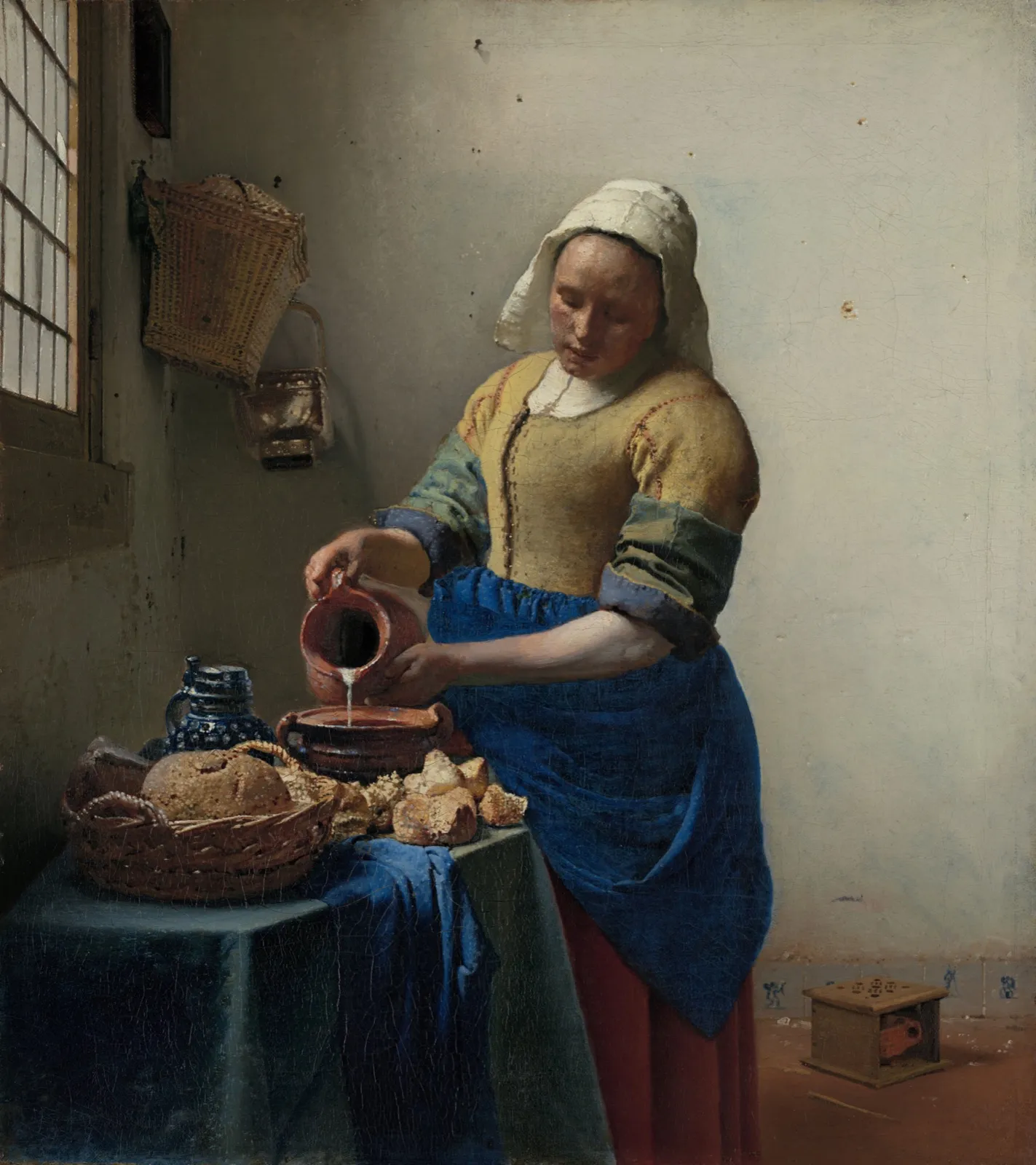
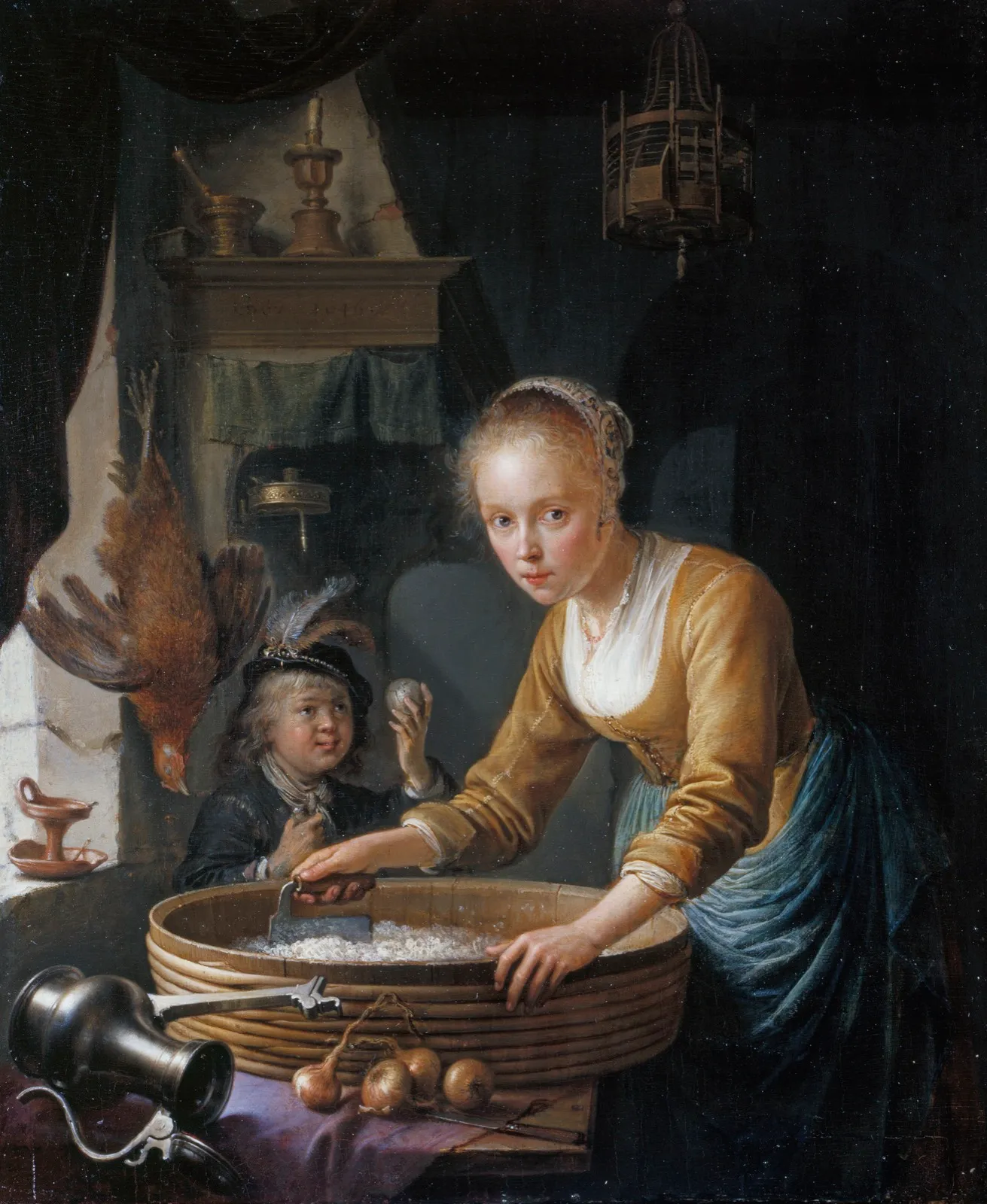 “Girl Chopping Onions” by Gerrit Dou, 1646. Royal Collection, London. Public domain.
Farmer’s project was to make cooking teachable from a page. It largely succeeded for the cookbook. It never reached the family recipe, which was not written to teach anyone. It was written by a person who knew the dish for a person who would, they assumed, learn it by standing next to them.
What is tacit knowledge, and why can’t you write it down?
In 1966 the chemist and philosopher Michael Polanyi opened The Tacit Dimension with a sentence that has been quoted ever since: “we can know more than we can tell.” His examples were recognising a face in a crowd or riding a bicycle. You can do these things reliably and still be unable to explain how. The knowledge is real, but it lives in perception and in the body rather than in words.
The sociologist Harry Collins later found a striking case of it in a physics laboratory. In the early 1970s he studied British scientists trying to build a new kind of laser, the TEA laser, which had been described in detail in published papers. Groups that worked only from the written accounts failed; they built devices that looked right and did not work. The groups that succeeded had visited a laboratory where the laser already worked, or had been in close contact with someone who had built one. Collins published the study in 1974. The people who could make the laser work could not fully say what they were doing differently, so the knowledge travelled with people, not with paper.
Cooking is the everyday version of the same thing. Consider what a recipe card cannot carry:
- Quantities measured by hand. “A handful” of flour depends on the hand. “A pinch” differs between cooks by a factor of several.
- Judgements made by the senses. The sound oil makes when it is hot enough. The look of a dough that has been kneaded long enough. The smell of onions just before they burn.
- Technique. How to fold, how to roll, how hard to press. These are movements, and movements are close to impossible to describe in prose.
- Adjustments. What the cook does when the tomatoes are watery or the oven runs hot. This is often the real expertise, and it almost never appears on the card.
This is why so many people have had the same experience: they find a parent’s or grandparent’s recipe, follow it carefully, and produce something that is clearly the same dish and clearly not the same food.
What else disappears with a family recipe?
The know-how is only half of what is lost. The other half is the meaning.
A family recipe is rarely just food. It is the dish someone’s mother made when there was no money, or the one brought over on a migrant ship in the form of a memory, or the cake that only appears at one festival each year. It is often observed that food is one of the last things migrant families let go of: language and dress may change within a generation while the recipes carry on. When a recipe card outlives its cook, it usually outlives that story too. The descendants know that the family makes this biscuit at Christmas. They no longer know why, or who first made it, or what it tasted like in the place it came from.
I have argued before that a family is a small culture, and that most families are reduced within a few generations to a box of unlabelled photographs and a name on a headstone. Recipes are one of the few parts of that culture that people actively try to keep, which makes it all the more striking how often the keeping fails. What survives is the list. What dies is the cook.
How to preserve family recipes properly
The answer follows from Collins’s laser. Knowledge that lives in people travels best by watching them. Until recently that meant standing beside someone in the kitchen for years. Now it means filming them, which captures most of what the card leaves out: the hands, the texture, the timing, the sound of the pan and, above all, the cook explaining what they are doing as they do it.
A practical method:
- Film in their kitchen, with their equipment. The bowl they always use, their oven, their stove. These are part of the recipe, and they are also memory cues; people remember more in the place where they learnt something.
- Ask them to cook it, not describe it. Agree on a day to make the dish together, from start to finish, at normal speed.
- Use two shots if you can. One wide shot of the person at the bench, face visible, and close shots of their hands at the key moments: the mixing, the kneading, the folding. A second phone propped on a stack of books is enough.
- Ask them to narrate, and ask the tacit questions. “How do you know it’s ready?” “What would go wrong if you added it now?” “What does it look like when it’s too dry?” Those answers are the knowledge Polanyi was describing, and people can often show it even when they cannot easily explain it unprompted.
- Measure as they go. Have a scale and measuring cups nearby. When they throw in a handful, catch the next one in a cup first. This is the one place where Fannie Farmer helps.
- Ask about the story. Where did the recipe come from? Who taught you? When did the family make it? What did it taste like when you were a child? Is there a version you have changed? Ask these sitting down after the cooking, when the noise has stopped and the dish is on the table.
- Manage the sound. Kitchens are among the worst rooms in the house for recording: hard surfaces, extractor fans, fridges, sizzling pans. Keep the phone close to the person, turn the range hood off whenever they are talking, and do the story questions in a quieter room. More on this in how to film an interview at home.
- Write the card afterwards, and keep both. A written recipe with real quantities is useful in the kitchen. The video is what makes the written version usable, and what makes it worth keeping.
Why video, and not only a better written recipe?
One could object that the answer is simply a more careful written recipe: quantities, times, temperatures, the works. That helps, and it is worth doing. But it misunderstands what the family wants to preserve.
A precise written recipe preserves the dish. It does not preserve the cook. The thing people miss, when they reach for a grandmother’s card after her death, is not mainly the biscuit. It is her: the way she cracked the eggs one-handed, what she muttered when the dough stuck, the story she always told while it was in the oven. Writing can carry the instructions. It cannot carry the face, the voice or the hands, and those are precisely what a descendant has no other way to recover. The same argument applies to life stories in general, which is why I think it is better to record a life story on video than to write it down.
What the tablet was missing
The Babylonian cooks who used YBC 4644 did not need more detail. They had each other. The knowledge passed from one cook to the next in the same kitchen, and the tablet was an aide-memoire for people who already belonged to the tradition. When that chain of people broke, the tablet became a puzzle that modern researchers have spent decades trying to reconstruct.
Every family recipe card is a small version of that tablet. As long as the cook is alive, the card is complete, because the rest of it is standing at the stove. The same is true of every heirloom in the house, which is the case for doing Swedish death cleaning with a camera running. The time to film them is while that is still true. In the Everyone app you can do it one question at a time, and the first question can simply be: “Will you show me how you make it?”