Some of history’s largest peoples are now known only by their pottery.
Lost cultures like the Indus and the Picts left cities and carvings but almost no voice. Why whole peoples vanish, and what it means for your own family.
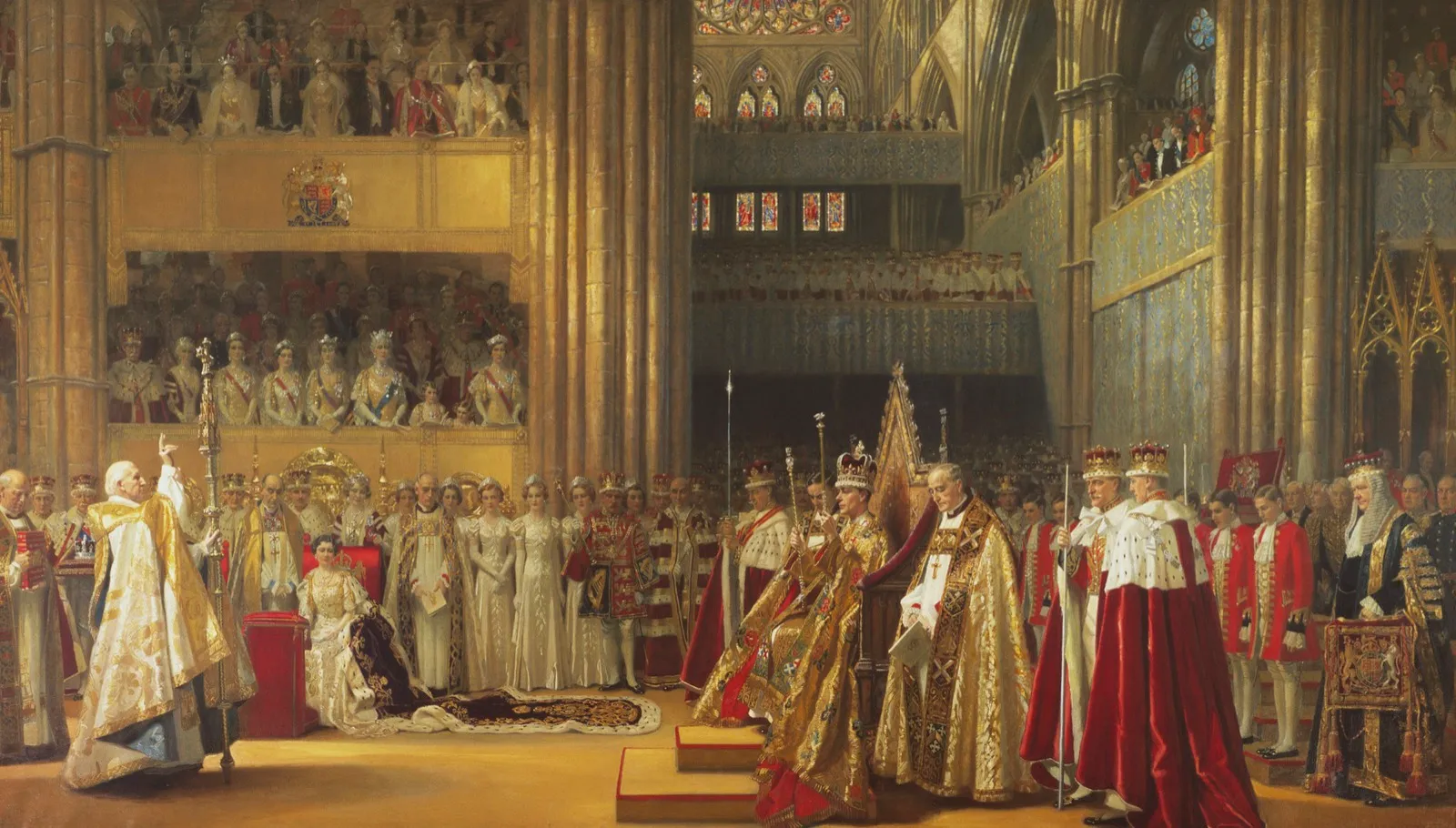
For several centuries around 5000 BCE, farmers spread across central Europe from Hungary to the Paris Basin, clearing forest, building longhouses up to forty metres long and raising families in villages that lasted for generations. They were among the first farmers in much of Europe. We do not know what they called themselves, what language they spoke, what gods they prayed to or what a single one of them was named. Archaeologists call them the Linear Pottery culture, after the bands of lines they scratched into their bowls.
They are not unusual. Later peoples of prehistoric Europe are known as the Corded Ware culture, after the cord impressions pressed into their pots, and the Bell Beaker culture, after the shape of a drinking cup. Millions of people over thousands of years are filed under the names of their crockery, because crockery is what survived.
Lost cultures are usually imagined as civilisations that collapsed or were conquered. The more unsettling category is the peoples who did not vanish so much as go silent: they left cities, tools and art, sometimes even writing, but almost nothing of what they thought. Their stories show precisely what survives of a people, and what does not, and the same pattern applies, on a smaller scale, to every family.
What do we call a people who left no name?
Usually, whatever someone else called them, or whatever a modern scholar decided. The Minoans of Bronze Age Crete built palaces at Knossos with running water and painted walls. Their name was given to them in the early twentieth century by the archaeologist Arthur Evans, who borrowed it from Minos, a king of later Greek myth. What the Minoans called themselves is unknown. Their script, Linear A, has never been deciphered. The related Linear B, which Michael Ventris showed in 1952 to be an early form of Greek, belonged to the Mycenaeans who came after them.
The Picts of northern Scotland are known by a Latin word, Picti, first recorded in a Roman panegyric of 297 CE and usually taken to mean “the painted ones”. It is a nickname, used by an empire that regarded them as barbarians on the far side of a wall. Their own word for themselves is not securely known.
This is the first lesson of lost cultures. When a people leaves no account of itself, it does not get to choose its name. The name comes from its enemies, its neighbours or its excavators, and it describes what they saw.
Why can the Indus script still not be read?
The Indus civilisation is perhaps the largest case of a people we can see but not hear. At its height, roughly between 2600 and 1900 BCE, it covered much of what is now Pakistan and north-western India, an area larger than Egypt and Mesopotamia combined. Its cities, including Harappa and Mohenjo-daro, were laid out on grids, with standardised bricks, covered drains and household bathrooms. Its weights were standardised across hundreds of kilometres. Estimates of its population vary widely, but it was certainly one of the great societies of the Bronze Age world.
The modern world did not know it existed until excavations at Harappa in the early 1920s.
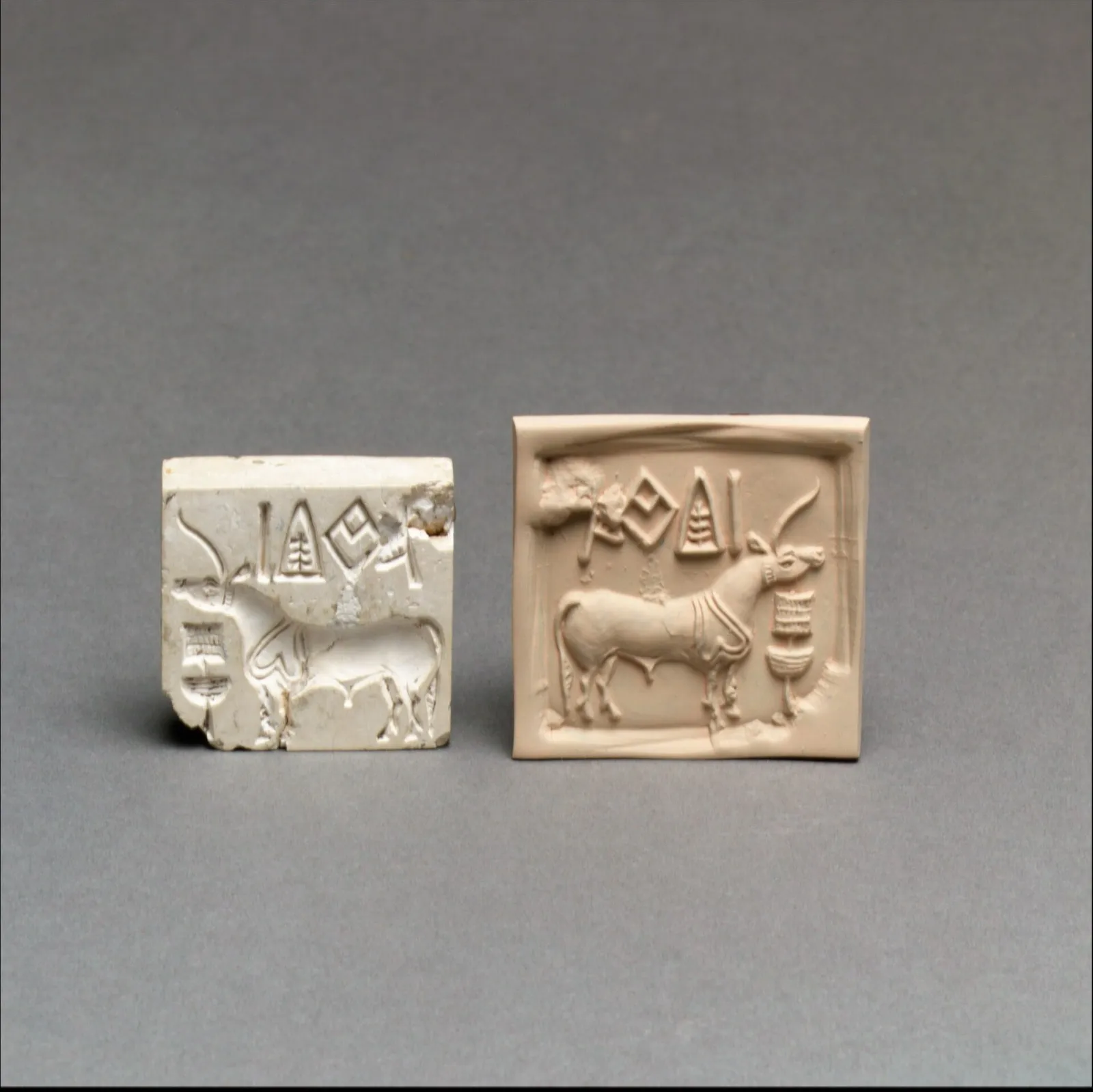
The Indus people wrote. Several thousand inscribed objects survive, most of them small stone seals like the one at the top of this page, carved with an animal and a short row of signs. The problem is that the inscriptions are very short. Most are under ten signs, and the average is around five. No bilingual inscription has been found, of the kind the Rosetta Stone provided for Egyptian hieroglyphs. We do not know what language the signs record, and proposed decipherments have not persuaded most specialists.
So the name we use for the place comes from outside. Mesopotamian texts refer to a distant land called Meluhha, which most scholars identify with the Indus region. Sargon of Akkad, around 2300 BCE, boasted that ships from Meluhha docked at his capital. One of the largest civilisations of its time survives, in words, chiefly as a trading destination mentioned by its customers.
What survives when the books do not?
The Etruscans are a stranger case, because we can read their script but not understand their language. They dominated central Italy before Rome, and the Romans borrowed a great deal from them, from religious practices to, by some accounts, the symbols of political office. They had a literature. Roman writers refer to Etruscan books on religion and divination.
They even had a historian. According to Suetonius, the emperor Claudius, who had an Etruscan first wife and an antiquarian’s interest in the subject, wrote a history of the Etruscans in Greek in twenty books. He reportedly drew on Etruscan sources that were still available to him. It was read aloud annually in Alexandria. Not a page of it survives.
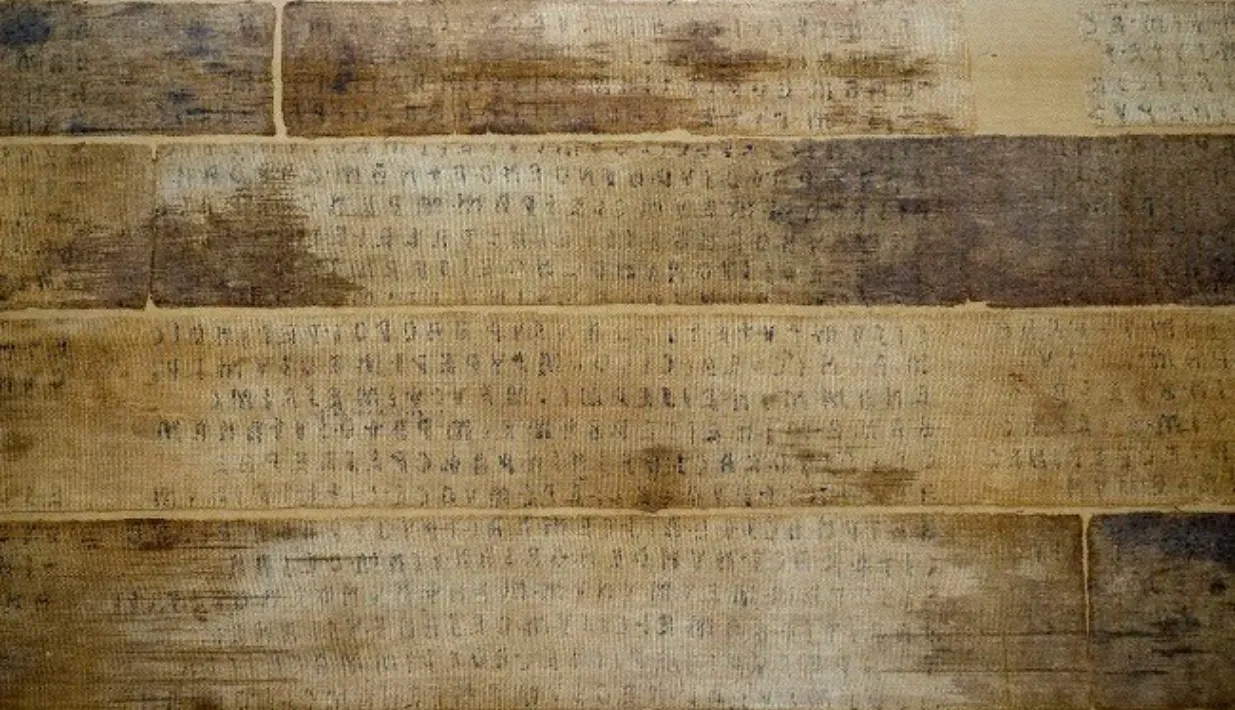 Part of the Liber Linteus, the longest surviving Etruscan text, written on linen in the last centuries BCE and later used to wrap an Egyptian mummy. Archaeological Museum, Zagreb. Public domain.
The longest Etruscan text we have survived by accident. It is a linen book, probably a ritual calendar, that at some point was cut into strips and used to wrap the body of a woman in Ptolemaic Egypt. The mummy was bought in Egypt in the mid-nineteenth century by a Croatian traveller and ended up in a museum in Zagreb. Only in the 1890s did a scholar realise that the writing on the bandages was not Egyptian but Etruscan. Much of it still cannot be translated with confidence.
A people that taught Rome some of its religion is now represented, in its own words, mainly by temple rules, tomb inscriptions and a prayer book reused as packaging. Claudius’ twenty books, the one long account of who they thought they were, went the way of most lost works of history: nobody kept copying it.
What happens when only your enemies write about you?
Around 1177 BCE, by the most commonly used chronology, Ramesses III of Egypt recorded a victory over a coalition of invaders who had come, his inscriptions say, from the sea and the islands. The reliefs on his mortuary temple at Medinet Habu show the battle in detail: their ships, their feathered and horned helmets, their dead in the water and their captives being led away. In the nineteenth century, French Egyptologists began calling them the “peoples of the sea”, and the name stuck.
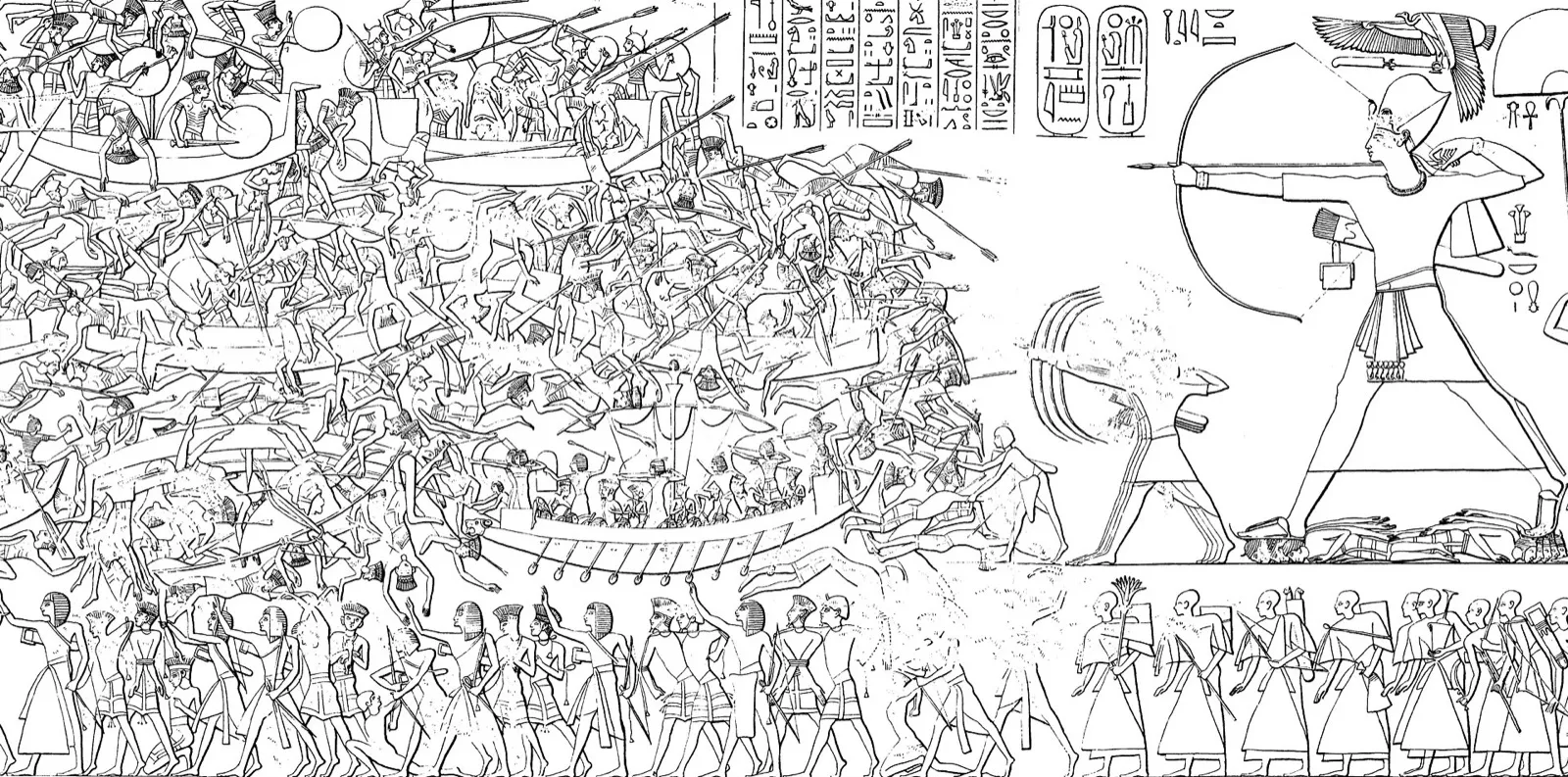 Line drawing of the naval battle against the Sea Peoples, from the temple of Ramesses III at Medinet Habu, c. 12th century BCE. Public domain.
Historians have argued for more than a century about who the Sea Peoples were, where they came from, and how far they were responsible for the collapse of Bronze Age civilisations around the eastern Mediterranean. One reason the argument has lasted so long is that the main evidence comes from the people who fought them. We see them as the pharaoh wanted them seen: defeated, drowning, and much smaller than him.
The Picts appear in the record in a similar way. For centuries their history was written by Romans, and later by the Gaelic, Northumbrian and Christian writers who absorbed or opposed them. What the Picts left themselves is mostly carved stone. Their symbol stones, covered in crescents, double discs, mirrors, combs and stylised animals, are among the most striking monuments in Scotland. What the symbols meant, whether they recorded names, ranks or something else, remains disputed.
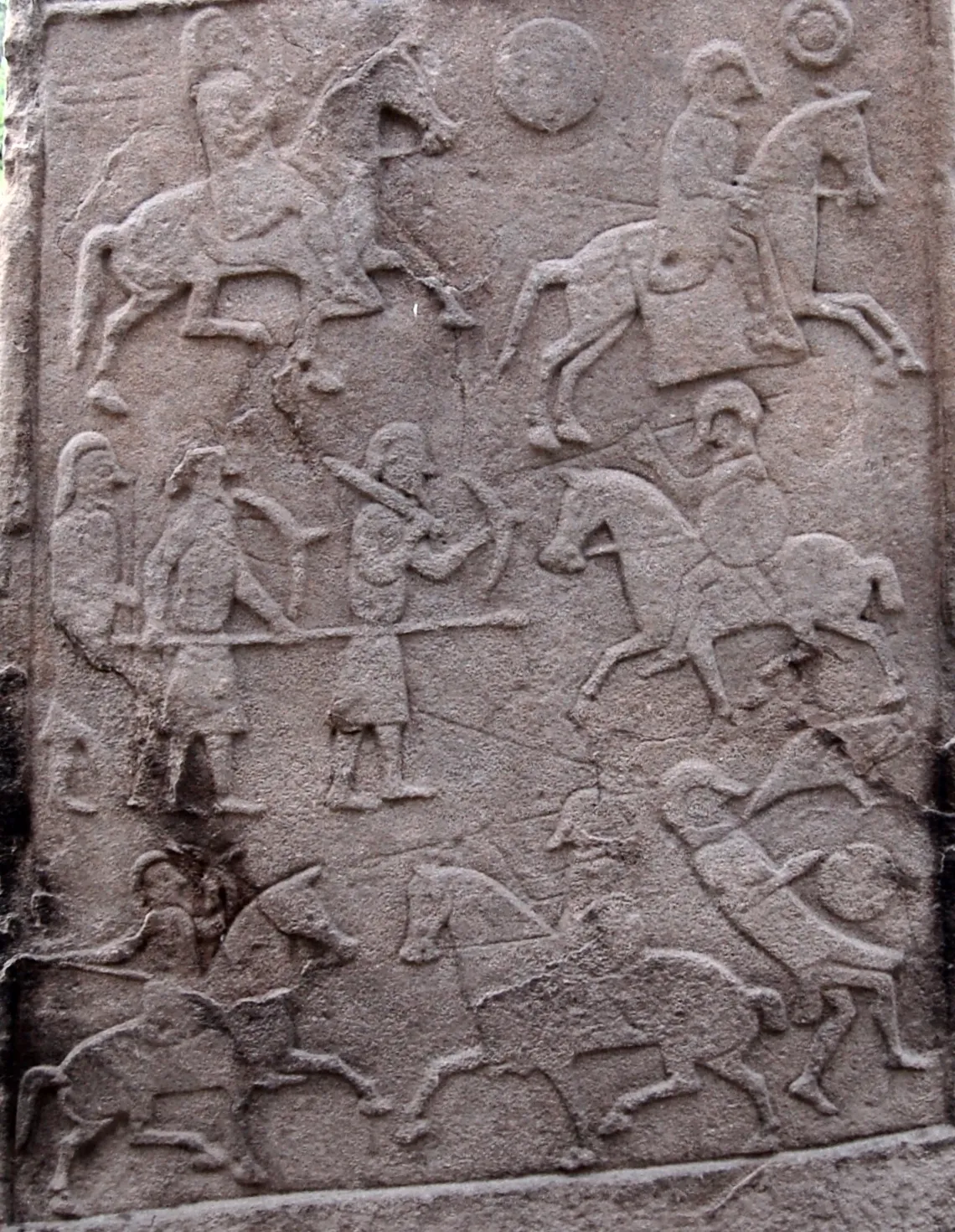 Battle scene on the Pictish cross-slab in Aberlemno churchyard, Angus, probably 8th century. Photo by Greenshed, 2007. Public domain.
The stone above shows a battle, which some historians link to the Pictish victory over the Northumbrians at Nechtansmere in 685. It is a powerful image. It is also a picture without a caption. A people that could organise armies and commission sculpture of this quality left us almost none of their own words, except, possibly, in place names: the “Pit-” at the start of towns such as Pitlochry is thought to come from a Pictish word for a piece of land.
Is this still happening?
It is, and closer to home than the Bronze Age. When the British arrived in Australia in 1788, more than 250 Aboriginal and Torres Strait Islander languages were spoken across the continent, many with several dialects. Fewer than half are spoken today, and only a small number are still being learnt by children as a first language. Each of those languages carried place names, songs, law and stories that were held in memory and passed on in conversation.
The case of Kaurna, the language of the Adelaide Plains, shows what a record can do. In 1840 two German missionaries, Christian Teichelmann and Clamor Schürmann, published a grammar and a vocabulary of around 2,000 words. The language later fell out of everyday use. From around 1990, Kaurna people and linguists began to revive it, working largely from those missionary records, and today Kaurna words appear again in Adelaide’s schools, ceremonies and public life. The revival exists because, a century and a half earlier, someone wrote things down while there were still people to ask. (Why a recording of a voice does even more than a word list is the subject of the last speaker of a language.)
What is the lesson for a single family?
The mechanism that silenced the Indus, the Etruscans and the Picts is not mysterious. The people were there, and they had plenty to say. What they lacked was a way to carry their own account forward that outlasted the people telling it. What survived was whatever was durable by accident: fired clay, carved stone, a linen book reused as bandages, and the descriptions of outsiders.
A family is a small culture. It has its own vocabulary, its jokes, its recipes, its explanations of why things are the way they are, and a cast of people whose faces and voices hold it together. Within two or three generations, most families are reduced to the equivalent of potsherds: a box of unlabelled photographs, a few certificates written by officials, and a name on a headstone. I made a similar argument about individuals in ordinary people in history. The same thing happens to whole households.
Over the more than a hundred life stories I have filmed through The Archive since 2020, including Holocaust survivors whose families and communities were all but erased, the pattern has been consistent. The people who hold a family’s culture rarely think of it as something that can be lost. My grandmother did not think of her four hours of stories as a record of anything. She has since passed, and they are now the only place where much of that world can still be seen and heard.
The difference between our position and that of the Picts is cost. Leaving an account of yourself used to require scribes, stonemasons or an emperor’s leisure. Now it requires a phone, a quiet room and someone willing to ask. The Everyone app was built to make that asking easier, one question at a time, on video. The Linear Pottery farmers left their bowls. Your family can leave its own voice.