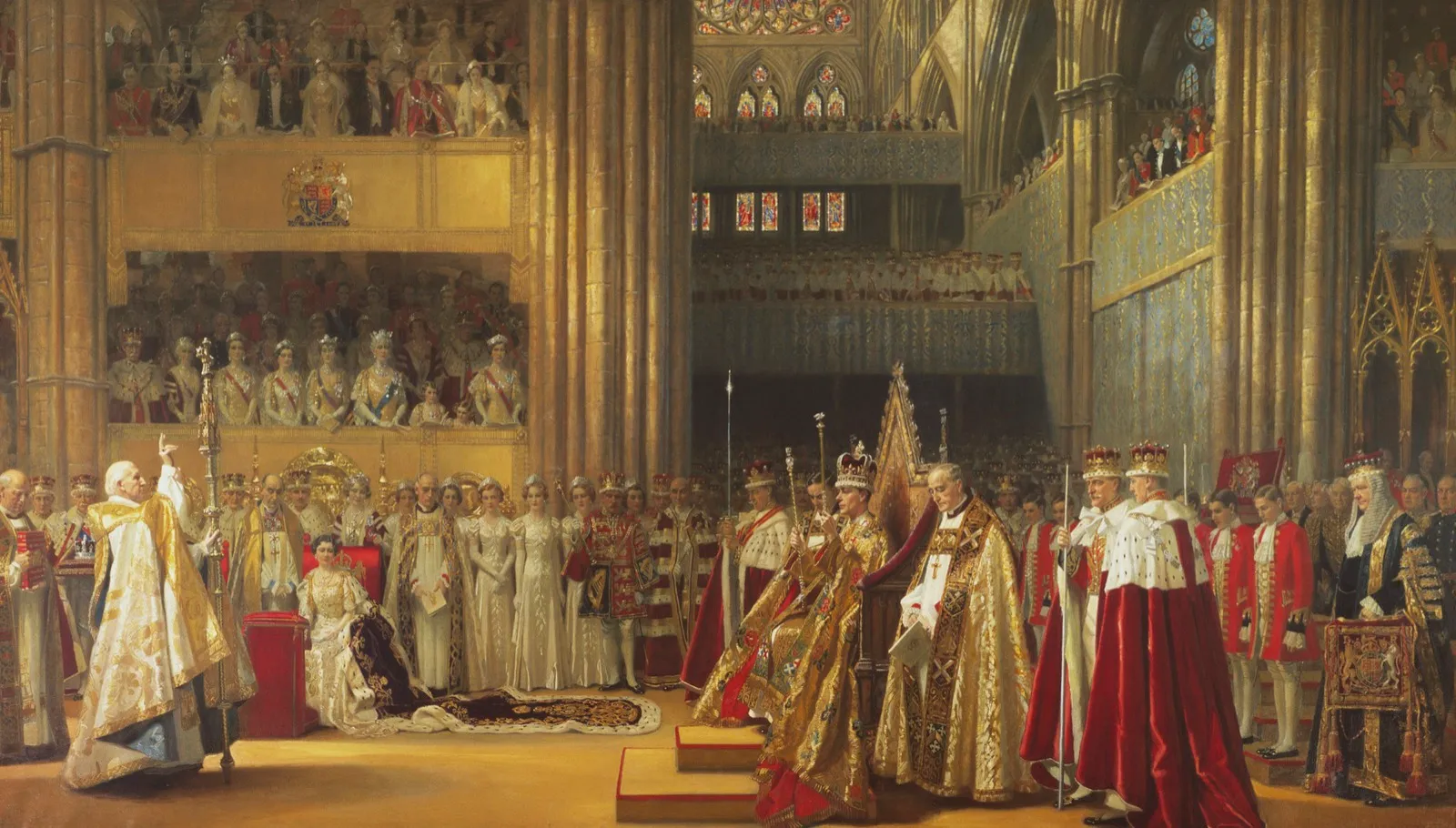
Victorian post-mortem photography, and why they did it.
Victorian families paid to photograph their dead children. It looks morbid now, but it was a rational answer to a problem we still have, in a new form.
In the summer of 1849, cholera swept through Cincinnati and killed thousands of people. One of them was an eighteen-month-old boy named Samuel Charles Stowe, known to his family as Charley. Before he was buried, his parents had him photographed. The daguerreotype survives in the Schlesinger Library at Harvard: a small boy on a white pillow, a sprig of flowers in his hands, a patterned shawl drawn over his legs. He looks asleep.
His mother was Harriet Beecher Stowe. In a letter a few years later, she wrote that standing at his deathbed and his grave taught her “what a poor slave mother may feel” when her child is taken from her. Many historians see that grief in Uncle Tom’s Cabin, which she published in 1852.
To modern eyes, the photograph is unsettling. Why would a family pay a stranger to photograph their dead child? The usual answer is that the Victorians were simply morbid, obsessed with death in a way we have outgrown. That answer is wrong, and the real one is more interesting. Victorian post-mortem photography was a sensible response to a problem every family faces: the fear that a person will vanish without a trace. The Victorians solved the version of that problem they had. We have a different version, and mostly we have not solved it.
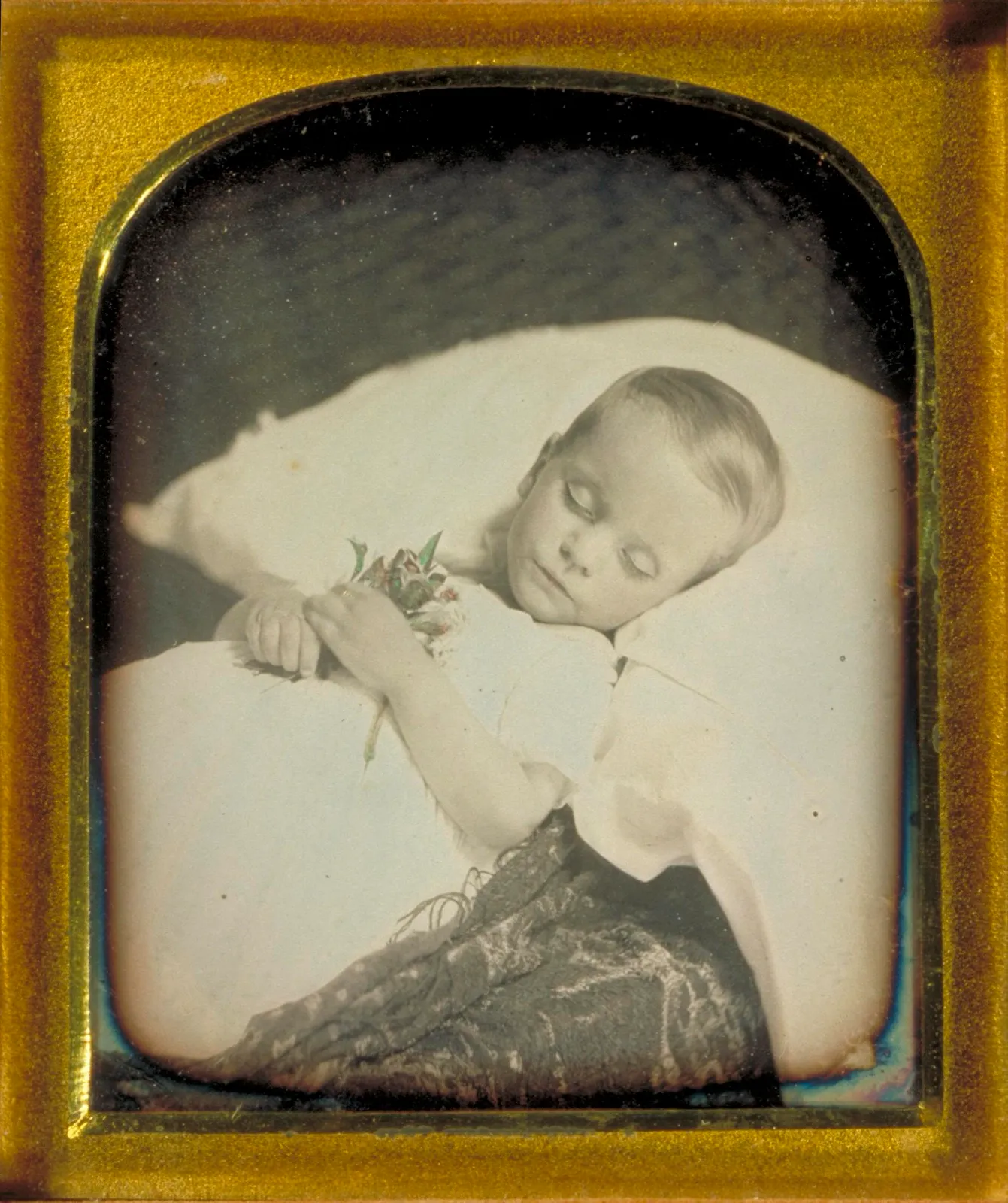 Post-mortem portrait of Samuel Charles Stowe, son of Harriet Beecher Stowe, 1849. Daguerreotype, Schlesinger Library, Harvard University. No known copyright restrictions.
What was Victorian post-mortem photography?
Post-mortem photography means photographing a person after death, usually as a memorial for the family. It began almost as soon as photography itself. Louis Daguerre’s process was announced in Paris in 1839, and within a few years portrait studios had opened in cities across Europe and America. Many of them advertised that they would photograph the deceased, often at the family’s home.
The pictures follow a few conventions. Children, who make up a large share of surviving examples, are usually shown as if asleep: in a cot, on a pillow, in a mother’s lap. Adults are more often shown in a coffin or on a bed, sometimes surrounded by flowers. Later photographs, from the second half of the century, more often show the coffin and the mourners together, a record of the funeral as much as of the person.
Collectors and historians began taking these images seriously only in the late twentieth century. The physician and collector Stanley Burns published Sleeping Beauty: Memorial Photography in America in 1990, generally described as the first book on the subject, and the anthropologist Jay Ruby followed with Secure the Shadow: Death and Photography in America in 1995. Ruby’s title came from a slogan that early photographers used in their advertising: “Secure the shadow, ere the substance fade.”
Why did Victorians photograph their dead?
The slogan contains most of the answer. A photograph was a shadow, and the substance was fading. For many families, especially in the 1840s and 1850s, it was now or never.
Three facts made the practice rational.
Children died often. In England and Wales in the mid-nineteenth century, around one in seven babies died before their first birthday, and in crowded cities the figure was often worse. Cholera, scarlet fever, diphtheria and measles took older children too. Almost every family lost someone young.
Photographs were scarce and expensive. A daguerreotype was a single image on a silvered copper plate, with no negative. Each one was unique, and a sitting cost real money. A working family might commission one or two portraits in a lifetime, if any. Most had never thought to photograph a healthy toddler, because there was no habit of doing so and no spare money for it.
So the first portrait was often the last. When a child died, parents realised that they had no image of them at all. Painted portraits had long been the preserve of the rich, as far back as the Fayum mummy portraits of Roman Egypt. Now, for the first time, an ordinary family could keep the face of someone they had lost, provided they acted before the funeral. The post-mortem photograph was not a morbid extra. Often it was the only picture of that person that would ever exist.
Did they really prop up the dead to look alive?
The internet is full of Victorian photographs said to show corpses propped upright with metal stands, eyes painted open, posed among their living siblings. Almost all of them are ordinary portraits of living people.
The myth rests on a misunderstanding of the posing stand. Early exposures took seconds, and sitters had to keep perfectly still, so studios used adjustable iron stands to brace a living person’s head and back. Collectors who have handled these stands, such as Mike Zohn, point out that they were built roughly like a modern microphone stand and could not hold up the dead weight of an adult body. Rigor mortis, which stiffens a body for a day or more after death, would also make the elaborate poses in these images close to impossible.
Real post-mortem photographs are usually easy to identify: the person is lying down, the eyes are closed, and the effect the family wanted was rest, not life. Some photographers did retouch prints to suggest open eyes, and a few families did pose the deceased sitting in a chair. But the familiar image of the Victorian corpse standing upright in the parlour is largely a twenty-first-century invention, which says more about our attitudes to death than theirs.
Why did post-mortem photography fade?
The practice did not end suddenly, and Ruby argued that in private it never really ended at all. But it became steadily less common, and less visible, for two reasons.
The first is that children stopped dying at the same rate. Clean water, sewerage, vaccination and better nutrition brought infant mortality down sharply over the late nineteenth and twentieth centuries. A family could expect its children to outlive the parents.
The second is that photographs stopped being scarce. The carte de visite, a small cheap print made from a glass negative, spread through the 1860s, and families began collecting albums. Then, in 1900, Kodak released the Brownie camera for one dollar. Photography moved out of the studio and into the home. Once parents had dozens of snapshots of a child alive, nobody needed a photograph taken after death.
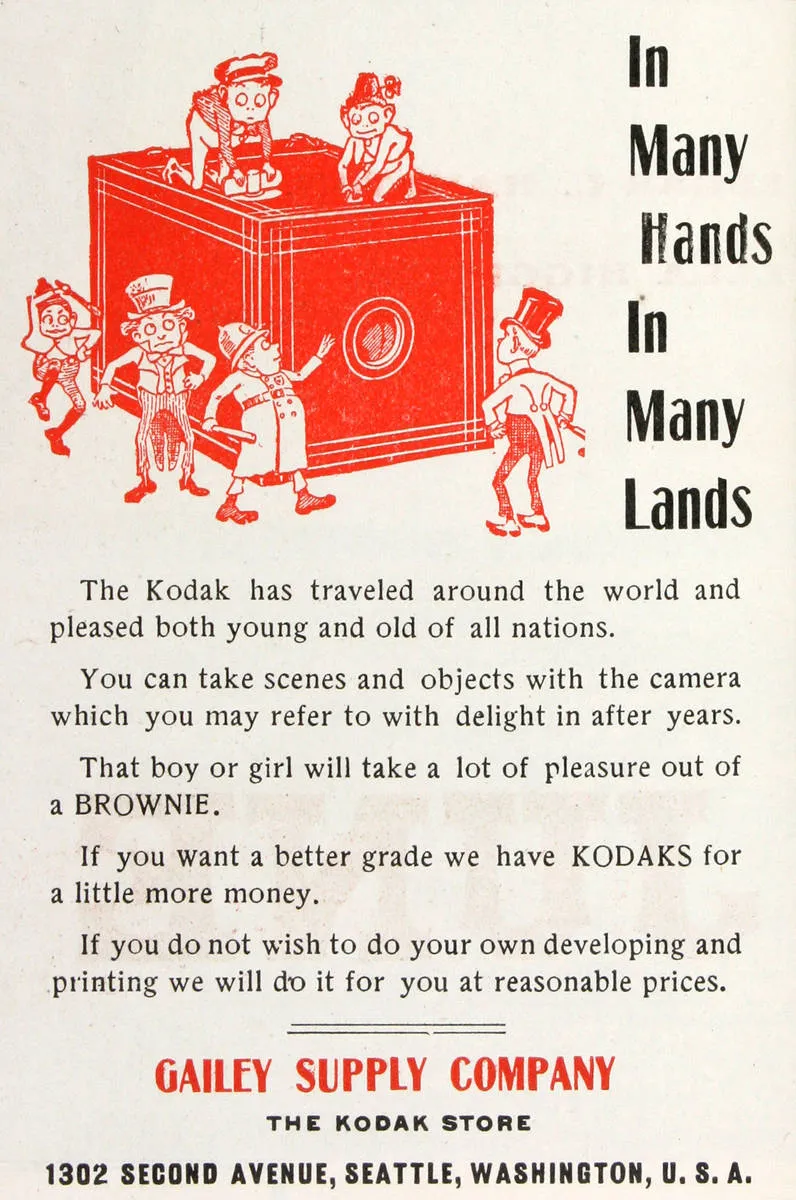 Advertisement for the Kodak Brownie, Gailey Supply Company, Seattle, 1905. Public domain.
So the practice did not fade because people became more sensible about death. It faded because the problem it solved had gone away. Once a family had plenty of pictures, a picture taken after death was no longer the only way to keep a face.
What problem do we have instead?
The Victorians’ problem was that they had no image of the person. Ours is close to the opposite. A child born today will be photographed more times by their fifth birthday than most nineteenth-century people were in their whole lives. We are not short of faces.
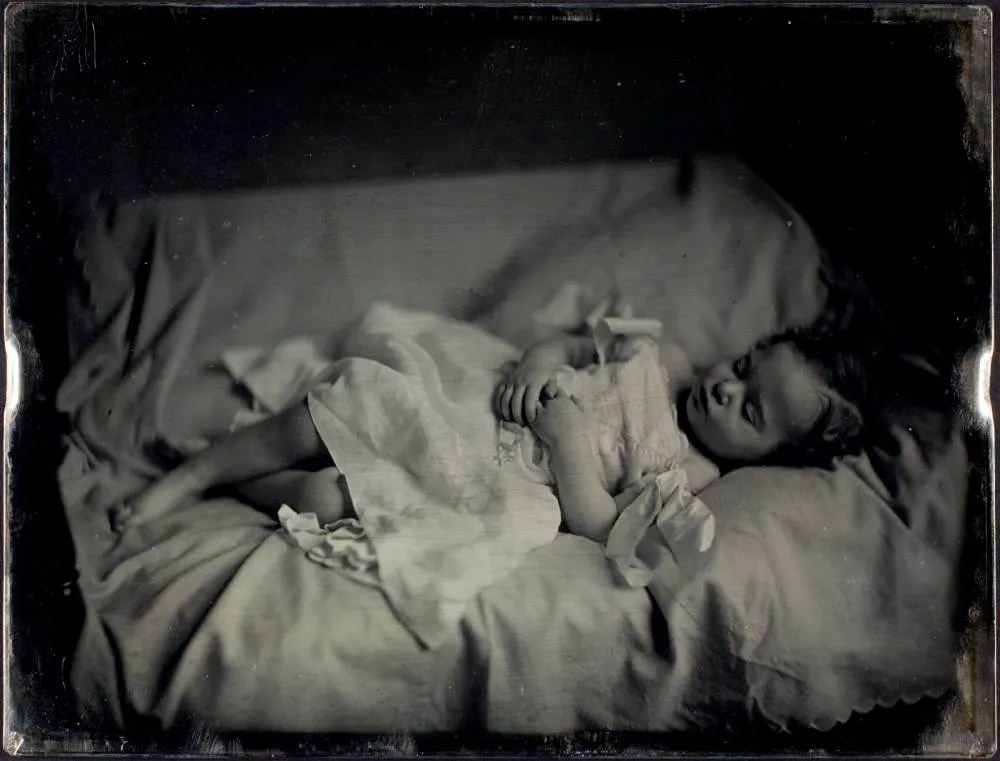
What we are short of is the person’s own account of themselves. Look again at the photograph at the top of this page. It was taken by Southworth & Hawes, one of the finest portrait studios in nineteenth-century Boston. The plate has survived for more than 170 years in good condition. And its catalogue title is “Post-mortem, unidentified young girl”. Her parents secured her shadow. Within a few generations her name was gone. The same thing happens to ordinary family photographs all the time: archives are full of well-preserved portraits labelled unidentified family, because the image survived and the person who could explain it did not.
We know Charley Stowe’s name only because his mother became one of the most famous writers in America. We know nothing of what he was like. Almost no one in the nineteenth century, adult or child, left behind their own voice telling their own story. They could not. The technology to record a person speaking, moving and laughing did not reach ordinary households until long after they were gone.
What would the Victorians make of what we have?
I have filmed more than a hundred life stories since 2020, including Holocaust survivors in their nineties and, before she died, four hours with my own grandmother. What strikes me, thinking about these daguerreotypes, is how much the Victorians would have given for what we take for granted. A family in 1849 would have treasured a single picture of their child. We could have hours of our parents and grandparents talking about their lives, in their own words, with their own expressions. The tools cost almost nothing and are already in our pockets.
Yet the Victorians and we share one habit. They acted only when death forced them to. A family that had never thought to photograph a living child sent for the photographer within hours of the death. We do the same with stories: we assume there will always be another visit, another Christmas, another chance to ask, and the realisation that there will not usually arrives at the funeral. The difference is that the Victorians, at that point, could still secure the shadow. A story cannot be recorded after the person who knew it has died.
That is the real lesson of Victorian post-mortem photography. It was not about death. It was about a family deciding that a person should not disappear without a trace, and doing the one thing then available to prevent it. The thing available to us is far better than a photograph of a face at rest. It is the person, alive, telling you who they were.
The Everyone app was built for that: one question at a time, each answer kept as a short video for the family. But any phone will do. The Victorians had to wait for a death to act. We do not, and the old reminder that time is limited is most useful when it applies to the people we love, while they can still answer.