The Fayum mummy portraits, and faces without stories.
The Fayum mummy portraits are the most lifelike faces to survive from the ancient world. We can date their hairstyles, but we cannot hear a word they said.
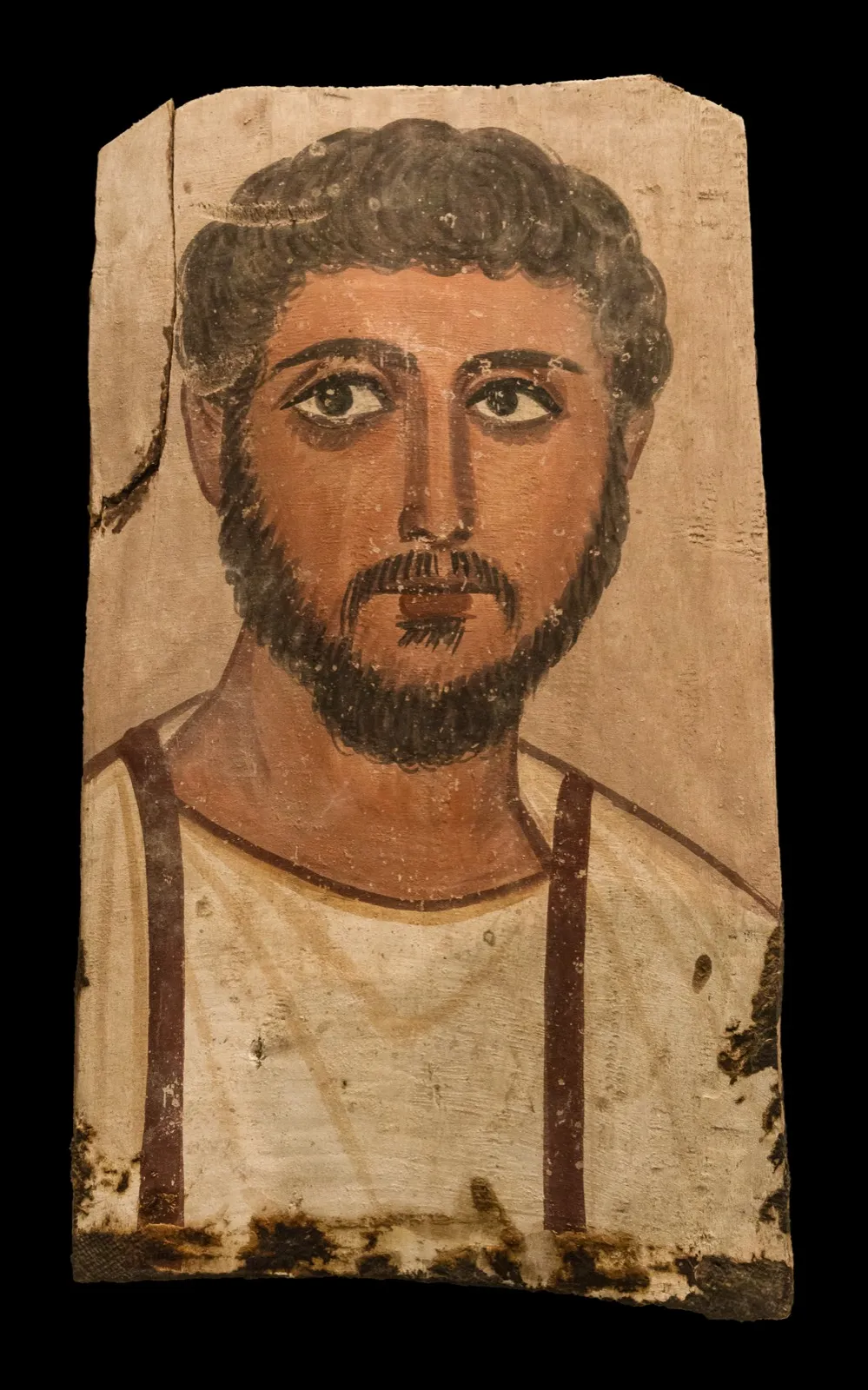
In the British Museum there is a mummy wrapped in a reddish case decorated in gold leaf. Over its face is a portrait of a young man with short dark curls, painted on a thin wooden panel in hot beeswax. He looks out with the slightly wary expression of someone sitting for a picture he did not ask for. Across the chest, in Greek, are two words: Artemidorus, farewell.
He was found at Hawara, in Egypt, and he died in the early second century AD, probably at about twenty, judging from scans of the body inside. We know his name, his age, roughly when he lived and exactly what he looked like. We know nothing else about him at all.
Artemidorus is one of the Fayum mummy portraits, a group of around a thousand painted faces from Roman Egypt. They are the most lifelike images of ordinary people to survive from the ancient world, and to look at them is a strange experience: people who died nearly two thousand years ago look back at you as if they might start speaking. They never do. That silence is the subject of this piece, because it is a more precise lesson than it first appears. The Fayum portraits show exactly what a face can preserve, and exactly what it cannot.
What are the Fayum mummy portraits?
From roughly the first to the third century AD, some families in Roman Egypt adopted a new way of burying their dead. The body was mummified in the traditional Egyptian manner, but instead of a stylised mask, a realistic portrait painted on a wooden panel was bound into the wrappings over the face. Most were painted in encaustic, pigment suspended in melted beeswax, which gives the skin a depth and sheen that still looks fresh. Others were painted in tempera.
They are named after the Fayum, the fertile basin south-west of Cairo where many were found, although examples have turned up across Egypt. The people in them belonged to a mixed society: descendants of Greek settlers who had arrived after Alexander the Great, Egyptians, and Romans, often intermarried. Artemidorus is typical. His name is Greek, his portrait is in the Roman style, and his case shows Egyptian gods attending his body.
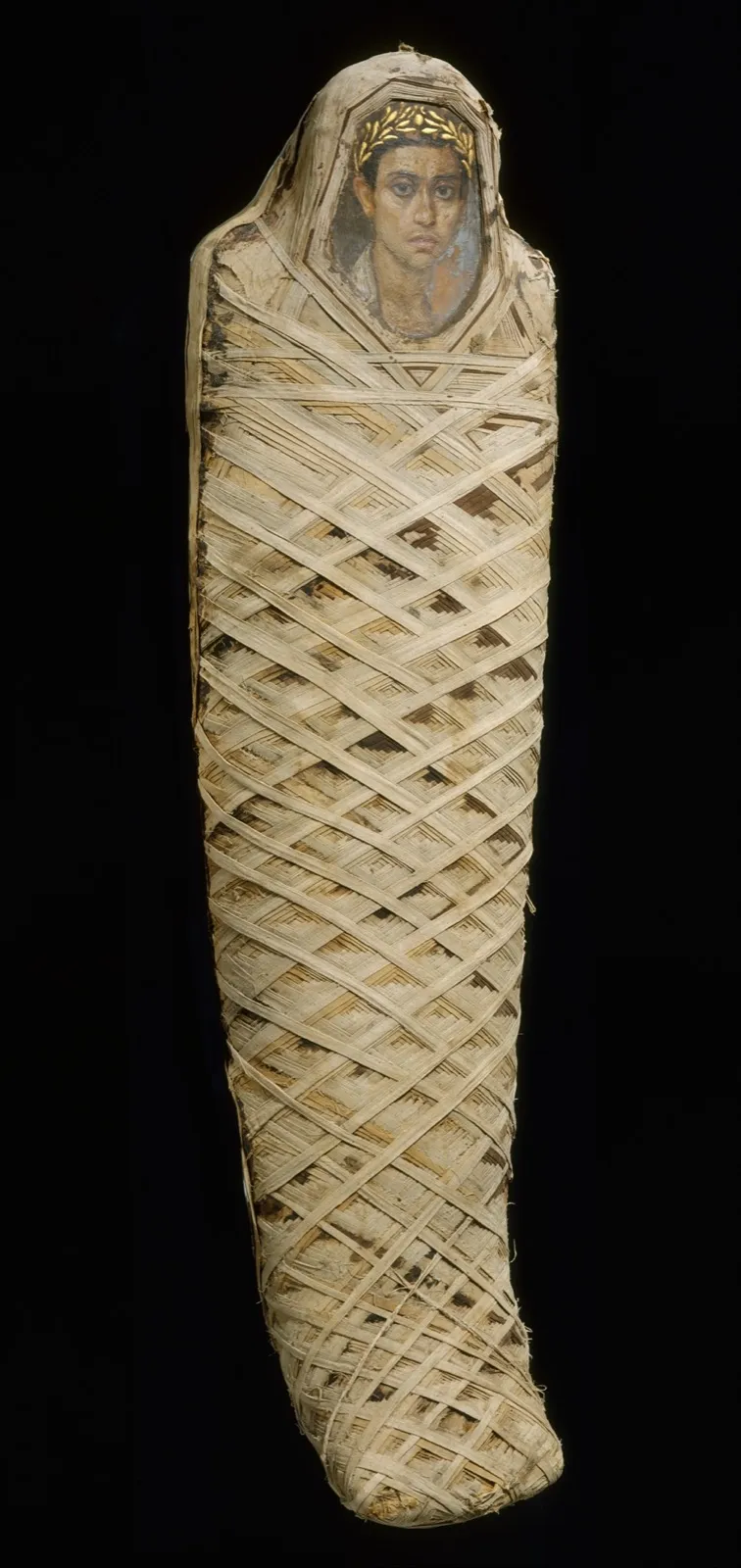 Mummy with an inserted panel portrait of a youth, from Hawara, AD 80–100. The Metropolitan Museum of Art, New York. CC0.
The portraits came to wide attention in the late 1880s. In 1887 the Viennese dealer Theodor Graf acquired a large hoard, usually put at more than three hundred panels, said to come from a cemetery at er-Rubayat. The following year the archaeologist Flinders Petrie excavated the cemetery at Hawara and found dozens more; across his seasons there, the Petrie Museum in London counts about 146 portraits. Today they are scattered through museums around the world.
Why do the Fayum portraits look so modern?
The first reaction of almost everyone who sees them is that they do not look ancient. They look like people you could pass in the street. There are three reasons for this, and each says something about what the portraits were for.
They were meant to be recognisable. Earlier Egyptian funerary art showed the dead as an ideal: young, calm, interchangeable. The Fayum painters drew on the Greek and Roman tradition of individual portraiture instead. Faces are asymmetrical. Noses are crooked. Some men have stubble or thinning hair. The point was not to show a perfect soul but this particular person.
They follow fashion closely. Art historians date many of the portraits by comparing the sitters’ hairstyles and jewellery with dated portraits of Roman emperors and empresses on coins and statues. A woman with her hair piled in tight curls on top of her head was following a style worn at court in the late first century; a man with a full beard probably lived after the emperor Hadrian, who came to power in AD 117, made beards fashionable. People in a provincial town on the edge of the desert copied the looks of Rome, much as people today copy celebrities. That makes them feel familiar, because it is exactly what we do.
Some may have been painted from life. Petrie found at least one portrait in a wooden frame, lying beside a mummy rather than wrapped into it, which suggested to him that some panels hung in the family home while the sitter was alive and were placed in the burial afterwards. Scholars still debate how common this was, and some portraits were clearly painted after death. But the idea is plausible, and it would mean that at least some of these faces were household objects before they were grave goods: the ancient equivalent of the framed photograph on the mantelpiece.
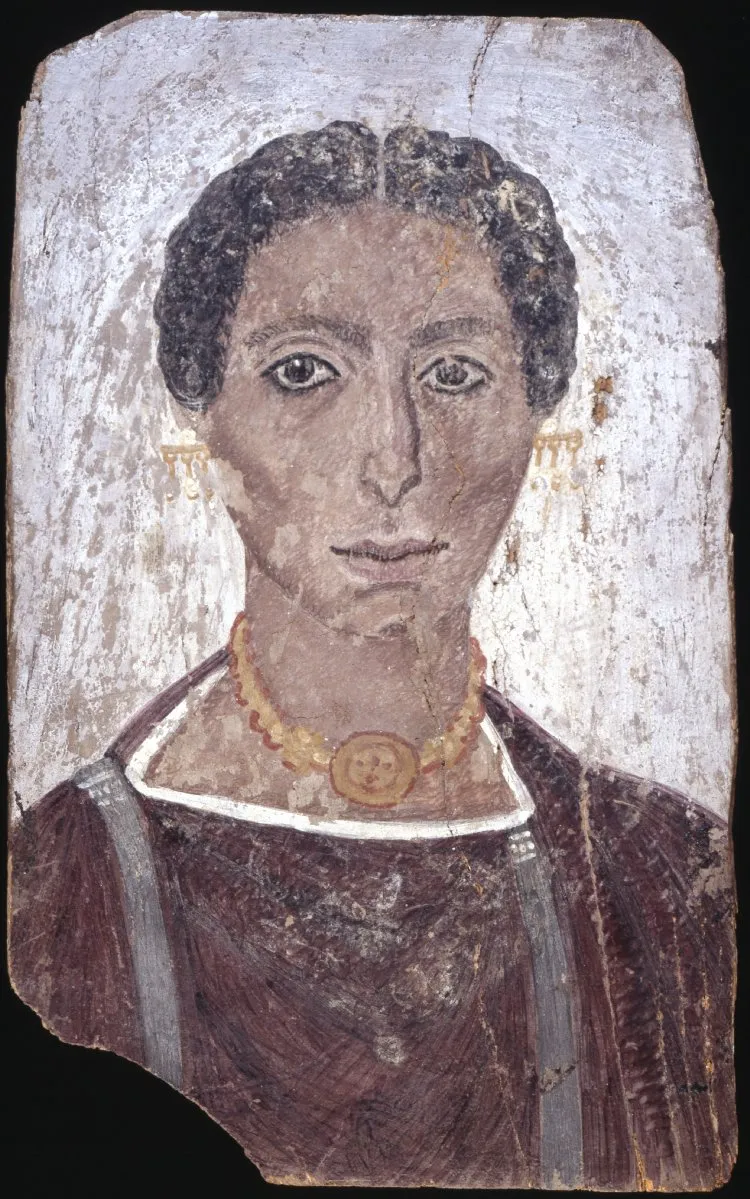 Funerary portrait of a woman on an oak panel, Roman Egypt, about AD 200. British Museum. Public domain.
What do the faces tell us, and what do they not?
Taken together, the portraits are a remarkable historical source. They tell us how people in Roman Egypt dressed, what jewellery they wore, how they cut their hair, roughly how old they were when they died, and that a fair number of them died young. With CT scanning, researchers can sometimes compare a face with the skull beneath it, and in some cases estimate age and health.
Now consider what they do not tell us. We do not know what a single one of these people believed, feared or found funny. We do not know whom they loved, what work they did, which decisions they regretted, or what they would have wanted their grandchildren to know. Most do not even have a name: only a minority of the panels and mummies carry an inscription.
This is the gap at the centre of the Fayum portraits. They give us an extraordinary amount of the outside of a person and almost nothing of the inside. A face, however well painted, records what someone looked like and how they wished to be seen. It does not record who they were.
The way the portraits reached us made the gap wider. Many were bought from dealers rather than excavated, and according to most accounts the diggers who supplied the trade in the nineteenth century prised the panels off the mummies and left the bodies behind. With the body went the case, any inscription, the grave goods and the record of where and with whom the person was buried. Museum labels for hundreds of these panels read, in effect, portrait of a man or portrait of a woman. The face survived; the little that was left of the person was thrown away.
Why did their families stop at a face?
It would be easy to say that the families of Roman Egypt did not care about their relatives’ inner lives. The opposite is more likely. Commissioning a portrait from a skilled painter was expensive, and wrapping it into a mummy was an act of considerable devotion. They kept what the technology of their time allowed them to keep.
For a person to leave behind more than a face, someone had to write, and writing a life was rare and costly. Literacy in Roman Egypt was limited, papyrus was not cheap, and biography was a genre for emperors, generals and philosophers. A family could pay a painter to capture a face in an afternoon. No one could capture a voice, a manner, a way of telling a story. That stayed inside the person until they died, and then it went with them.
The ancient Egyptians had a word for what happened next. They believed a person could die twice: once when the body failed, and again when they were no longer remembered. The Fayum families went to great lengths to prevent the second death, and in a narrow sense they succeeded. We still look at their faces. But looking at someone is not the same as knowing them, and in the sense that matters most, almost all of these people have died the second death anyway.
Are we making the same mistake?
The Fayum portraits have an odd modern parallel. Nineteenth-century families who photographed their dead, as the history of Victorian post-mortem photography shows, faced the same limit: they could keep a face, and very little else. Families today face the reverse situation, and most have not noticed.
We are the first people in history with no technical reason to stop at the face. A phone records a person moving, speaking, pausing, laughing and changing their mind, in their own words, and it costs nothing. Yet most of what we keep of our parents and grandparents is still, in effect, a Fayum portrait: thousands of photographs that show exactly what they looked like at a birthday or on a beach, and almost no recording of them explaining who they were. If our descendants find those photographs in two hundred years, they will be in the position of a museum visitor in front of Artemidorus. They will see a face that looks as if it might start talking. It will not.
I have filmed more than a hundred life stories since 2020, including Holocaust survivors and, before she died, four hours with my own grandmother. The pictures I have of her are lovely. The recording is something else. In it she is not a face; she is a person telling me what happened, in the order she chose, with the jokes she always made. That is the part the painters of the Fayum could never capture, however skilled they were, and it is the part most families still leave unrecorded.
The Fayum portraits are a reminder that people have always wanted those who come after them to see them as they were. What has changed is how much of a person can now be kept. A face was the best the people of Roman Egypt could do. We can keep the story as well, and it takes only someone willing to ask the questions and press record. That is what we built the Everyone app for, but any phone will do. The important thing is not to stop at the face.