The Lysenko brothers. Ten went to war, ten came home.
All ten Lysenko brothers of Brovakhy, Ukraine, fought in World War II and all ten came home. The story of their mother, Yevdokia, and what her family kept.
On a hill in the centre of Brovakhy, a village in the Cherkasy region of central Ukraine, stands the figure of a peasant woman in an apron and headscarf. She is looking into the distance, down the road. Around her grow fifteen trees: ten poplars and five willows. The inscription on the pedestal reads, in Ukrainian, “Pause in thought, lay flowers for her, as a tribute to the mothers of the whole world.”
The woman is Yevdokia Danylivna Lysenko. The ten poplars are her sons, every one of whom fought in the Second World War. The willows are her five daughters. What makes the monument unusual is not that her sons went to war. Millions of mothers sent sons to that war. It is that all ten of the Lysenko brothers came home.
This is the story of that family, as far as it can still be reconstructed. It is also a story about how fragile such stories are. The Lysenko brothers became famous enough to earn a bronze statue, a village museum and a place in Ukraine’s national war museum. Yet when the sculptor came to make the statue of their mother, two decades after her death, he had no good likeness to work from, and modelled her face partly on one of her daughters.
Who was Yevdokia Lysenko?
Most of what we know comes from an article published in 2016 by Svitlana Datsenko, a senior researcher at the National Museum of the History of Ukraine in the Second World War in Kyiv, who visited the surviving family in Brovakhy in 2002 and recorded what they told her. Other accounts, in Ukrainian regional press and elsewhere, add details and occasionally contradict one another. Where they disagree, I have said so.
Yevdokia and her husband, Makar Lysenko, had sixteen children: eleven sons and five daughters. By the account of their son Stepan, the family had once been prosperous by village standards. “They had seven hectares of land,” he told Datsenko, “cows, horses, oxen, and perhaps fifty sheep.” In the early 1930s, when the Soviet state forced Ukrainian peasants into collective farms, Makar refused to farm collectively. The land was taken anyway, and then came the famine of 1932–33, the Holodomor, in which several million Ukrainians died. Makar died during those years; one account dates his death to 1933.
The eldest son, Yavtukh, also disappeared in that decade. The family’s accounts of what happened to him differ: one says he left for Kyiv to look for work in 1933 and was never heard from again; another that he went to the Soviet Far East before the war and that a letter sent to him came back marked “addressee departed”. Either way, he never came home. When people say Yevdokia had ten sons at the front, they mean the ten who were left.
So by 1941 Yevdokia was a widow who had already lived through collectivisation and famine, with a household of children in a village that would soon be occupied by the German army.
Who were the Lysenko brothers?
Five of the brothers were called up in 1941, when Germany invaded the Soviet Union. The other five went to the front in 1943 and 1944, called up from territory the Red Army had retaken. One regional account says all ten went at once; the museum researcher’s account of two waves is the more detailed and more plausible. Their service, as recorded by Datsenko and in other accounts, ran roughly as follows.
- Feodosiy, about thirty in 1941, a scout. He fought through Ukraine, Moldova, Romania and Hungary. Near Budapest his group of divisional scouts walked into a minefield, and he lost a leg.
- Petro, a telephone operator, had been in the army since 1938 and served in the Far East, where by his brother’s account he lost a hand. He came home in 1946.
- Ivan had already fought in the Winter War against Finland. In 1941 he defended Cherkasy and Kyiv, was captured, and escaped from a column of prisoners, by the family’s account bound for Treblinka. He walked for about three months to get back to Brovakhy, returned to the front in 1944, won the medal For Courage, and finished the war in Vienna.
- Vasyl was the only officer among them, a senior lieutenant commanding a rifle platoon. He was wounded three times and awarded the Order of the Red Star.
- Mykhailo, an infantry scout, was encircled and captured near Kaniv in 1941, escaped, and was back at the front by 1944. In Romania he took three prisoners and was awarded the Order of the Red Star; near Debrecen in Hungary he knocked out two machine-gun positions and took seven more, earning the Order of Glory, third class. Seriously wounded near Miskolc, he spent Victory Day in a hospital in Yerevan.
- Stepan was a tank crewman. His tank burned in the defensive battles near Smolensk. He was wounded in East Prussia, then sent east for the war against Japan, which ended before he arrived.
- Mykola, twenty years old in 1943, had been a tractor driver. He fought for barely three weeks in December 1943 before both his legs were badly wounded near Zhytomyr. One account says he survived an explosion that killed seven of his comrades.
- Pavlo was taken to Germany as a forced labourer in 1943 and spent two years there before being freed by the 1st Ukrainian Front, with which he then served until the end of the war.
- Andriy was taken for forced labour in Germany at seventeen, in 1942, and escaped after about a month. Mobilised in 1944, he was badly wounded near Iași in Romania and came home without a leg.
- Oleksandr, the youngest, was fourteen when the war began. He served as a signals sergeant all the way to Berlin, and was decorated for repairing five breaks in a communication line under fire. Family tradition holds that he signed the walls of the Reichstag on behalf of all his brothers.
Five of them came home disabled: Feodosiy, Petro, Mykhailo, Mykola and Andriy. As Petro put it, in a line the family repeated: “The Lysenkos went from the Kurils to Berlin. That is our geography.”
How unlikely was it that all ten survived?
The Soviet Union’s losses in the war were so large that they are difficult to hold in the mind. The most widely cited official study, led by the Russian military historian Grigori Krivosheev, put the number of people mobilised into the Soviet armed forces at about 34.5 million and military deaths at about 8.7 million. Other historians argue the true figures are higher. Taken at face value, roughly one in four Soviet servicemen did not come back.
Suppose, crudely, that each Lysenko brother had a three-in-four chance of surviving, and that their fates were independent. The chance that all ten would come home is 0.75 multiplied by itself ten times, or about 6 per cent. The real odds were almost certainly worse. Several of the brothers were infantrymen and scouts, among the most dangerous jobs in the army; two were captured in 1941, when Soviet prisoners of war died in German captivity in enormous numbers; and Ukraine itself was a battlefield, occupied, fought over twice and stripped of labour.
This is why the story spread. In a country where almost every family had a gap at the table, a mother who had sent ten sons and received ten sons back was something close to a miracle. Datsenko writes that such a case was unique not only in Ukraine but across the former Soviet Union. That claim is impossible to verify, but it captures how the story was received.
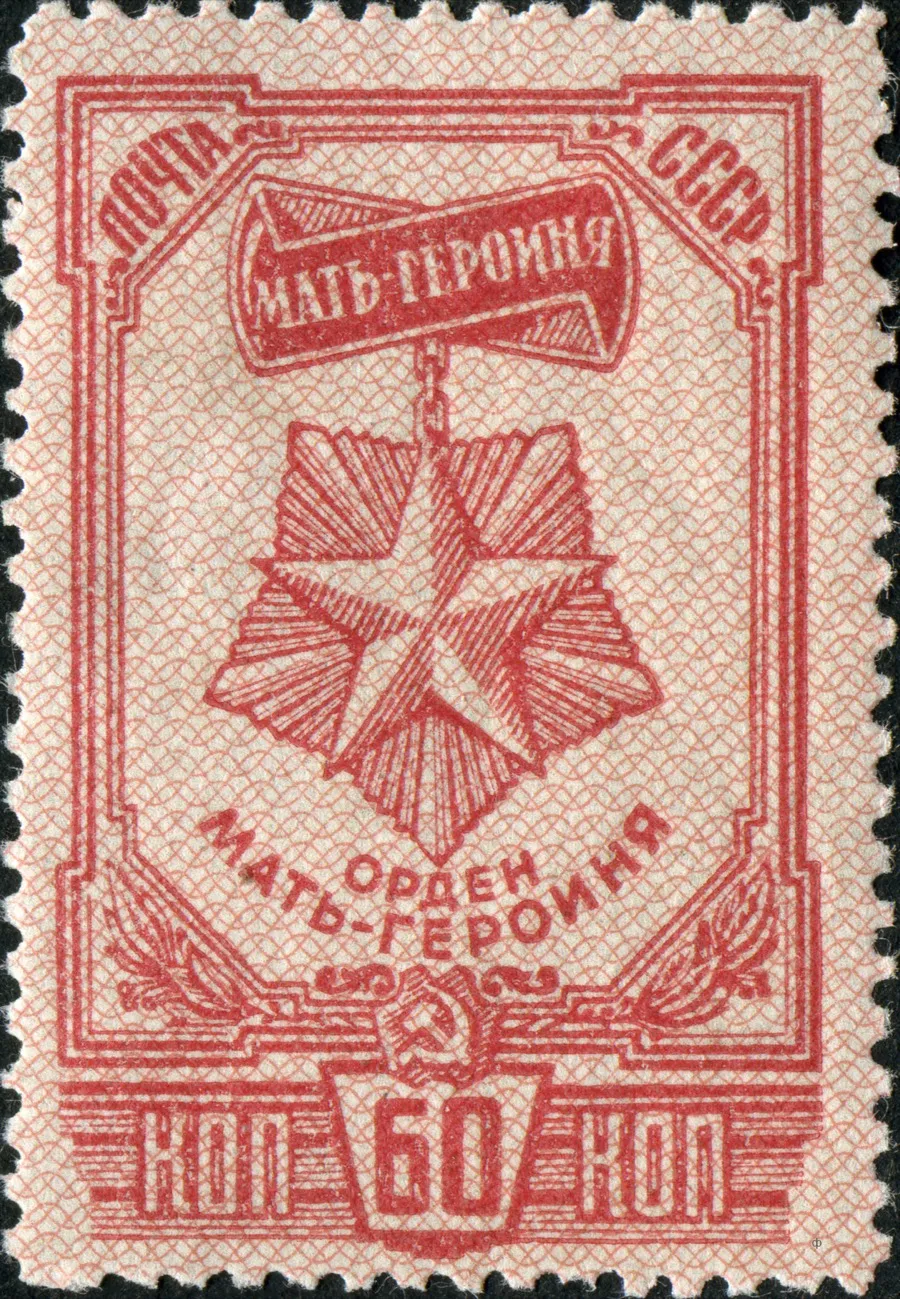 Soviet postage stamp showing the order of the “Mother Heroine”, 1945. Public domain.
How did the brothers come home?
They did not come home together. Mykola, the most recently mobilised, was the first: wounded in December 1943, he was sent home from hospital in 1944. Petro returned in 1946. Pavlo came back in 1947, the second to last, so changed that his mother did not recognise him at first; she had believed he was dead. Stepan, by one account, was the last of all, also in 1947.
Some of the most human details are about the brothers finding each other. Mykhailo and Feodosiy met by chance at the front in 1944, near Chișinău by one account and near Iași by another. “I jumped into the trench where he was and hugged him,” one of them later recalled. “We both cried.” After the war Stepan and Mykhailo, who had not seen each other for seven years, almost walked past each other on the road. Stepan married four days after he got home. The girl had waited seven years for him, even though, the family said, he never wrote her a single letter.
What did their mother do while they were away? The villagers remembered that Yevdokia never cried during the war. She only prayed that her children would come home, wounded or maimed, as long as they were alive. Pavlo told Datsenko that when she saw each son off to the front, she sprinkled him with holy water and gave him a small lump of earth from home to carry. It is the kind of detail that survives only because someone thought to ask.
What does the museum hold?
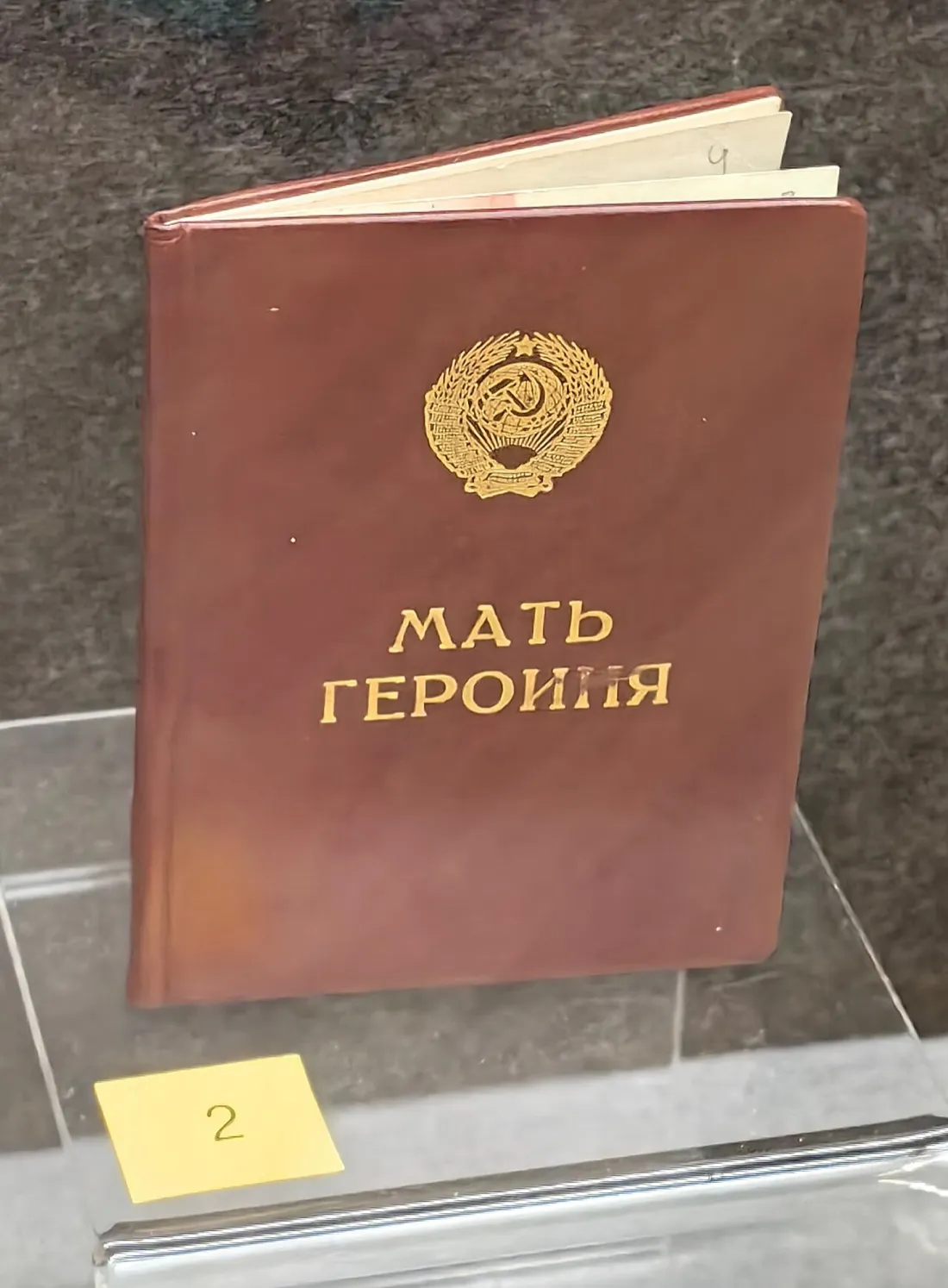
In 1946 Yevdokia was awarded the honorary title of “Mother Heroine”, a Soviet distinction created by decree on 8 July 1944 for women who had borne and raised ten or more children. Her certificate, number 013396, issued by the Presidium of the Supreme Soviet of the USSR, is now on display in the National Museum of the History of Ukraine in the Second World War in Kyiv, along with other family belongings.
When Datsenko visited in 2002, the certificate was still with the family. Yevdokia’s daughter took it down from the highest shelf of the cupboard, wrapped in a white kerchief. She explained that she was wary of showing it, because people asked and things got stolen, but that she trusted her visitors: “You came with bread; you are good people.”
The objects that survive are ordinary ones. The museum’s photographs include a worn wooden salt box in which Yevdokia kept her sons’ letters from the front, and her festive headscarf. In 1984, the year the statue went up, the village school opened its own museum. Its centrepiece is a row of ten soldiers’ greatcoats and the army boots in which the brothers came home. Accounts differ on exactly how many boots there are, and that is fitting: two of the brothers came home with one leg.
Why did the sculptor not know her face?
Yevdokia died in March 1967, in her seventies. According to Datsenko, before she died she gathered all her children, cooked them a meal, and asked her sons to live in harmony with one another. The monument was not built until 1984, after the story was taken up by the Soviet newspaper Literaturnaya Gazeta. By then she had been dead for seventeen years, and the sculptor drew on a daughter’s resemblance to her.
This is the part of the story that stays with me. The Lysenkos are, by the standards of ordinary families, extraordinarily well documented. There are photographs of the brothers together on Victory Day, medals, a certificate in a national museum, a village museum, a bronze statue and articles in several languages. And still, the central figure is almost silent. We have the villagers’ memory that she did not cry. We have a few things she did. We have almost nothing she said. Her face survives in bronze because her daughter happened to look like her.
The brothers’ stories survived better, and for a clear reason: they lived long enough to tell them, and someone came to listen. When Datsenko visited in 2002, three of the brothers and a sister were still living in the village. By 2016, she wrote, only Stepan, then ninety-four, and his sister Hanna were left of Yevdokia’s sixteen children. Almost everything in this piece that is not a date or a medal comes from those conversations.
What the Lysenko story asks of the rest of us
It is tempting to read the story of the Lysenko brothers as a story about luck, or faith, or a mother’s love, and the family has read it in all those ways. But it is also a story about a common pattern in how history is kept. The extraordinary is remembered; the ordinary voice inside it is lost. The war is recorded in medals and casualty figures. What it was like to wait for ten sons, and to recognise the ninth one only on second look, was recorded only when someone sat at a kitchen table and asked.
Most families have no statue and no museum. They have, at most, a box of letters and a few people who remember. If you have a grandparent or great-grandparent who lived through that war, the questions are worth asking now (I gathered some in questions to ask grandparents about WW2). For why ordinary people’s accounts so often vanish from history altogether, see ordinary people in history.
The Lysenkos were lucky twice: once in the war, and once in having a story remarkable enough that people came to record it. Today almost anyone can record a parent’s face and voice on a phone, and apps such as Everyone are built to make that easy, one question at a time. Yevdokia Lysenko’s family had to borrow her face from her daughter. No family needs to do that now.