The Voyager Golden Record was made for strangers. Your story has a better audience.
The Voyager Golden Record is built to last a billion years, and will almost certainly never be played. What it teaches about messages to the future.
Some time on 18 November 2026, Voyager 1 will become the first human-made object to sit one light-day from Earth. A radio signal sent to it then will take twenty-four hours to arrive. The spacecraft was launched in September 1977, and its power is now so low that NASA has switched off all but two of its science instruments. Within a decade or so it will fall silent altogether.
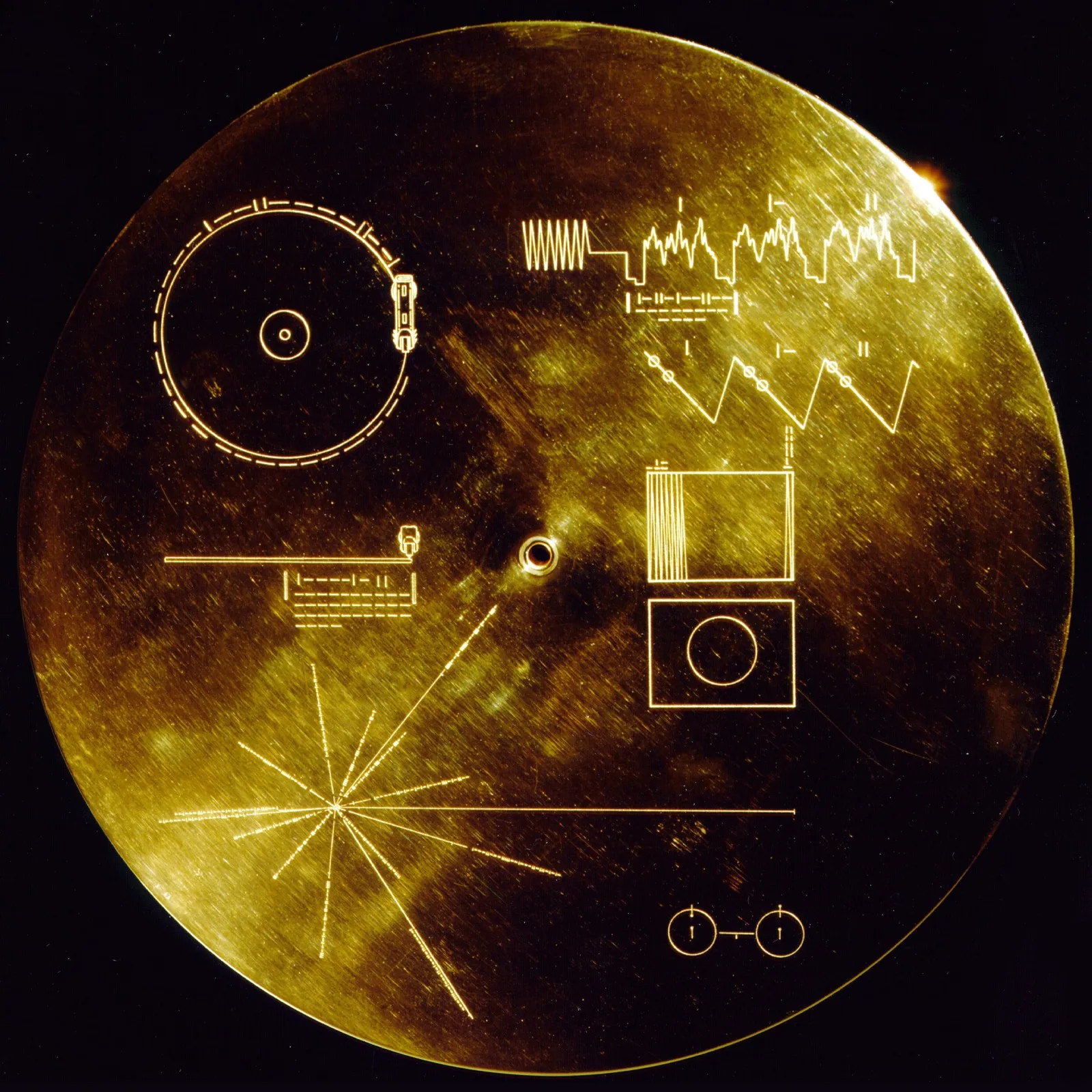
It will keep travelling. Bolted to its side is a twelve-inch disc of gold-plated copper, the Voyager Golden Record, carrying pictures, music, greetings and the sounds of Earth. Its twin is on Voyager 2. Together they are the most carefully considered message humanity has ever addressed to the far future, built to survive in space for something like a billion years.
They will almost certainly never be played. That is the interesting part. The Golden Record is a near-perfect solution to one half of the problem of being remembered, and almost no solution to the other half. Most of us have the opposite problem, and it is far easier to fix.
What is on the Voyager Golden Record?
The record was put together in 1977 by a small committee chaired by the astronomer Carl Sagan, on a tight deadline before launch. Ann Druyan was its creative director and Timothy Ferris its producer; the radio astronomer Frank Drake, the artist Jon Lomberg and the writer Linda Salzman Sagan also worked on it.
Each disc holds 115 images encoded as sound, greetings in 55 languages, a roughly twelve-minute montage of the sounds of Earth, and about ninety minutes of music, from Bach and Beethoven to Chuck Berry’s “Johnny B. Goode” and a clan song from Arnhem Land in northern Australia. The protective cover carries engraved instructions showing how to play the record with the stylus packed beside it, and a map locating our Sun relative to fourteen pulsars.
The committee had to answer an impossible question: how do you summarise a species for someone who knows nothing about it? Their answer is worth looking at closely, because it is the same question anyone faces when they try to record a life.
Who was the Golden Record really for?
Sagan was candid about the odds. In a statement at the time, he said the spacecraft would be encountered and the record played “only if there are advanced spacefaring civilizations in interstellar space”. He then added that launching this bottle into the cosmic ocean “says something very hopeful about life on this planet”.
That second sentence gives the game away. Voyager 1 will not pass close to another star for tens of thousands of years, and space is so empty that the chance of anyone intercepting a disc the size of a dinner plate is close to nil. Even if someone did, they would need to understand the diagrams, build a turntable, and make sense of sounds produced by a species they have never met. The record’s real audience was always the people who made it, and the people on Earth who heard about it.
There is no shame in that. Messages to the future often work this way. The organisers of the great time capsules of the twentieth century were also, in part, speaking to their own generation about what it valued. But it does expose a principle that applies to every message we leave behind.
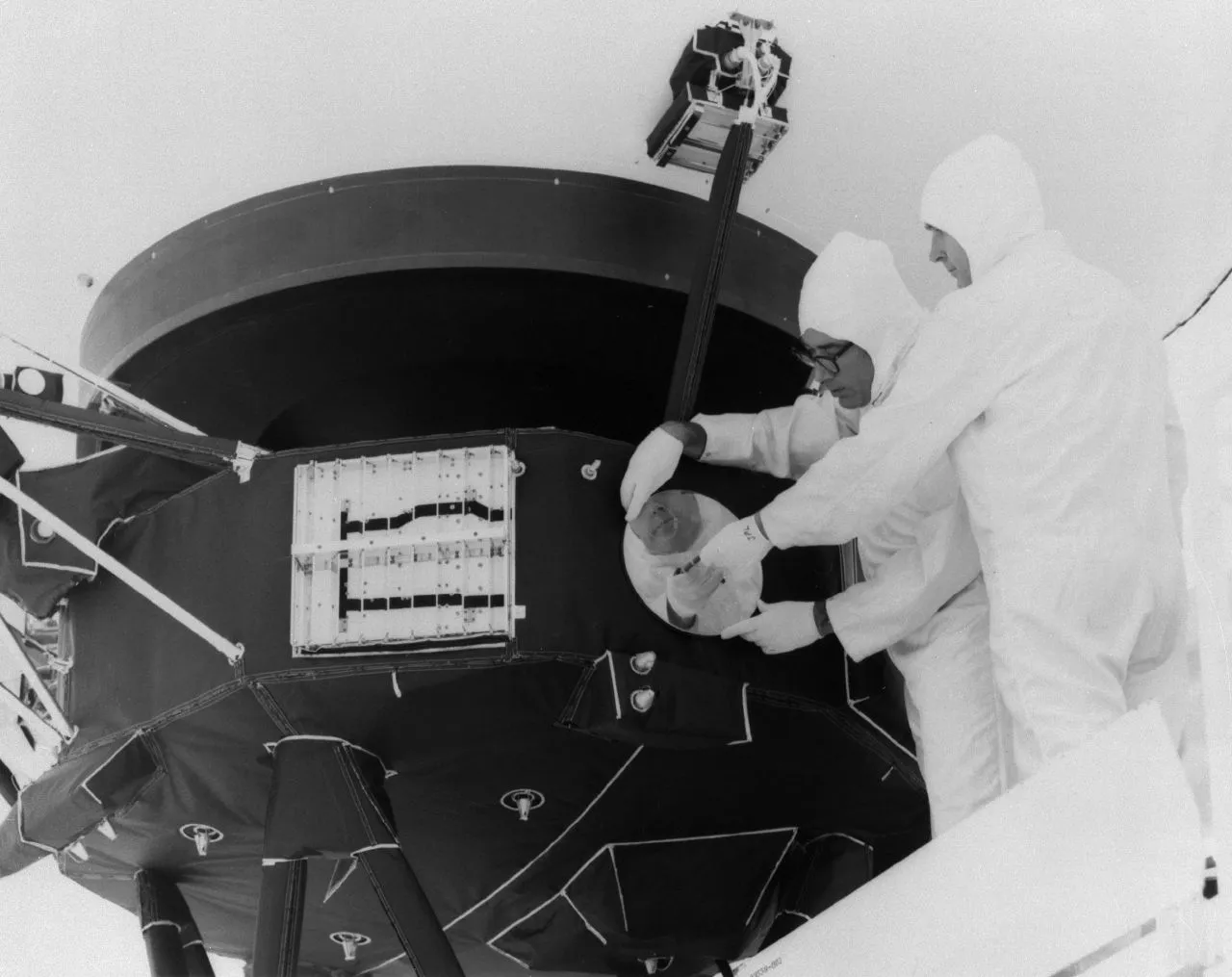 Technicians mounting the Golden Record on a Voyager spacecraft, 1977. NASA/JPL. Public domain.
Why most messages to the future fail
Whether a message reaches the future depends on three things multiplied together: whether it survives, whether anyone looks for it, and whether the person who finds it can understand it. If any one of these is close to zero, the whole thing is close to zero, no matter how well the other two are done.
The Golden Record maximises the first. Gold does not corrode, and in the vacuum between the stars there is almost nothing to wear it away. Its makers also worked hard on the third, which is why the cover is a diagram rather than a sentence. But the second factor, whether anyone is looking, is something they could do nothing about. It is a message of extraordinary durability sent to an audience that may not exist.
Ordinary family records have the reverse profile. The audience is not in doubt. Your grandchildren, and their children, will want to know who you were; people trace their ancestry in enormous numbers precisely because that curiosity is so common. They will share your language, recognise your gestures and know exactly what a laugh means. What is usually missing is the message itself. Most people leave behind a scattering of photographs and a name, and the descendants who want to know them have almost nothing to go on. (I wrote about how quickly this happens in you have sixteen great-great-grandparents: most of us cannot name them.)
The Golden Record has a perfect message and no reader. Most families have eager readers and no message.
What did the committee choose to keep?
The most revealing thing about the record is where its makers ended up when they tried to represent all of humanity. They did not settle for summaries. Again and again, they reached for particular people.
The English greeting is not a statement from a head of state. It is Sagan’s young son, Nick, saying “Hello from the children of planet Earth.” The greeting in Amoy, a Chinese dialect, is a woman asking, in NASA’s translation, “Friends of space, how are you all? Have you eaten yet? Come visit us if you have time.” It is the kind of thing you would say to a neighbour, and that is precisely why it is moving. Among the sounds of Earth are footsteps, laughter, a kiss, and a mother with her child.
The strangest item is Ann Druyan’s brainwaves. On 3 June 1977, at a hospital in New York, she was connected to an EEG for an hour while she meditated on a set of prepared thoughts, and the recording was compressed into about a minute of sound. She has said in interviews that among the things she thought about was what it is like to fall in love; she and Sagan had decided to marry only days earlier.
That minute captures something real and important to her. It is also, in practice, unreadable. No one on Earth, let alone elsewhere, can listen to it and recover what she felt. The intention is personal; the format is not.
What can a face do that a signal cannot?
This is the second lesson, and it applies directly to how we record the people we love.
The committee’s instinct to include individual voices and faces was right. The more particular a record is, the more it carries. A list of facts about a person survives in the way a name on a gravestone survives: accurately, and almost emptily. A greeting about whether you have eaten yet tells you something about the speaker that no summary could.
But a record also has to be legible to the people who will receive it. The brainwaves fail that test, and so, in a gentler way, does a great deal of what families keep. A box of unlabelled photographs is meaningful to the person who took them and a puzzle to everyone else. A diary written in a private shorthand is a kind of EEG.
Human beings come equipped with an extraordinary decoder for one format in particular: another person’s face and voice. We read tone, hesitation, warmth and humour in fractions of a second, without instruction. A descendant watching a video of you talking about your childhood does not need a diagram on the cover. They need only to press play. This is why I have argued that video is the most future-proof way to record a life: it is the format the receiver is built to understand.
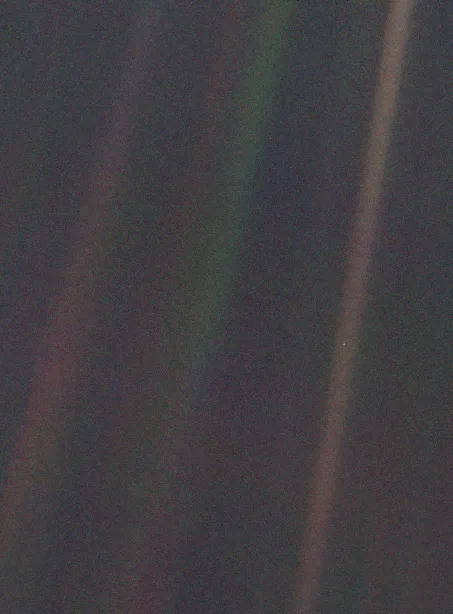 The “Pale Blue Dot”: Earth photographed by Voyager 1 from about six billion kilometres away, 14 February 1990. NASA/JPL. Public domain.
The message with a guaranteed audience
In February 1990, at Sagan’s urging, Voyager 1 turned its camera back towards home and photographed Earth as a single pale pixel. Sagan later reflected that everyone you love, everyone you know, every human being who ever was, lived out their lives on that mote of dust.
It is easy to take the wrong lesson from that image, that any one life is too small to matter. The Golden Record suggests the opposite. When a group of very thoughtful people tried to say something true about the whole species, they reached for a child’s hello, a neighbourly question about dinner, and a woman thinking about falling in love. The general was conveyed through the particular.
A record of a single life does not need to travel between the stars, and it does not need to last a billion years. It needs to last a few generations, and to be kept in a format people can still open, which mostly means copying it forward as technology changes. In exchange, it has something the Golden Record will probably never have: an audience that is certain to exist and wants to hear it.
I have four hours of my grandmother telling me her life story. She has since passed away. It will never leave the solar system, and nobody will engrave instructions on it. It has already been watched by more people who loved her than the Golden Record is likely ever to reach.
That is the difference between a message for strangers and a message for family. If you want to make one, the hardest step is the first: sitting someone down and asking. Everyone, a free app for filming family life stories on video, is designed to make that step easier. But a phone, a quiet room and a list of good questions are enough. The Voyager team had a fixed launch date by which to summarise humanity. You have a little longer to capture one person, though not as long as it feels. If you are not sure what to ask, how to capture someone’s life story is a good place to start.