Hearing a loved one’s voice after they have died.
People keep old voicemails for years and visit stations to hear a dead husband’s voice. Why the voice matters so much, and why we save it only by accident.
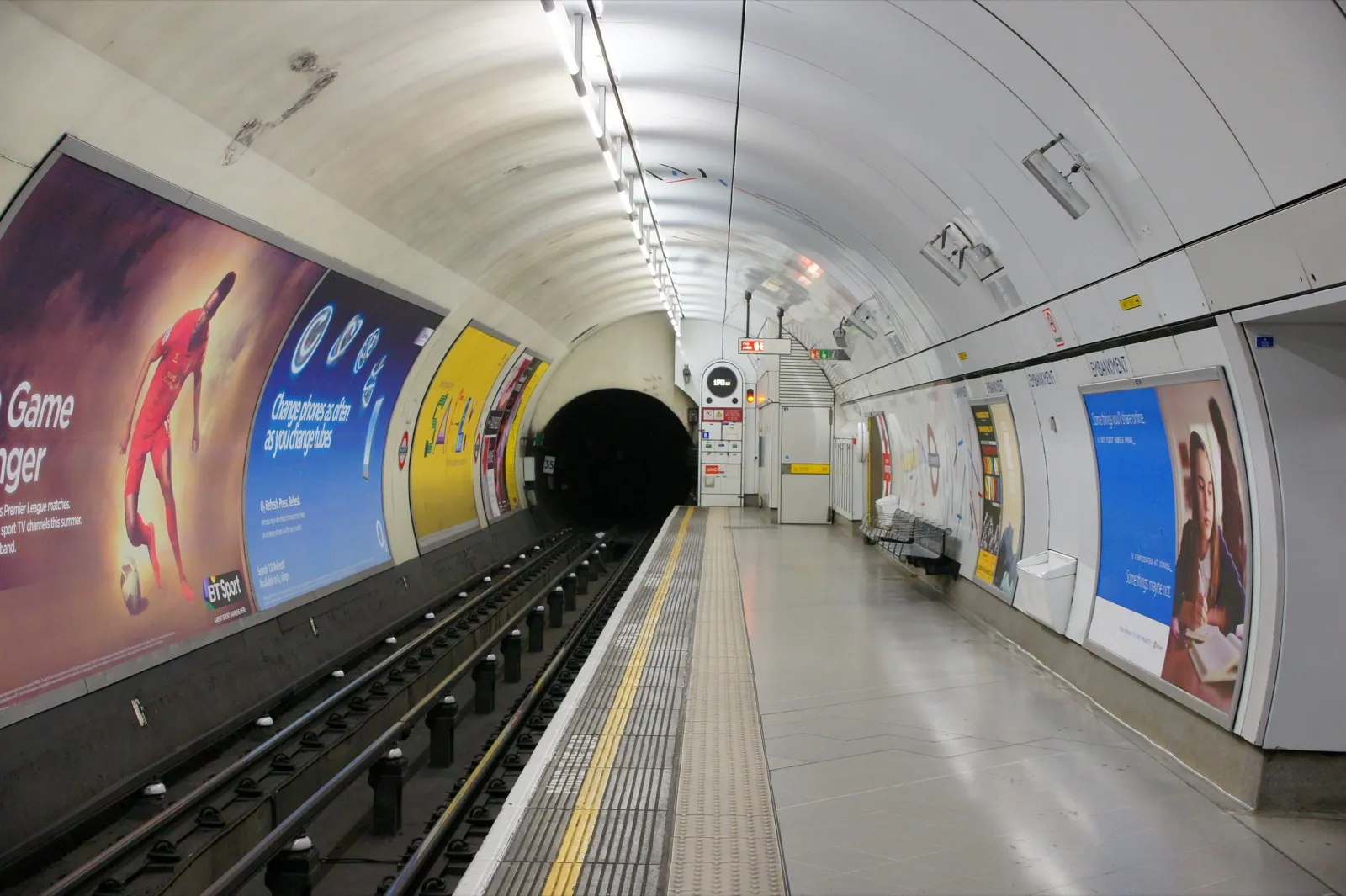
On the northbound Northern line platform at Embankment station in London, the warning to “mind the gap” is not read by the voice heard elsewhere on the Underground. It belongs to Oswald Laurence, a theatre actor who recorded the announcement decades ago and died in 2007. For years after his death, his widow, Dr Margaret McCollum, would go to the station to sit on the platform and hear him speak.
In 2012 the recording was replaced with a newer one. She wrote to the network to ask whether it still existed. According to the London Transport Museum and press reports at the time, staff found the original in the archive, restored it to the platform in early 2013 and gave her a copy on CD. Three words of a safety announcement had become the most precious recording of her husband she had.
The story is unusual, but the impulse behind it is not. Many people keep a voicemail from a parent who has died, carrying it from phone to phone for years. Hearing a loved one’s voice after death turns out to matter far more than most of us expect, and almost everyone who has it, has it by accident. This piece is about why both of those things are true.
For most of history, could you hear the dead?
No. It is easy to forget how recent this is.
For almost the entire history of our species, a voice ended with the person. You could keep someone’s letters, their portrait, a lock of their hair. You could not keep the sound of them. Every voice in human history before the middle of the nineteenth century is gone. We know what Julius Caesar wrote; nobody alive knows what he sounded like.
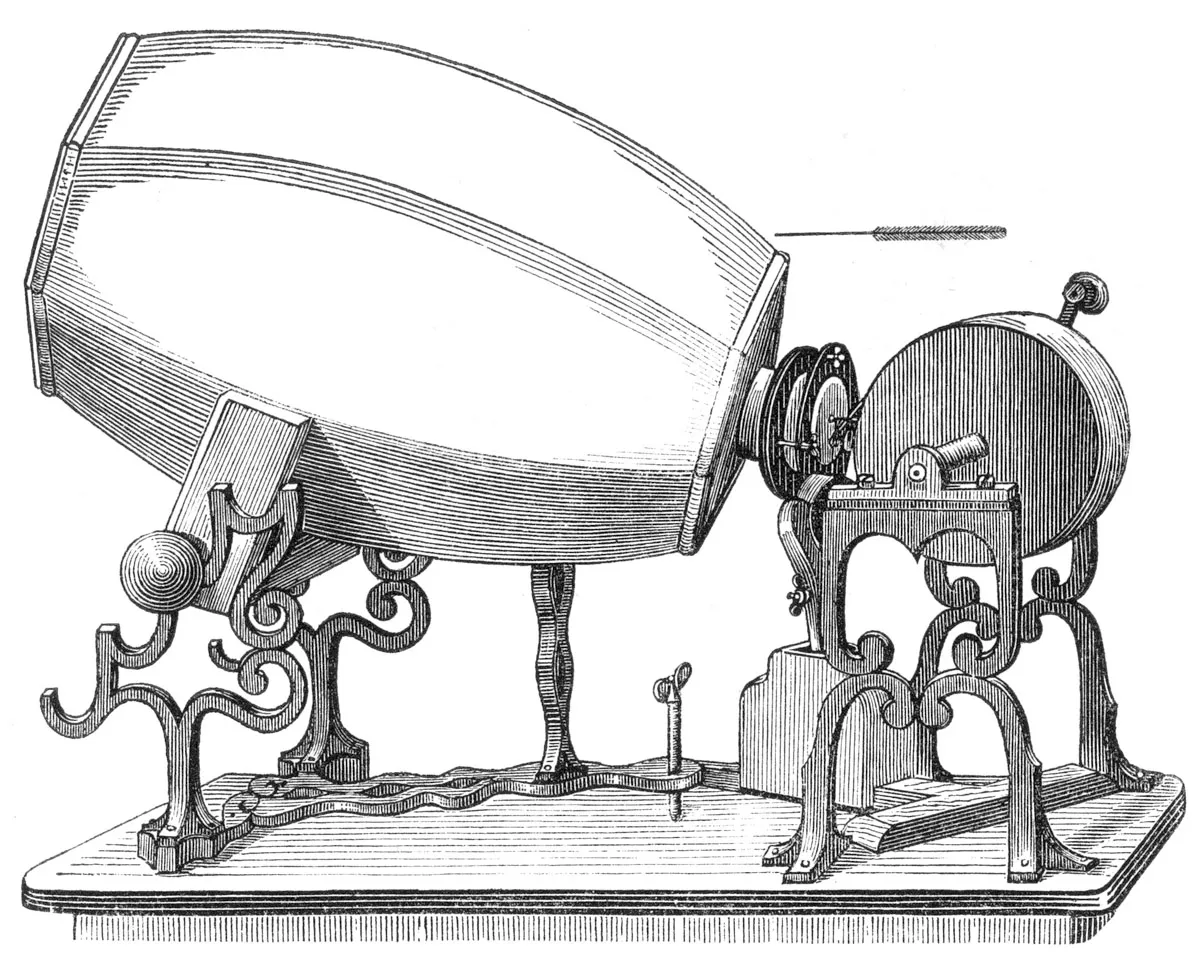 The phonautograph of Édouard-Léon Scott de Martinville, 1859 model. Public domain.
The first machine to capture sound was not designed to play it back. The French printer Édouard-Léon Scott de Martinville patented his phonautograph in 1857: a horn and a membrane that traced sound waves as wavy lines on soot-blackened paper. He meant it as a way of seeing speech. In 2008, researchers with the First Sounds project converted one of his tracings from 1860, a voice singing the French folk song “Au clair de la lune”, back into sound. A recording had waited nearly 150 years for the technology to hear it.
Thomas Edison’s phonograph of 1877 was the first device that could both record and replay a voice. Within a year people were imagining what it meant. In an 1878 article for the North American Review, Edison listed possible uses for his invention, and one of them was a “family record”: sayings and reminiscences of family members in their own voices, and the last words of dying persons. (The earliest-born person whose recorded voice we can still hear, the field marshal Helmuth von Moltke, said much the same into a phonograph in 1889.) It took another century for that to become ordinary, and longer still for it to become free.
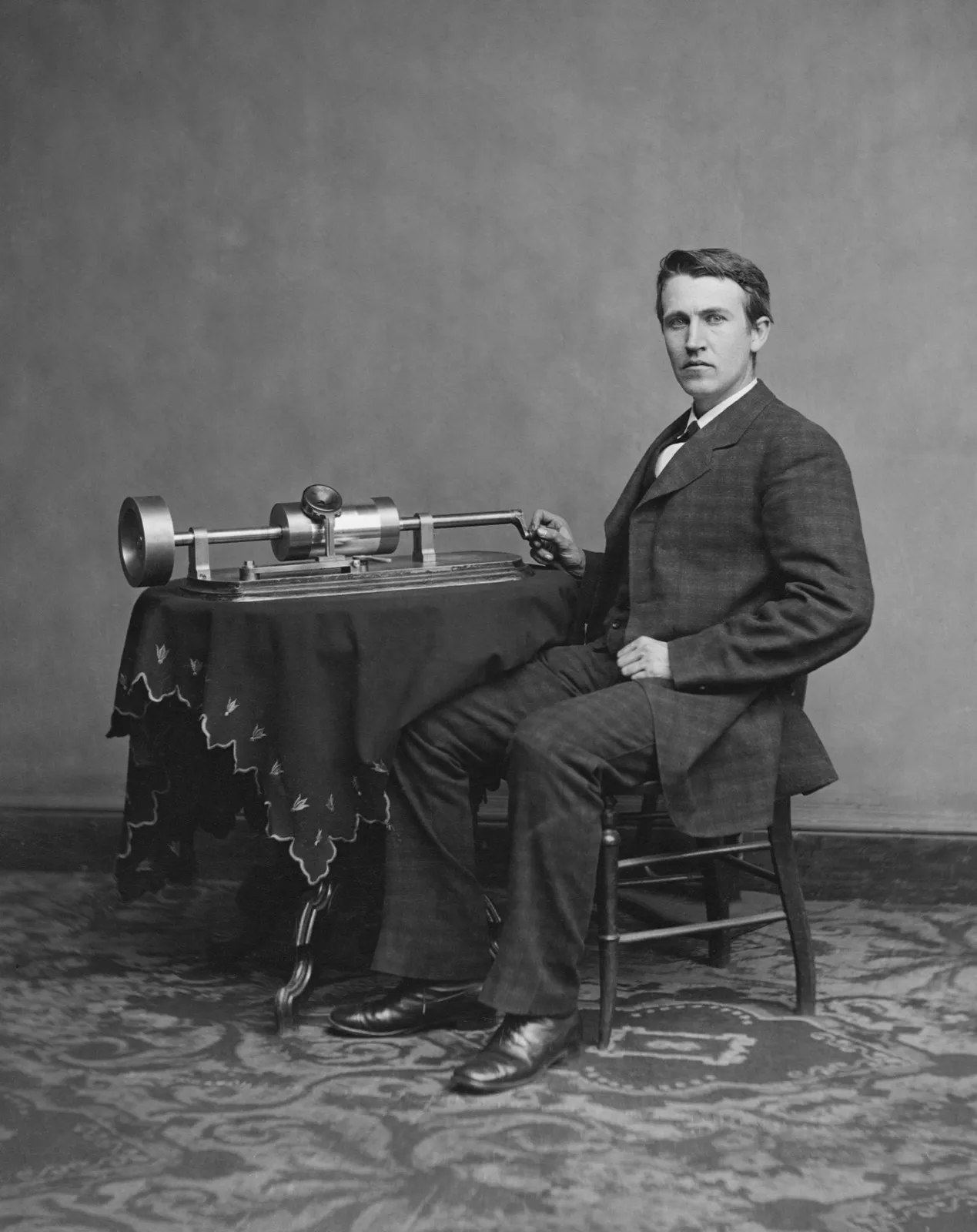 Thomas Edison with his phonograph, probably 1878. Photo by Levin C. Handy, Library of Congress. Public domain.
So the people now reaching for a saved voicemail are among the first generations in history who could. The grief is ancient. The ability to answer it, even partly, is new.
Why does a voice matter so much?
Part of the answer is that voice is one of the first ways we know anyone. In a well-known 1980 study, the psychologists Anthony DeCasper and William Fifer found that newborns, only days old, would change their sucking pattern to hear a recording of their own mother’s voice rather than a stranger’s. We recognise the people closest to us by sound before we can focus on their faces.
A second part of the answer is that a voice does something that words alone do not. In 2010 the anthropologist Leslie Seltzer and colleagues at the University of Wisconsin–Madison stressed a group of girls aged seven to twelve with a public-speaking and arithmetic task, then let some of them be comforted by their mothers. The girls who spoke with their mothers on the phone showed hormonal changes, lower cortisol and higher oxytocin, much like those who were comforted in person with a hug. In a 2012 follow-up, girls who exchanged instant messages with their mothers showed no such effect: their hormone levels looked like those of girls who had no contact at all. The studies were small and limited to mothers and daughters. But the suggestion is striking: the same reassurance, delivered as text, did not comfort in the same way. The sound of the person carried something the sentences did not.
The words of a voicemail are usually mundane: call me back, nothing urgent, love you. What people are keeping is not the information. It is the timbre, the accent, the way a particular person said a particular name. Those things are hard to describe and impossible to reconstruct from memory once they begin to fade.
Is the voice the first thing you forget?
Many bereaved people say that it is, or at least that it is the first thing they notice slipping. The research on this specific question is thin, so it is worth being careful. But the mechanism is plausible. We rehearse faces constantly, because photographs keep them in front of us. Most families have hundreds of pictures of someone who has died and only a handful of recordings of them speaking, if any. A face is refreshed every time we look at the mantelpiece. A voice, unrehearsed, has nothing to hold it in place.
For a long time, the dominant view in grief psychology was that healthy mourning meant gradually letting go of the dead. That changed in the 1990s. In Continuing Bonds (1996), Dennis Klass, Phyllis Silverman and Steven Nickman argued that many people do not detach from those they have lost; they maintain an ongoing relationship with them, and this is often healthy rather than a symptom of something wrong. Visiting a grave, talking to a photograph, wearing a parent’s watch: these are ways of keeping the bond. Sitting on a platform at Embankment to hear three words is the same thing. So is the voicemail kept for a decade.
If that view is right, then a recording is not a morbid relic. It is one of the most direct ways of continuing a relationship with someone, and one of the very few that lets them, in a limited sense, speak back.
Why are most of these recordings accidental?
The recordings people treasure most are almost never ones anyone meant to make.
A voicemail exists because someone did not pick up. Margaret McCollum’s recording exists because her husband was hired to read a safety notice. Most of the video families have of someone who has died was shot for another reason: a birthday, a wedding, a child’s first steps, with the person who is now gone somewhere in the background, saying something about the cake.
There are a few reasons this happens.
- Recording someone on purpose feels presumptuous. Asking a parent to sit down and talk about their life can feel like an admission that they are going to die. So we wait for a reason that never quite arrives. (I have written about this pattern in questions I wish I had asked my parents.)
- We do not value what is always available. While someone is alive, their voice is the least scarce thing about them. You can hear it whenever you call. Its worth only becomes visible when the supply stops.
- Accidental recordings are short. A voicemail lasts twenty seconds. A clip from a party lasts a minute. People end up replaying the same fragment hundreds of times because there is nothing else.
The result is a strange inversion. The people we love most often leave behind less of themselves, in recorded form, than a stranger who once did a voice-over for the Underground.
What would a deliberate recording look like?
My grandmother has since passed away. Before she did, I filmed four hours of her telling me about her life. I can still hear exactly how she said things: the rhythm of her sentences, the way she laughed before she reached the end of a funny story. But I can also see her: her hands moving when she spoke about her mother, the moments she looked away before deciding whether to tell me the next part.
That is the difference between an accidental recording and a deliberate one. A voicemail preserves a voice saying something incidental. A deliberate recording preserves a person saying the things that matter, in their own words, with their own face. Since 2020 I have filmed more than a hundred life stories, including those of Holocaust survivors, and the pattern is consistent: the families do not go back to the recordings for the facts. They go back to spend time with the person.
There is a good argument that this should be video rather than sound alone. Voice carries much of what we lose, but not all of it. Expression, gesture and the pauses where someone decides what to say are part of how we knew them, and in decades to come a recording that shows a face will mean more to people who never met them at all. I set out the longer case in why recording a life story on video beats writing, and the question of which formats will still play in fifty years is covered in audio vs video recording.
How to record a loved one’s voice while you still can
The practical steps are simple, which is part of the point. The barrier was never technology.
- Save what you already have. Move old voicemails off your phone before you upgrade it; most phones let you share or export them as files. Back them up somewhere other than the device. (See what happens to your photos and videos when you die.)
- Ask for stories, not statements. “Tell me about the house you grew up in” gets you ten minutes of someone in their element. “Say something for the grandkids” gets you an awkward sentence.
- Film rather than only record sound. The phone is already in your pocket, and a face adds what a voice cannot.
- Do it in short sessions. Twenty minutes on a Sunday, repeated, is easier to ask for and produces better material than one long interview.
- Do not wait for a reason. A birthday, a visit or simple curiosity is enough. Recordings made now are also what make a memorial feel personal later (see these celebration of life ideas).
Everyone, the app I built, is designed around the last two points: it asks one question at a time, so a life story builds up as a series of short videos rather than a single daunting session.
Oswald Laurence did not know, when he stood in front of a microphone to record a safety warning, that it would one day be the thing his wife travelled across London to hear. Almost none of us know which recordings of our family will end up mattering. The difference now is that we do not have to leave it to chance.