The lost art of letter writing, and the silence that replaced it.
For 2,000 years, letters kept ordinary private voices alive. Then the telephone arrived, and a century of family life went unrecorded. What we can do about it.
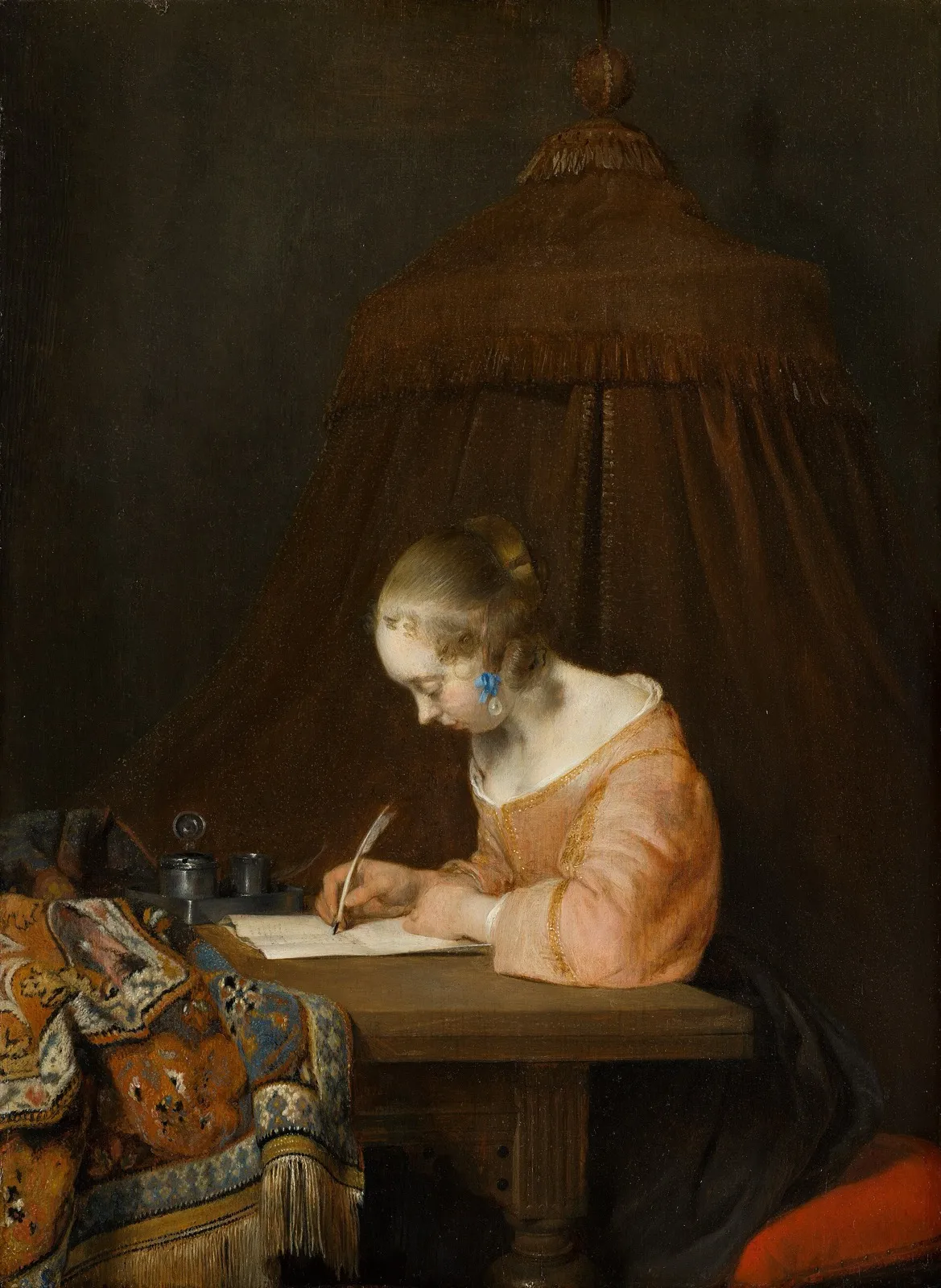
Around the year 100, at a Roman fort called Vindolanda, near what would later become Hadrian’s Wall, a woman named Claudia Severa sent a birthday invitation to her friend Sulpicia Lepidina. The body of the letter was written by a scribe on a thin sheet of wood. But at the bottom, in a different and less practised hand, Severa added her own lines: she would expect her sister, and she sent her greetings. The tablet, now in the British Museum, is thought to be among the earliest surviving examples of writing in Latin by a woman.
We know almost nothing else about Claudia Severa. We do not know her face or her age, or how her life ended. But we know she wanted her friend at her birthday, and that she cared enough to pick up the pen herself. That small, private fact survived nearly two thousand years because it was written in a letter, and the letter was kept.
This is the real story behind the lost art of letter writing. Letters were never mainly an art. For most of history they were the main way the private voices of ordinary people survived at all. And when letters declined in the twentieth century, nothing equivalent replaced them. We did not just lose a habit. We lost a record.
Why did letters survive when so little else did?
Most of what people said to each other in the past is gone. Conversation evaporates the moment it ends. Letters were the exception, for three reasons.
First, distance forced people to write. If your son was in another city, or your husband was at sea, or your sister had married into a family two counties away, the only way to speak to them was on paper. Writing was not a choice of style. It was the only channel available.
Second, a letter was deliberate. Paper was expensive and postage was slow, so people composed their letters. They chose what mattered enough to say, and they said it in full sentences, because the reader could not interrupt to ask what they meant.
Third, letters were physical, and people kept them. A letter from someone you love is hard to throw away. It went into a drawer, then a box, then an attic, and sometimes, generations later, into an archive.
The Paston Letters show what this could produce. They are the correspondence of a Norfolk gentry family, written between 1422 and 1509, and they are the largest surviving collection of English private letters from the fifteenth century, most of them now in the British Library. Much of it concerns land, money and lawsuits. But private life leaks through. In February 1477, Margery Brews wrote to John Paston, the man she hoped to marry, while their families were still arguing over her dowry. She addressed him as her “right well-beloved Valentine”, and the letter is often described as the oldest surviving Valentine in English. They married later that year.
No chronicle of the Wars of the Roses would have recorded a young woman’s anxiety about whether her engagement would survive a dispute over money. A letter did.
What did letters preserve that history books did not?
The main thing letters preserve is the ordinary texture of a life, written by the person living it, before they knew how things would turn out.
The First World War is the clearest example, because it was the last great age of the personal letter. The British Army Postal Service is usually credited with handling around two billion letters during the war, and at its peak about twelve million letters a week crossed the Channel to soldiers on the Western Front. Men wrote home from trenches, hospitals and rest camps, and families wrote back.
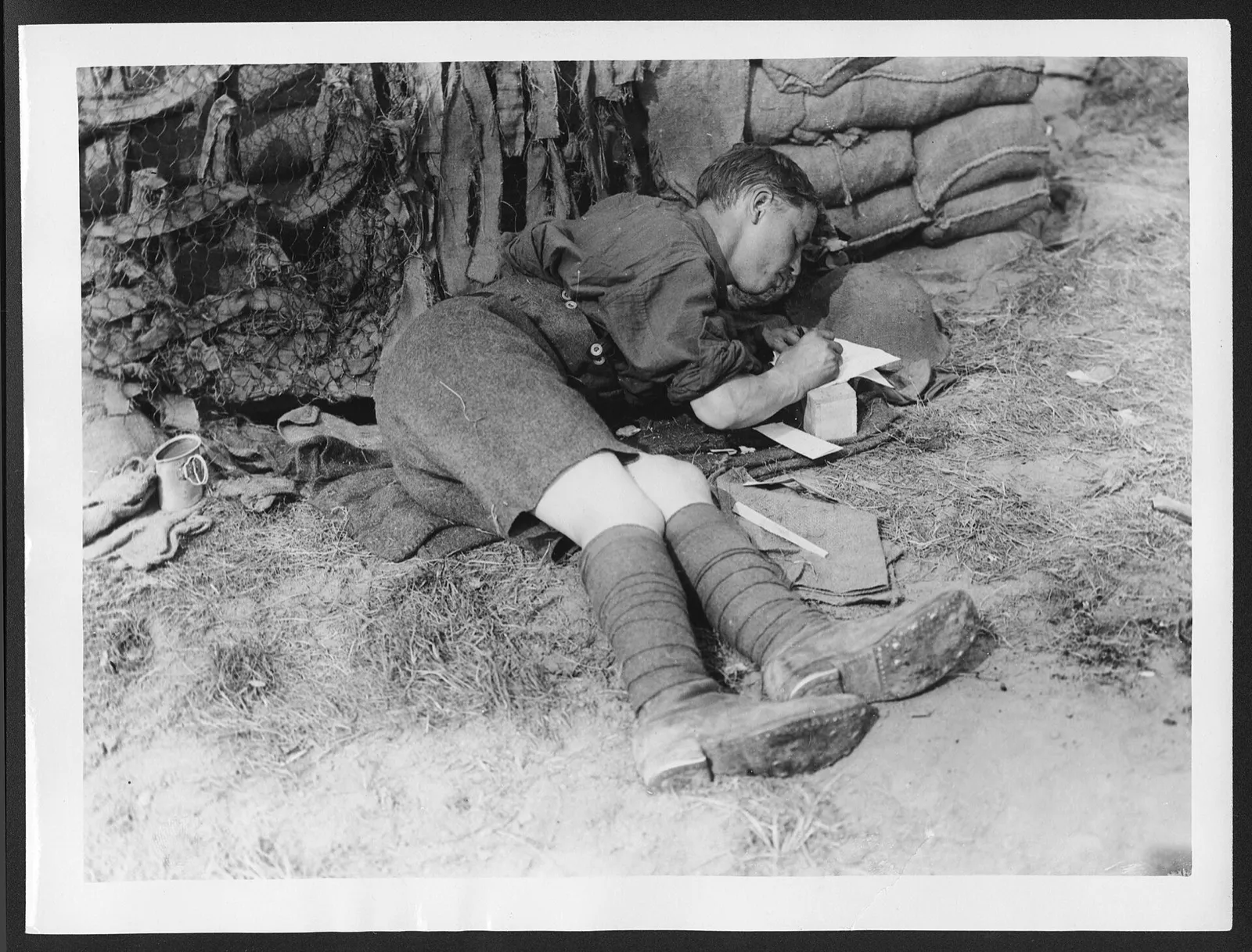 “Writing home”, Battle of Messines, Belgium, 1917. Official photograph, National Library of Scotland. No known copyright restrictions.
Many of those letters are still in family shoeboxes. For a great many families, they are the only surviving record of what a great-grandfather was like as a young man: what he joked about, what he asked for, how he wrote to his mother. Historians have used them to build a picture of the war from below, the same way ordinary people in history have usually been recovered: through what they happened to write down and what someone happened to keep.
What killed the letter?
Not literacy, which kept rising. Not interest, since people have never stopped wanting to talk to the ones they love. The letter was killed by something better at the immediate job: the telephone.
Alexander Graham Bell patented the telephone in 1876. Over the following century it moved from offices into homes, and then into almost every home in the developed world. Long-distance calls became cheaper. By the late twentieth century, if you wanted to hear how your daughter was getting on in another city, you rang her.
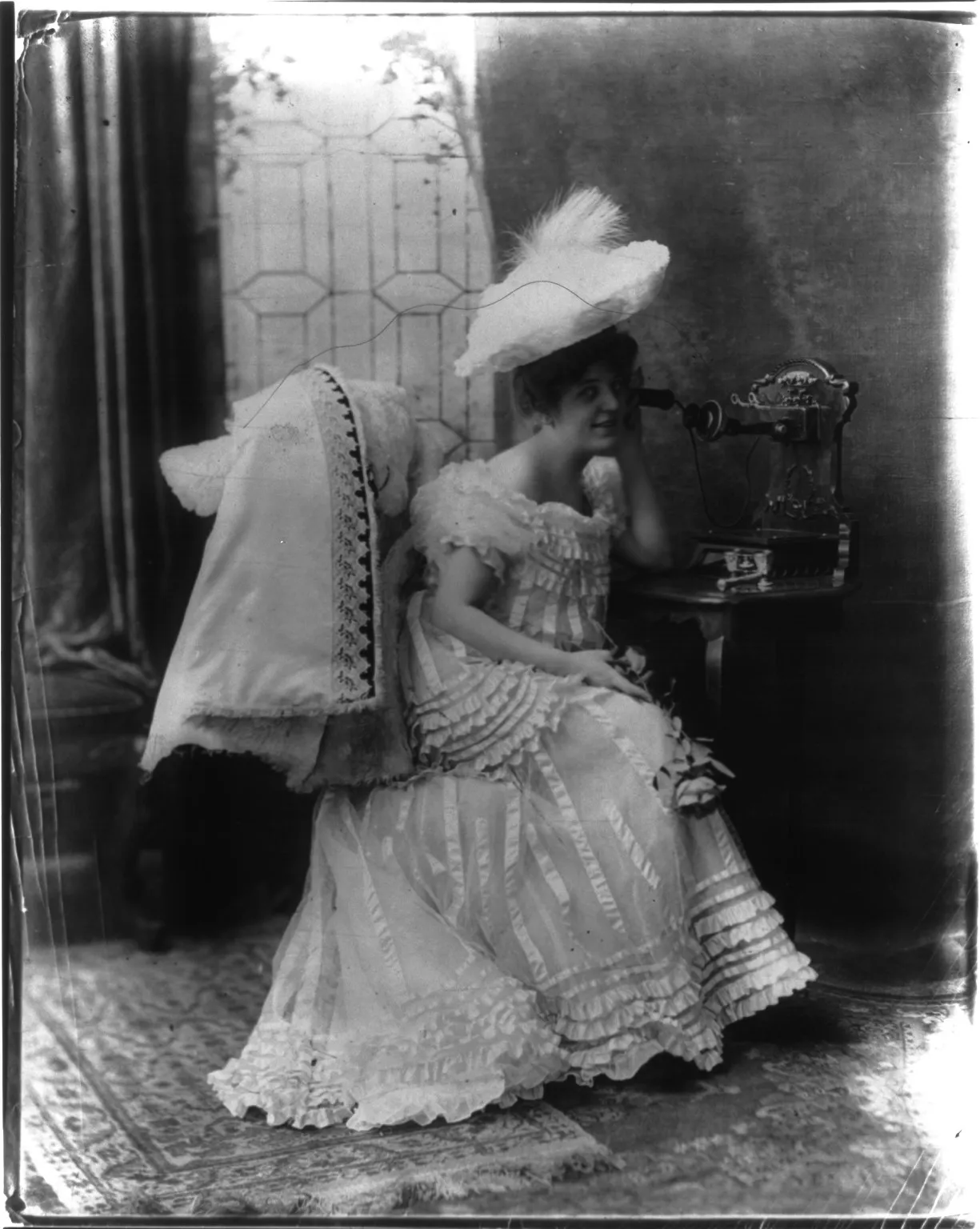 “Woman using early home telephone”, 1904. Library of Congress. Public domain.
As communication, this was a large improvement. A phone call carries a voice, it is immediate, and you can ask questions. But as a record it was a disaster, because almost none of those calls were recorded. The conversations that would once have been letters, such as the news of a birth, a worry about money or advice from a mother to a daughter, now vanished the moment the receiver went down.
The decline shows up in the postal figures, though they are dominated by business mail rather than personal letters. Royal Mail’s letter volumes peaked at around 20 billion items a year in the mid-2000s. By 2023–24, according to the regulator Ofcom, addressed letters in the UK had fallen to about 6.6 billion. Personal letters had declined long before that, quietly replaced first by calls and then by screens.
The odd consequence is that, in some respects, we know more about the private feelings of a fifteenth-century Norfolk family than about our own grandparents’ courtship in the 1960s. The Pastons wrote it down. Our grandparents phoned.
Aren’t emails and text messages the new letters?
In volume, yes. People today write more words to each other than at any time in history. But volume is not the same as survival, and a message is not the same as a letter.
Most digital messages are fragments: half a sentence, a photo, a reaction. They depend on the context of the conversation around them and make little sense alone. A letter had to be self-contained, because the reader might open it weeks later, far away.
They are also fragile in a way paper was not. Messages sit inside accounts that are locked by passwords, tied to phones that are replaced every few years, and held by companies with their own policies about inactive users. Very few people print them, and fewer still put them in a box for their grandchildren. I wrote about this in more detail in what happens to your photos and videos when you die. The short version is that the default fate of a digital message is to be lost, while the default fate of a kept letter was to survive.
So we write more than ever and keep less than ever. The next century’s historians may find our era oddly silent: enormous quantities of data, and very little that anyone thought to preserve on purpose.
What made a letter worth keeping?
If the letter is unlikely to return, it is worth asking what exactly we lost, because the qualities that made letters valuable are not tied to paper.
A good letter had four features:
- It was addressed to one person. It was written for a specific reader, and that shaped what was said and how honestly.
- It was considered. The writer chose what mattered and said it fully.
- It was self-contained. It made sense on its own, years later, to someone who was not there.
- It was kept. Someone made a decision that it was worth holding on to.
None of these depends on ink. A video can have every one of them, and it adds the two things a letter could never carry: a face and a voice. Claudia Severa’s handwriting is moving precisely because it is the closest thing we have to her presence. A recording of her speaking those same lines would be closer still. I have argued elsewhere that this is why recording a life story on video beats writing. The same logic applies to a message meant for a particular person.
My grandmother never wrote me a letter that I kept. But I have four hours of her on video, telling me about her life, and she has since passed away. In practice, those recordings are the letters she left: considered, addressed to her family, and kept.
Bringing back what the letter did
The answer to the lost art of letter writing is not nostalgia. Few people are going to start writing weekly letters again, and that is fine. The useful lesson is narrower: every so often, make a deliberate record for a specific person, made to be kept.
That can be a letter, if you prefer to write. It can also be a few minutes of video: a message to your children about the year they were born, an explanation to a grandchild of why the family moved countries, a parent’s answer to a question you never thought to ask until now. The Everyone app was built around that idea, one question and one short video at a time, saved for the people it is meant for.
For two thousand years, people like Claudia Severa and Margery Brews survived because they wrote to someone they loved and that person kept it. The telephone took that habit away without anyone noticing. It is worth deliberately taking it back.