About 117 billion people have lived. Almost none can be named.
About 117 billion people have ever lived, and almost none can now be seen, heard or even named. Why that happened, and why the people alive now can change it.
The foreword to Arthur C. Clarke’s 2001: A Space Odyssey, published in 1968, opens with a striking image: “Behind every man now alive stand thirty ghosts.” Clarke’s point was that the dead vastly outnumber the living, and that roughly a hundred billion human beings had walked the Earth before us.
His arithmetic was close. The best-known modern estimate of how many people have ever lived comes from the Population Reference Bureau, a demographic research organisation in Washington. In its 2022 update, the demographers Toshiko Kaneda and Carl Haub put the figure at about 117 billion people born since our species appeared. Around eight billion of them are alive today, which is just under 7 per cent.
So the ghosts have thinned a little since Clarke wrote: there are now about fourteen of them behind each of us, not thirty. That is not because fewer people have died. It is because so many more people are alive. But the number that interests me is a different one, and it is much smaller. Of those 117 billion people, how many could you actually meet? How many can still be seen, or heard, or even named?
How do demographers count people who left no record?
With difficulty, and with a great deal of honesty about the difficulty. The authors of the estimate point out that no demographic data exist for more than 99 per cent of the span of human existence. There were no censuses in the Palaeolithic. Everything before the last few centuries is reconstructed from archaeology, assumptions about growth rates and a fair amount of informed guesswork.
The method is simple to describe. Pick a starting point (the 2022 version begins with a notional two people in 190,000 BCE), estimate the population at benchmark dates, assume a birth rate for each period, and add up the births in between. The authors call it part science and part art; an earlier version, starting at 50,000 BCE, arrived at about 106 billion.
The estimate is useful mainly for killing a myth. In the early 1970s a widely repeated claim held that three-quarters of all the people who had ever lived were alive at that moment. It sounds plausible in an age of population explosions, and it is wildly wrong. For it to be true, either the twentieth century would have to contain more births than the whole of prior history several times over, or an extraordinary number of very old people would have to be alive at once. Neither was the case. The living are a thin layer on top of a very deep pile.
How many people have ever lived, and when?
This is where the figures become strange. According to the same table, roughly 46 billion people were born between 8000 BCE and the year 1 CE, the long era of the first farmers, villages and early states. Only about 23 billion have been born since 1650. In other words, about twice as many human beings were born in the eight thousand years before the year 1 as in the entire modern age.
That is partly because the period is so long, and partly because of how people lived and died within it. For most of history, the PRB estimate suggests, life expectancy at birth may have averaged only about ten years. That does not mean adults died at ten. It means that a huge share of children never reached adulthood. A 2013 review by the psychologists Anthony Volk and Jeremy Atkinson, drawing on 20 hunter-gatherer societies and 43 historical populations, estimated that about 27 per cent of infants died in their first year and almost half of all children died before puberty.
So the human story, measured by headcount, is overwhelmingly a story of people who lived in small farming communities, often died young, and left almost nothing behind.
How many people from the past can we still name?
Very few, and the proportion falls off a cliff as you go back.
Writing appeared in Mesopotamia a little over five thousand years ago, which means many billions of people lived before anyone could have written their name down. After writing, names survive mostly where someone had a reason to record them: a king, a priest, a tax-payer, a debtor, a defendant. (Even the first personal name we can read, Kushim, comes from a barley account.) Records of ordinary people in history are rare, and they usually exist because an institution wanted something from them.
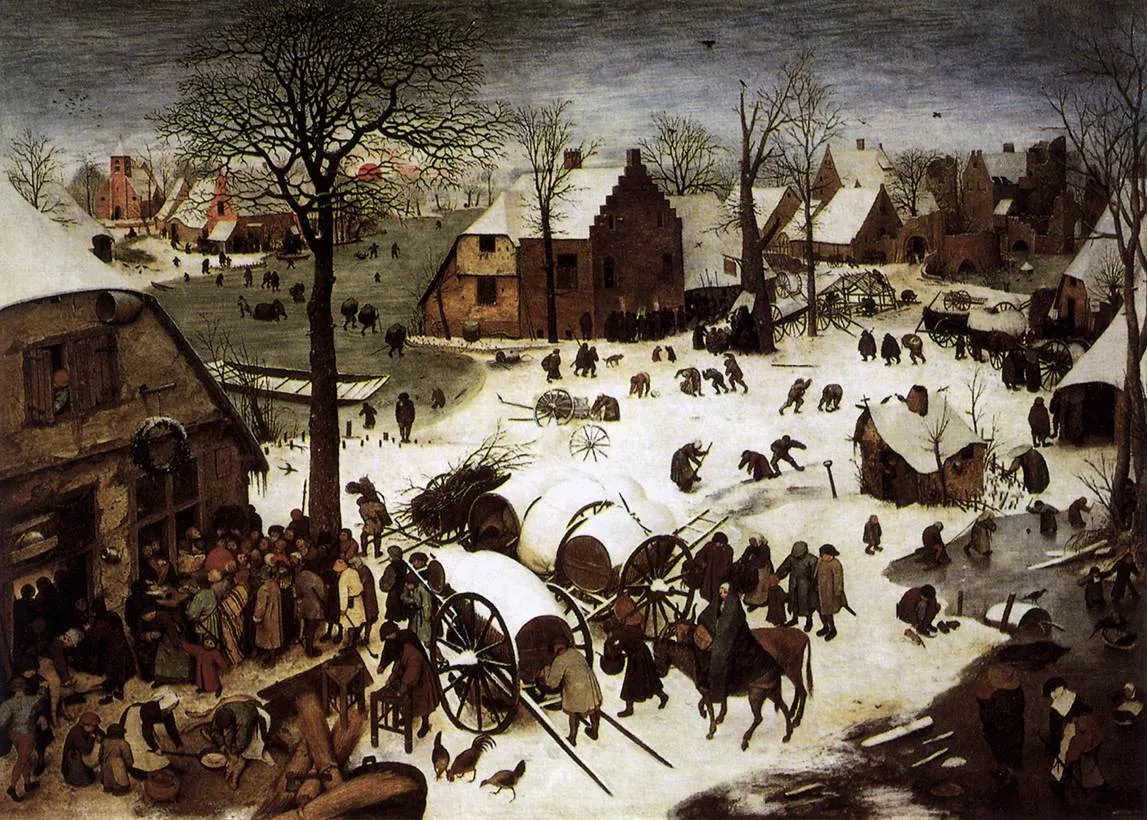
A census, which might seem like the great exception, is not really one either. Bruegel’s painting at the top of this page shows the biblical census at Bethlehem relocated to a snowy Flemish village: a crowd at the inn door waiting to be counted, while everyone else gets on with the business of winter. It is a good picture of what a census captures. It records that a person existed, and where, and perhaps how much they owed. It says nothing about who they were. (This is also why anyone starting a family tree should talk to the living before searching the records.)
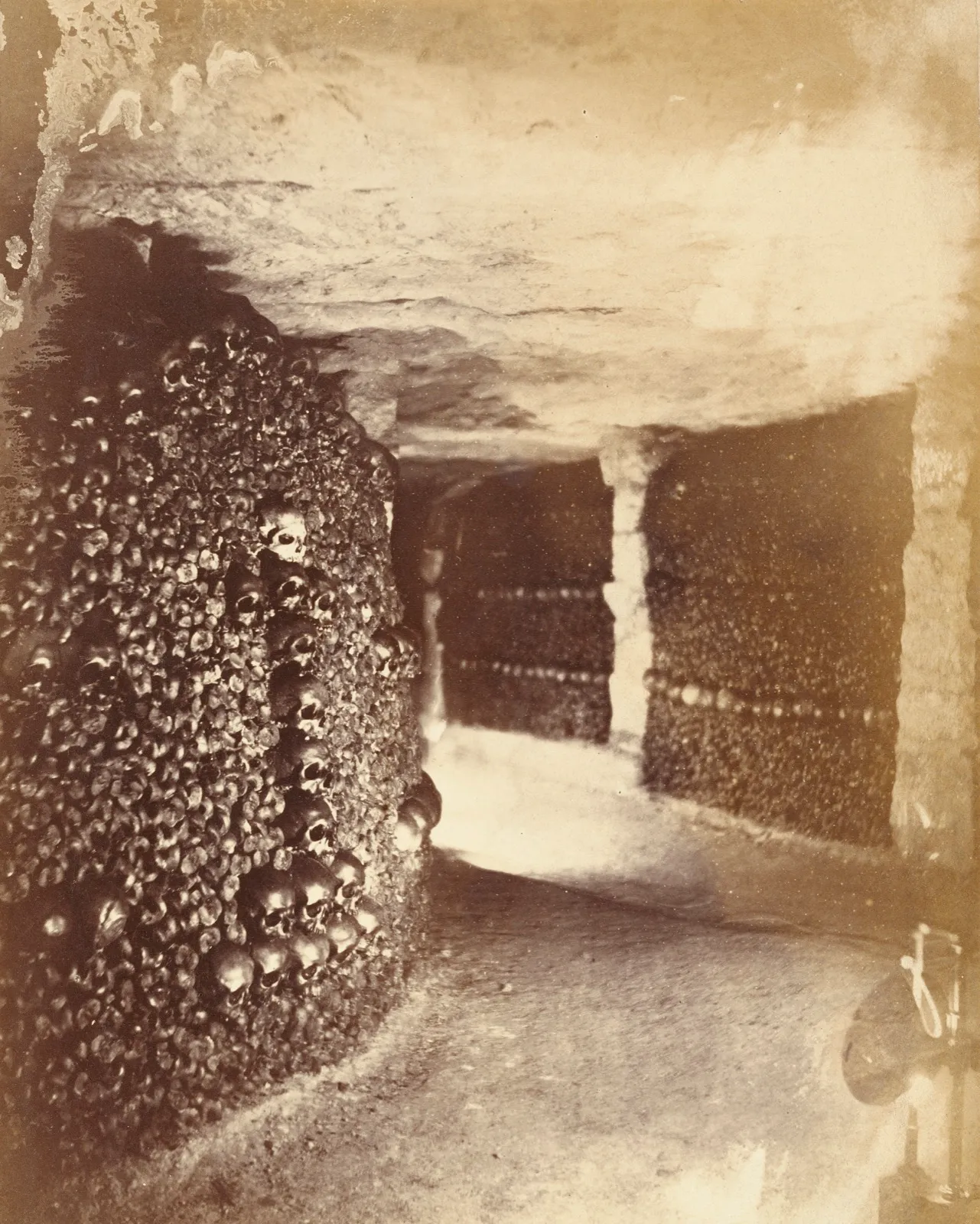 “View in the Catacombs” by Nadar (Gaspard-Félix Tournachon), 1861, one of a series of photographs he took underground using artificial light. Public domain.
The catacombs of Paris make the same point in bone. From 1786 onwards, the remains of around six million people were moved there from the city’s overflowing cemeteries, and stacked into walls. Nearly all of them had once been named, baptised, married and buried by someone who knew them. Within a few generations they had become anonymous material, arranged in decorative patterns. That is the ordinary fate of the dead, and it does not take thousands of years. It takes about three generations.
Most of us know this from our own families. With a little research, you can usually recover the names of your sixteen great-great-grandparents. You will almost never know what their voices sounded like, what they found funny or what they were afraid of. Name, dates, place, occupation: that is what survives, when anything does.
When did it become possible to see and hear the dead?
Very recently, and the timing is the point of this piece.
The oldest known recordings of a human voice were made in Paris in the late 1850s by Édouard-Léon Scott de Martinville, whose phonautograph traced sound waves onto paper. It was not designed to play them back; that only happened in 2008, when researchers converted the tracings into sound. Thomas Edison’s phonograph, which could record and replay, arrived in 1877. The oldest surviving motion picture was filmed by Louis Le Prince in a garden in Leeds in October 1888.
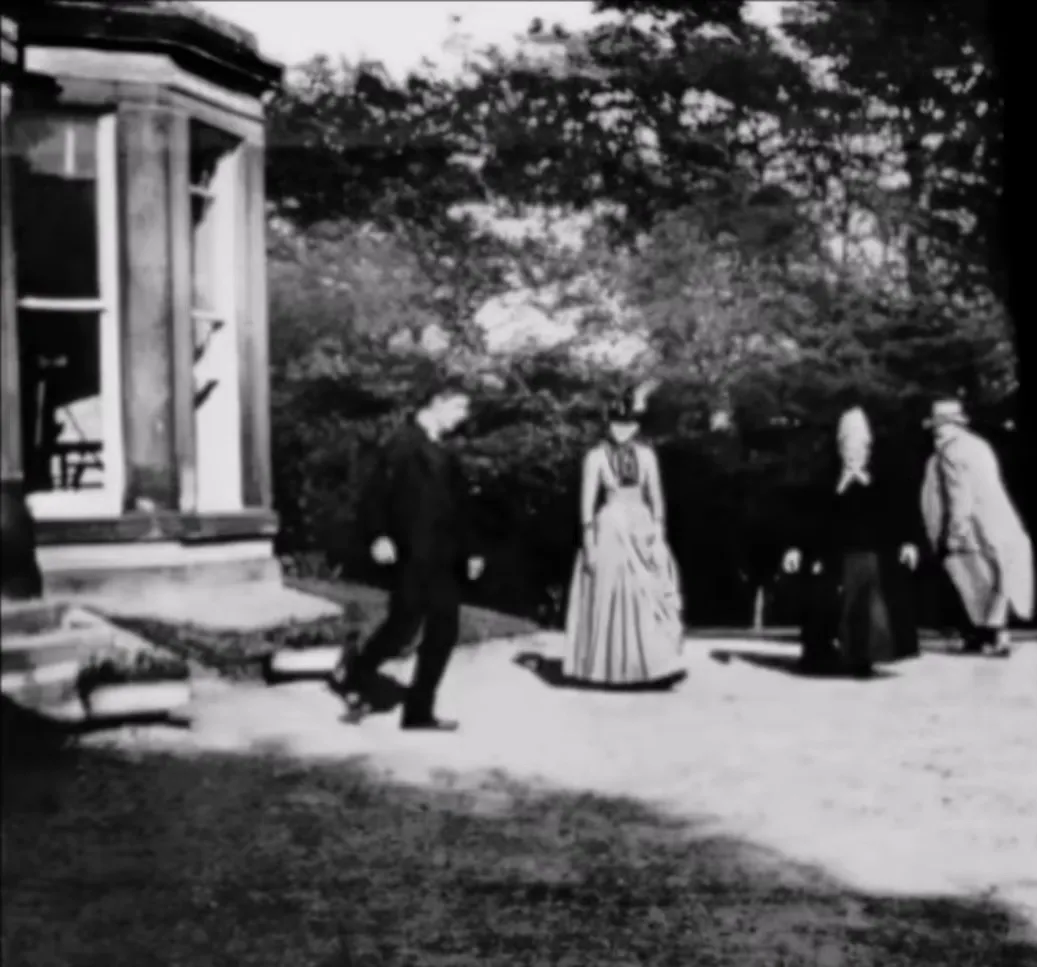 A frame from “Roundhay Garden Scene”, filmed by Louis Le Prince at Oakwood Grange, Leeds, on 14 October 1888. Public domain.
Now put those dates against the population table. By 1850, around 101.6 billion people had been born, about 87 per cent of everyone who has ever lived. By 1900, the figure was around 104.5 billion, or roughly 89 per cent. Nearly nine in ten human beings were born too early for anyone to have filmed them, under any circumstances, at any price.
And for most of the twentieth century, being filmed remained unusual. A home movie camera was a middle-class luxury, film was expensive, and recording sound with it was harder still. One of the women in Le Prince’s film, his mother-in-law Sarah Whitley, was born around 1816; she is among the earliest-born people anyone has ever seen move. (I wrote about her, and what that implies for your own descendants, in your great-great-great-grandchildren could know you.)
So the honest answer to the question “how many of the 117 billion can we still meet?” is: almost none. Nearly all the people who have ever been filmed talking about their own lives were filmed in the last few decades, most of them since phones put cameras into billions of pockets. Against the full population of the dead, the share who can still be seen and heard is close to zero.
Why does this matter for the people alive now?
Because the 7 per cent of humanity alive today is the first large group in history for whom this is no longer a matter of luck or wealth.
For most of history, being remembered took a throne, a tomb, a scribe, a portrait or at least a gravestone with room for words. I often think of the stone of John Welch in the old cemetery at Whroo, in central Victoria, which carries the line “Remember me as you pass by.” It is a plea, carved because there was no other way to make it, and it reaches the reader as a request rather than a person.
Today the cost of preserving a person, not just a name, is close to nothing. Most of us carry a camera that films in high definition, records clear sound, and stores hours of footage. The technology that separates the 109 billion dead from the 8 billion living has, for the first time, become universal.
Yet most of the living are on track to be remembered much as the dead were. We take thousands of photos, but they are photos of things and events, not of anyone explaining who they are. When I filmed my grandmother’s life story, it ran to four hours. Before that afternoon, I realised I knew roughly what most people know about their grandparents: a handful of facts, a few repeated anecdotes, a face. Since 2020 I have filmed more than a hundred life stories, including those of Holocaust survivors, and the pattern is always the same. The family assumes the stories will somehow be kept. They are kept only if someone sits down, asks, and presses record.
The smallest number
Here is the figure that seems to me most worth holding onto. Of roughly 117 billion people, about 109 billion are gone, and of those, nearly all left no image, no voice and no name that anyone now knows. The share of humanity that can be met, rather than merely counted, is tiny, and most of it is alive now.
That makes the people around you, your parents, grandparents, aunts and old friends, part of an extraordinarily small and lucky group. They are among the first human beings whose way of speaking, laughing and telling a story can outlast them by centuries. Whether it does depends on a decision that is easy to postpone.
That is what we built Everyone for: a simple way to film the people you love answering one good question at a time, and keep those videos for the family that comes after. The difficult part was never the technology. It is asking.