Childhood amnesia: why we forget the years we were loved most.
Almost no one remembers being two. Psychologists call it childhood amnesia. Why it happens, why many first memories are invented, and who keeps those years.
For the first three years of your life, someone fed you several times a day, carried you, sang to you, worried about you at night and watched you learn to walk and speak. It was, for most of us, the period in which we received more undivided attention than at any time since. You remember none of it.
This is not a personal failing. It is close to universal, and psychologists have a name for it: childhood amnesia, sometimes called infantile amnesia. Most adults can recall almost nothing from before the age of three or so, and only fragments from the years shortly after. Sigmund Freud drew attention to the puzzle in 1905: the years in which a child learns faster than at any later stage leave almost no trace in adult memory.
Childhood amnesia is usually discussed as a curiosity of the brain. It is more interesting as a fact about families. If the child cannot keep those years, someone else has to, and the research suggests that what survives of our earliest life depends heavily on what the people around us said about it.
What is childhood amnesia?
Childhood amnesia is the inability of adults to retrieve episodic memories, memories of specific events, from infancy and early childhood. It does not mean babies cannot remember. A one-year-old can recognise faces, learn routines and remember where a toy was hidden. A three-year-old can describe a trip to the zoo last month in some detail. The memories form. They simply do not last into adulthood.
When adults are asked for their earliest memory, the average age they give is a little over three. In the reminiscence research of David Rubin and others, the curve of remembered life begins almost flat, then rises slowly through the early school years. (The other end of that curve, the surge of memories from our teens and twenties, is the subject of the reminiscence bump.)
When do childhood memories disappear?
Later than most people assume. For a long time it was thought that early memories were simply never stored properly. A study from Emory University showed that, in fact, they are stored and then lost during childhood itself.
Patricia Bauer and Marina Larkina recorded mothers talking with their three-year-olds about six recent events, such as a visit to the zoo or a first day at preschool. They then went back to the same children at different ages, between five and nine, and asked about the same events. In the results, published in 2014, children aged five to seven still remembered around 63 to 72 per cent of the events. Children aged eight and nine remembered only about 35 per cent.
So the forgetting happens in middle childhood, somewhere around the age of seven. The memories of being three exist for several years. Then, quietly, most of them go. Bauer also noticed something else: the older children remembered fewer events, but the ones they kept were more detailed and better organised as stories. The memories that survived were the ones that had become narratives.
Why do we forget our earliest years?
There is no single answer, but two explanations carry most of the evidence, and they work at different levels.
Is it the brain?
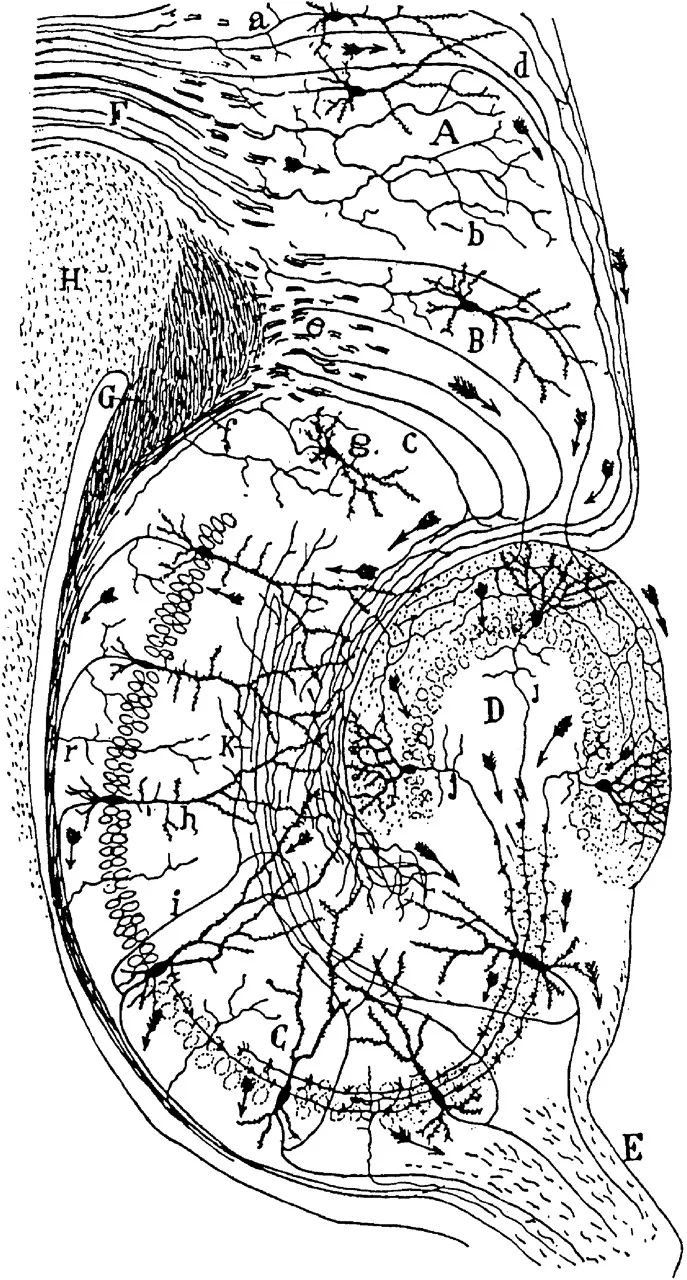 Santiago Ramón y Cajal’s drawing of the neural circuitry of the rodent hippocampus, from “Histologie du système nerveux de l’homme et des vertébrés”, 1911. Public domain.
The first explanation is biological. The hippocampus, the part of the brain most involved in forming lasting memories of events, keeps producing new neurons long after birth, and at a particularly high rate in infancy. In 2014 Katherine Akers, Paul Frankland and colleagues published a study in Science suggesting this growth may be part of the cause. When new neurons are wired into the existing circuit, they appear to disrupt memories that were already stored there.
Their evidence came from animals. Infant mice forgot quickly, and reducing the production of new neurons after they learnt something helped them remember. Guinea pigs, which are born with a more mature hippocampus, did not show the same infant forgetting, until the researchers increased neurogenesis, at which point they did. Mice are not people, but the finding offers a plausible mechanism: a brain growing as fast as a toddler’s has trouble keeping what it has written.
Is it language and story?
The second explanation is social. Before about the age of three, children have little language, no stable sense of themselves as a person with a past, and no practice in telling stories. A memory that is never put into words, and never connected to a self, has little to hold it in place.
This is where the role of other people becomes visible. Developmental psychologists including Robyn Fivush and Elaine Reese have studied how parents talk with young children about the past. Some parents speak in what researchers call an elaborative style: they ask open questions, add detail, talk about feelings and build a story together with the child. Others ask fewer questions and move on. Children whose parents reminisce elaboratively tend, as they grow up, to give longer and richer accounts of their own past.
Culture seems to matter in the same way. In a 2000 study, the psychologists MacDonald, Uesiliana and Hayne asked adults in New Zealand to describe and date their earliest memory. Māori participants reported earlier first memories, on average, than New Zealanders of European or Asian descent. The authors linked this to the strong emphasis on the past, and on family history, in Māori culture. The age of a person’s first memory is not fixed by biology alone. It is partly set by how much their family talks about where they came from.
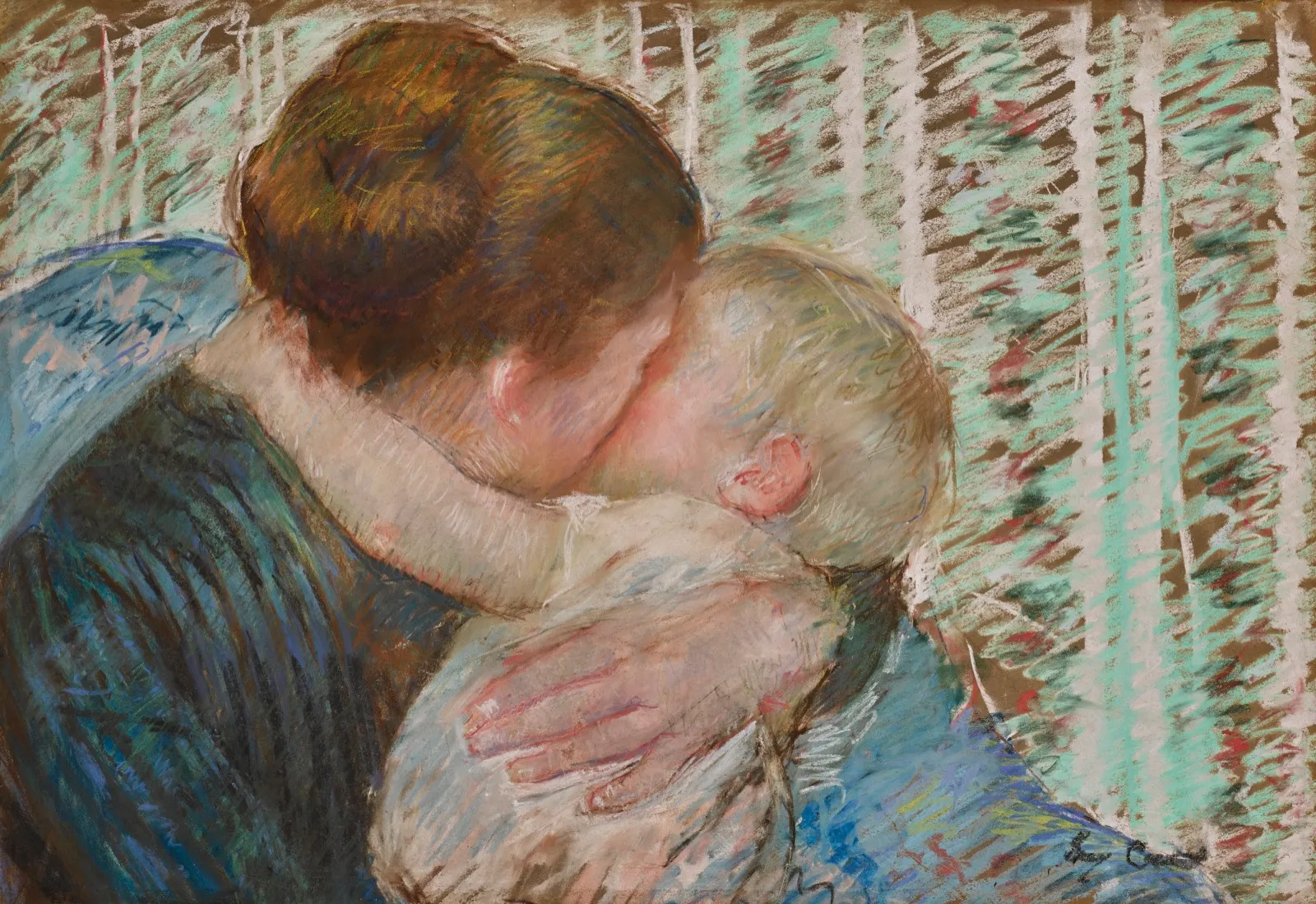
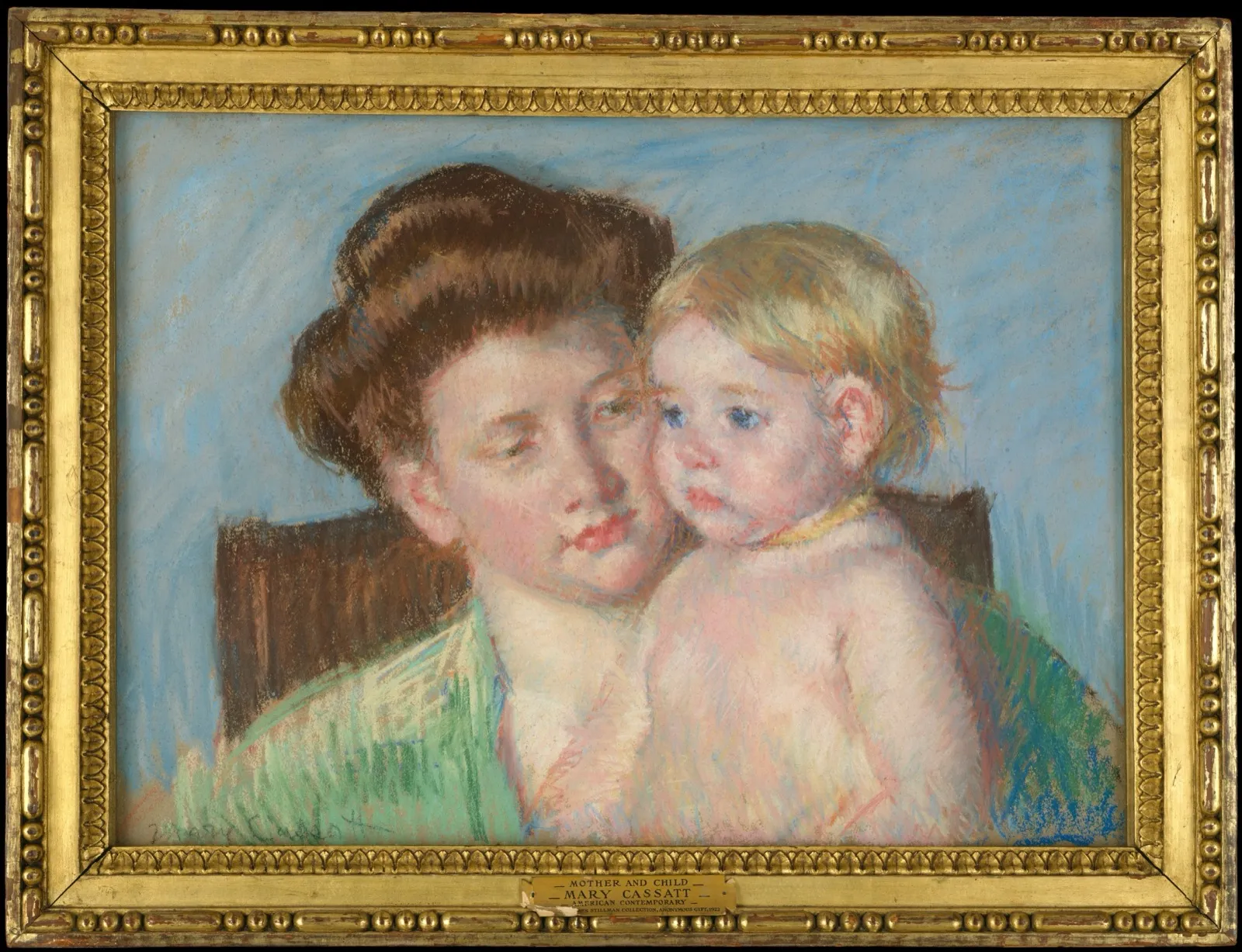 “Mother and Child” by Mary Cassatt, about 1910. Pastel. The Metropolitan Museum of Art. CC0.
Are your earliest memories real?
Possibly not. In 2018 Shazia Akhtar, Martin Conway and colleagues published a survey of 6,641 people in Psychological Science, asking each to describe their first memory and how old they were at the time. Around 38.6 per cent described a memory from the age of two or younger, and 893 people claimed memories from the age of one or younger.
Given what is known about childhood amnesia, the authors argued that most of these very early memories are unlikely to be genuine. Their suggestion was that people assemble them from fragments: a photograph, a story told at family gatherings, a fact about where they lived, and perhaps a real but undated image. Over years of being recalled, the construction comes to feel like a memory. The study could not check the memories against records, so “fictional” is an inference, but a reasonable one.
This has a striking implication. For many people, the earliest thing they believe they remember is, in effect, a family story they have absorbed. The first page of their autobiography was written by someone else.
Who remembers your early years?
Put these findings together and an uncomfortable picture appears. Your first years happened, they mattered and they shaped you, but you hold almost none of them. What you know of that period comes from your parents, grandparents, older siblings and the occasional photograph. They are the only witnesses.
That has two consequences.
The first is about your own past. If your parents are alive, they hold a part of your life you cannot reach any other way: how you were born, what you were like at two, what frightened you, what your first words were, what they were worried about at the time. When they die, that part of your story goes with them unless someone has asked. Many of the most useful questions to ask your parents about their life are, it turns out, also questions about yours.
The second is about your children. A child who is two today will, by about the age of nine, have forgotten most of what is happening now, including most of what you were like. They will not remember your voice at thirty, the jokes you made or the songs you sang to them. They will know the parent you became later. The young parent who carried them will exist for them mainly in photographs, which show a face but not a person.
What can parents do about childhood amnesia?
Nothing will stop it, and nothing should. But the research suggests a few things that change what survives.
- Talk about the past with your children. Elaborative reminiscing, asking “What happened next? How did you feel?” about shared events, is associated with richer memory later. It is also a good conversation.
- Record the ordinary days. The events that seem routine now, bath time, a walk to the shops, a bedtime story, are exactly what will be forgotten, by your children and eventually by you.
- Film yourself, not only them. Most family videos are taken from behind the camera, so the parent never appears. A few minutes of you talking about what life is like now, while they are small, is something your child will never otherwise have.
- Tell them their own story. How they were born, what their first year was like, what you hoped for them. Say it on video, with the date, so it can be watched when they are old enough to want it. (There are good prompts in these legacy video questions.)
The years someone else has to keep
When I filmed my grandmother, over four hours, some of the moments I value most were her descriptions of her own mother: what she was like when my grandmother was very young, things my grandmother could only have known from being told. In my experience of filming more than a hundred life stories since 2020, this is common. People’s earliest chapters are, almost always, partly borrowed.
That is not a flaw in memory. It is how human memory has always worked. Our first years are held for us by others, and handed back in stories. What has changed is that those stories no longer need to be passed down by word of mouth alone, losing a detail with every telling. They can be recorded, by the people who were there, in their own faces and voices. Everyone, an app that asks one question at a time and keeps each answer as a short video, is one way to do it. The more important step is simply recognising that the years you cannot remember are still there, in someone else, for now.